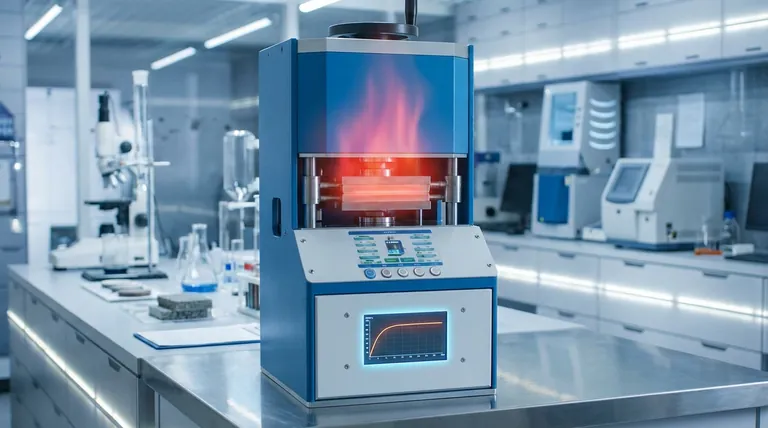
A Tale of Two Samples
Imagine a materials scientist developing a new polymer composite. The first sample, pressed on Monday, is a triumph—strong, flexible, exactly to spec. The second sample, created on Tuesday using the exact same recipe, is brittle and useless.
What went wrong?
The answer often lies in an invisible variable: the precise thermal journey the material took. The human desire for certainty and repeatability is the cornerstone of science. In materials science, that certainty is forged in the heart of a laboratory press, and it depends entirely on mastering temperature.
The Illusion of a "Set Temperature"
We tend to think of temperature control as a static command. We dial in "200°C" and assume the machine simply obeys.
This is a psychological shortcut. In reality, precise thermal management is a dynamic, fluid process—a closed-loop conversation between hardware and physics. It's not about being at a temperature; it's about the entire lifecycle of heating, holding steady, and cooling down. Each phase is actively managed to dictate the final molecular structure of a material.
The Anatomy of Control: A Four-Part System
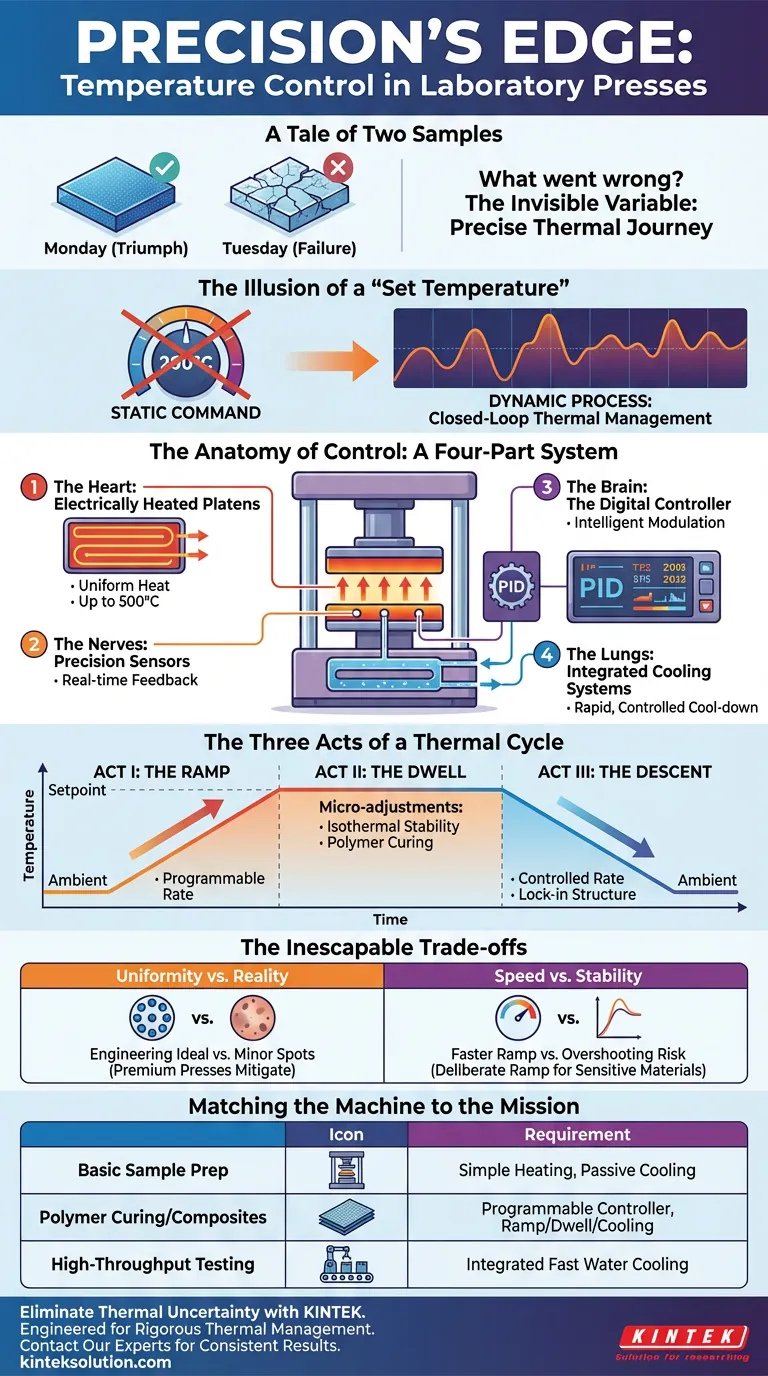
A heated lab press achieves this control through an elegant synergy of four core components, each playing a critical role.
The Heart: Electrically Heated Platens
The platens are the muscular, steel plates that deliver both force and heat. They aren't just hot blocks; they are engineered thermal reservoirs. Embedded electric resistance cartridges convert electrical energy into heat, designed to distribute it as uniformly as possible across the entire pressing surface, which can often reach up to 500°C.
The Nerves: Precision Sensors
If the platens are the heart, thermocouples are the nervous system. These sensors are embedded directly within the platens, as close to the action as possible. They provide constant, real-time temperature feedback to the controller, reporting the slightest deviation from the target. They are the system's source of truth.
The Brain: The Digital Controller
The controller is the central intelligence. Here, the operator's intent is translated into a precise electrical script. Using sophisticated algorithms like PID (Proportional-Integral-Derivative), the controller constantly compares the sensor's feedback to the user's setpoint. It doesn't just turn the heat on or off; it modulates the power with incredible speed to prevent overshooting the target and minimize fluctuations.
The Lungs: Integrated Cooling Systems
For many modern materials, the cool-down is as critical as the heat-up. Controlled cooling "locks in" a desired crystalline or amorphous structure. High-end presses feature internal channels within the platens, allowing a coolant like water to circulate and draw heat away rapidly and evenly. This is the system taking a controlled, deep breath, finishing one cycle to prepare for the next.
The Three Acts of a Thermal Cycle
Every press cycle is a carefully choreographed performance in three acts.
Act I: The Ramp
Once the program starts, the controller sends power to the platens to ramp up the temperature. The rate of this climb is often a programmable parameter itself. A slow, gentle ramp can prevent thermal shock to a delicate sample, while a fast ramp maximizes throughput.
Act II: The Dwell
Upon reaching the setpoint, the holding phase, or "dwell," begins. The controller now works subtly, making micro-adjustments to power to counteract ambient heat loss and maintain a perfectly stable temperature. This isothermal state is where the magic happens—where polymers cure, composites bond, and materials anneal.
Act III: The Descent
After the dwell time, the heaters are deactivated. If equipped, the controller initiates the cooling system, ensuring a rapid, repeatable descent in temperature. This controlled rate is crucial for achieving consistent results, sample after sample.
The Inescapable Trade-offs
Even in the most advanced systems, the laws of physics present trade-offs that a skilled operator must understand.
- Uniformity vs. Reality: Perfect temperature uniformity across a large platen is an engineering ideal. Minor hot or cool spots can exist. Premium presses mitigate this with multiple heating zones and sensors, but it's a factor to be aware of.
- Speed vs. Stability: A faster ramp rate increases the risk of overshooting the target temperature. For sensitive materials, a slightly slower, more deliberate ramp is a small price to pay for avoiding thermal damage.
Matching the Machine to the Mission
The level of thermal precision you need is dictated entirely by your application.
| Application Goal | Key Requirement |
|---|---|
| Basic Sample Prep (e.g., KBr pellets) | Simple heating with passive air cooling. |
| Polymer Curing/Composites | Programmable controller for ramp, dwell, and cooling cycles. |
| High-Throughput Testing | Integrated, fast-response water cooling to minimize cycle time. |
Understanding this dance of heat, time, and control empowers you to move beyond simply following a recipe. It allows you to truly direct the formation of your material, eliminating the uncertainty that plagued our scientist on that frustrating Tuesday.
At KINTEK, we build lab presses engineered for precisely this challenge. Our automatic and heated models are designed to provide the rigorous thermal management required for consistent, repeatable results in polymers, composites, and beyond. If you're ready to eliminate thermal uncertainty from your workflow, Contact Our Experts.
Visual Guide
Related Products
- 24T 30T 60T Heated Hydraulic Lab Press Machine with Hot Plates for Laboratory
- Heated Hydraulic Press Machine with Heated Plates for Vacuum Box Laboratory Hot Press
- Laboratory Split Manual Heated Hydraulic Press Machine with Hot Plates
- Automatic Heated Hydraulic Press Machine with Hot Plates for Laboratory
- Automatic Heated Hydraulic Press Machine with Heated Plates for Laboratory
Related Articles
- The Invisible Forge: Why the Laboratory Press is the Soul of Nano-Composites
- The Architecture of Slow: Why Physical Precision Dictates Chemical Destiny
- The Architecture of Density: Why Pressure is the Silent Architect of Solid-State Batteries
- The Physics of Transparency: Why Pressure is the Silent Architect of Spectroscopic Clarity
- The Architecture of Certainty: Why the Laboratory Press is the Anchor of Material Science



















