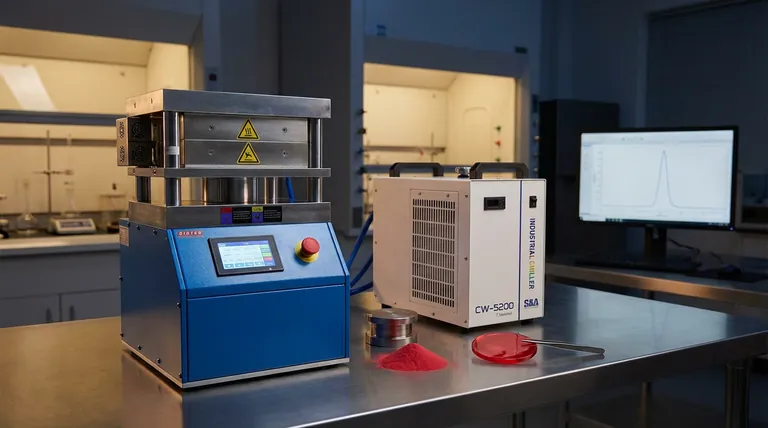
It’s a familiar scene in labs around the world. A researcher, late at night, stares at a spectral reading that makes no sense. The peak is off, the baseline is noisy. A dozen questions flood their mind. Is the new material formulation a failure? Is the multi-thousand-dollar spectrometer malfunctioning?
Or, perhaps, the problem is something far more fundamental: the small, hand-pressed sample pellet itself.
This moment of doubt reveals a deeper truth in science and engineering. The most advanced analytical instruments are useless if the sample they measure is inconsistent. The quest for discovery is built on a foundation of repeatable, trustworthy sample preparation. This is a battle against variability, and a heated lab press is a primary weapon.
The Psychology of Control
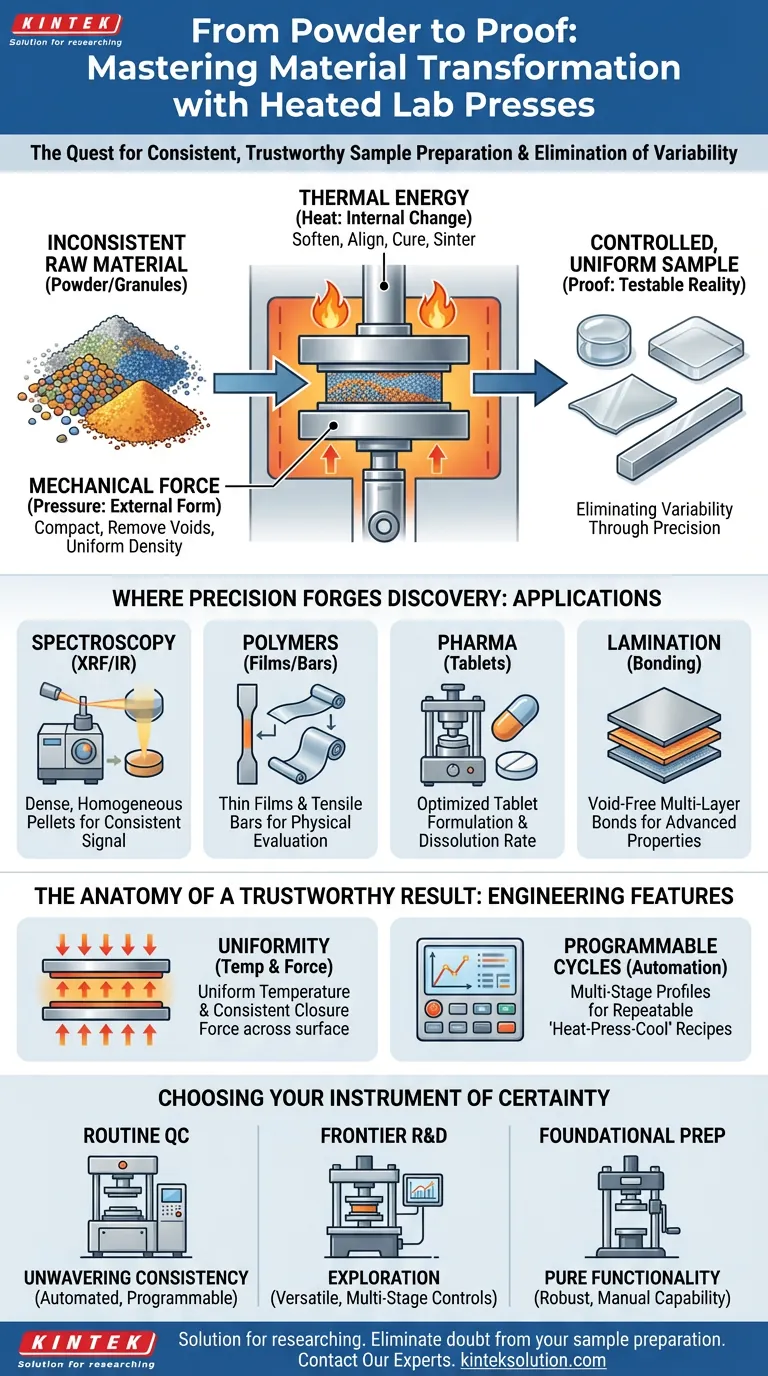
At its core, a heated lab press is an instrument of control. It addresses a fundamental human need in research: to eliminate variables and isolate the one you are trying to measure. It does this by applying two forms of energy—thermal and mechanical—with immense precision.
-
Heat is the agent of internal change. It softens a polymer, allowing its chains to realign. It provides the activation energy for a thermoset resin to cure. It helps microscopic particles bind together into a cohesive whole.
-
Pressure is the agent of external form. It compacts loose powder, squeezing out air and ambiguity. It ensures uniform density and shapes the material into a pellet, a film, or a standardized plaque.
Together, they transform a material's potential into a testable reality. This isn’t just about squashing something; it’s about imposing a new, highly ordered state onto matter.
The Core Principle: A Duet of Heat and Force
The magic of a heated lab press lies in its ability to conduct a perfect duet between temperature and pressure.
Thermal Energy: Unlocking Potential
Applying heat modifies a material’s internal energy. This can make a rigid thermoplastic pliable, initiate a chemical cross-linking reaction (curing) , or facilitate sintering between particles. The goal is to bring the material to a state where it can be fundamentally reshaped.
Mechanical Force: Imposing Structure
Simultaneously, the press applies a controlled force. This compacts the material, removes voids, ensures uniform density, and shapes it into a desired geometry. The result is a sample free from the randomness of its original powdered or granulated form.
Where Precision Forges Discovery
This ability to control material form makes the heated press a cornerstone tool across both industrial quality control and academic research.
H3: The Ground Truth for Spectroscopy
In X-Ray Fluorescence (XRF) or Infrared (IR) spectroscopy, sample quality is everything. A heated press is used to compact a powdered sample (often with a binder like KBr) into a dense, homogeneous, and sometimes transparent pellet.
This ensures the analytical beam travels through a consistent medium, eliminating signal variations caused by density or thickness. The press creates the perfect window into the material's elemental or molecular soul.
H3: Shaping the Future of Polymers
For polymer scientists, a heated press is indispensable. It melts thermoplastic pellets and forms them into thin films for optical testing or standardized tensile bars for mechanical evaluation. It's the bridge between a chemical formula on a whiteboard and a physical object whose strength, flexibility, and durability can be measured.
H3: Engineering Predictable Medicine
In pharmaceutical R&D, presses are used to study how powders compact into tablets. Researchers test formulations under precise pressures and temperatures to optimize a tablet's hardness, stability, and dissolution rate. This ensures the final product is not only effective but consistently so, from batch to batch.
H3: Building Strength, Layer by Layer
Heated presses are also masters of lamination, bonding multiple layers of materials together. Whether creating multi-layer polymer films with specific gas-barrier properties or curing composite plies into a lightweight, ultra-strong panel, the uniform heat and pressure guarantee a bond free from voids and weaknesses.
The Anatomy of a Trustworthy Result
The effectiveness of a heated lab press comes down to the engineering features that turn a simple concept into a precision instrument.
H3: The Mandate for Uniformity
Advanced presses, like those engineered by KINTEK, feature platens with integrated heating systems that guarantee uniform temperature distribution. This prevents hot spots that could compromise sample integrity. The hydraulic system is designed to apply a consistent closure force across the entire surface, ensuring the final part has uniform thickness and density. This uniformity isn't a feature; it's a prerequisite for trust.
H3: The Power of Programmable Cycles
Modern presses offer sophisticated controls, including multi-stage temperature and pressure profiles. This allows an operator to program a precise recipe—heat, press, hold, cool—that can be repeated perfectly every time. This automation removes the variable of human intervention, ensuring the results from Monday are identical to the results from Friday.
Choosing Your Instrument of Certainty
The right heated lab press aligns with your primary objective.
- For Routine QC: The goal is unwavering consistency. An automated press with programmable cycles is a non-negotiable workhorse.
- For Frontier R&D: The goal is exploration. A versatile press with multi-stage controls and data logging provides the flexibility to test new frontiers.
- For Foundational Prep: The goal is pure functionality. A robust manual press offers the core capability needed to create high-quality samples.
Ultimately, a heated lab press does more than just make pellets and films. It takes the ambiguity of raw materials and transforms it into the hard evidence of a finished sample, ready for analysis. It is where powder becomes proof.
At KINTEK, we specialize in building these instruments of certainty. Our range of automatic, isostatic, and heated lab presses are engineered to provide the uniform heat, consistent pressure, and repeatable control your research demands. If you're ready to eliminate doubt from your sample preparation, Contact Our Experts.
Visual Guide
Related Products
- 24T 30T 60T Heated Hydraulic Lab Press Machine with Hot Plates for Laboratory
- Manual Heated Hydraulic Lab Press with Integrated Hot Plates Hydraulic Press Machine
- Automatic High Temperature Heated Hydraulic Press Machine with Heated Plates for Lab
- Automatic Heated Hydraulic Press Machine with Hot Plates for Laboratory
- Heated Hydraulic Press Machine with Heated Plates for Vacuum Box Laboratory Hot Press
Related Articles
- The Invisible Forge: Why the Laboratory Press is the Soul of Nano-Composites
- The Architecture of Slow: Why Physical Precision Dictates Chemical Destiny
- The Architecture of Density: Why Pressure is the Silent Architect of Solid-State Batteries
- The Physics of Transparency: Why Pressure is the Silent Architect of Spectroscopic Clarity
- The Architecture of Certainty: Why the Laboratory Press is the Anchor of Material Science



















