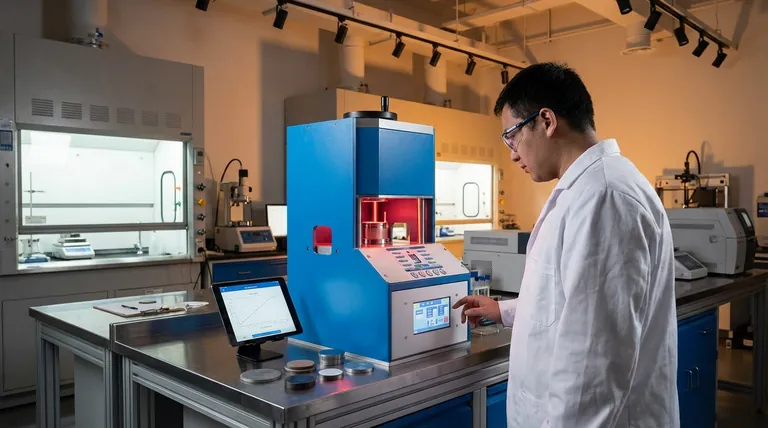
The Agony of the Long Wait
The longest distance in any laboratory isn't between two benches. It's the time between forming a hypothesis and holding the physical result.
For materials scientists, this gap is often occupied by the slow, deliberate heat of a traditional sintering furnace. This waiting period is more than just a delay; it's a bottleneck for curiosity, a brake on the engine of discovery. An entire day spent waiting for a single sample to consolidate is a day an idea cannot be tested, a new path cannot be explored.
This is a systemic problem, but its solution lies in changing the physics of the process itself.
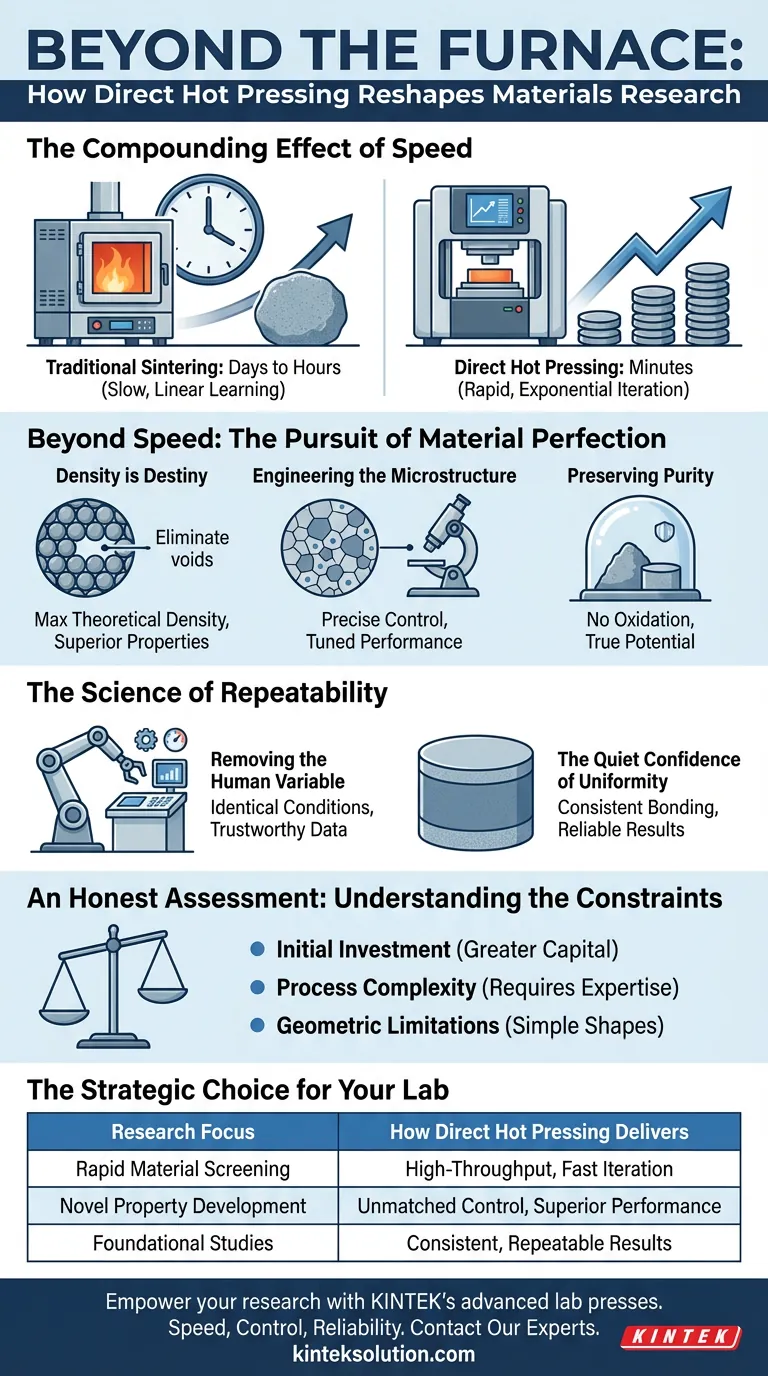
The Compounding Effect of Speed
The most obvious benefit of direct hot pressing is its speed. But to see it as just a time-saver is to miss the point. Its true value is in how it changes the fundamental cadence of research.
From Days to Minutes
Traditional sintering can take many hours, sometimes days. Direct hot pressing applies high pressure and high temperature simultaneously, forcing material consolidation in a fraction of that time—often just minutes.
This isn't a small, incremental improvement. It's a phase shift in productivity.
The Psychology of Rapid Iteration
When the feedback loop between idea and result shrinks from a day to an hour, the entire mindset of the researcher changes.
Instead of running one perfect experiment, you can run ten exploratory ones. You can afford to test riskier compositions and more aggressive parameters. The cost of failure drops, so the rate of learning skyrockates. This acceleration is not linear; it's exponential, as each result rapidly informs the next.
Beyond Speed: The Pursuit of Material Perfection
While speed gets you more data points, the goal remains the same: creating a better material. Direct hot pressing provides an unparalleled level of control to achieve properties that are often impossible with conventional methods.
Density is Destiny
The simultaneous pressure and heat leave no room for voids. Particles are forced into intimate contact, eliminating the porosity that plagues conventional sintering. This push toward maximum theoretical density directly translates into superior mechanical properties like hardness and strength.
Engineering the Microstructure
Heat alone can lead to unwanted grain growth, compromising a material's integrity. By using pressure as a primary driver for densification, hot pressing allows for lower temperatures and shorter times. This gives the researcher the power of an architect at the micro-level, precisely controlling grain size and phase to tune a material’s electrical, thermal, or optical properties.
Preserving Purity
Many advanced materials are oxygen-sensitive. In a standard furnace, they are compromised. Modern hot presses, like those engineered by KINTEK, operate in a vacuum or a controlled inert atmosphere. In this pristine environment, shielded from oxidation and contamination, a material's true potential can be realized.
The Science of Repeatability
A discovery that cannot be repeated is not a discovery at all. Good science is built on a foundation of trust in the data, and that trust begins with the sample itself.
Removing the Human Variable
Advanced hot pressing systems offer precise, automated control over every critical parameter—temperature ramps, pressure application, and atmospheric conditions. This removes operator-to-operator variability, ensuring every sample is produced under identical conditions. The result is data you can trust, compare, and build upon with confidence.
The Quiet Confidence of Uniformity
By applying heat and pressure uniformly, the process ensures consistent bonding and density throughout the entire sample. This eliminates the hidden weak spots or internal defects that can skew test results and lead researchers down the wrong path.
An Honest Assessment: Understanding the Constraints
No technology is a universal solution. An objective evaluation requires acknowledging its trade-offs.
- Initial Investment: A hot press is a sophisticated instrument. It represents a greater capital investment than a simple furnace, a cost that must be weighed against the immense acceleration in research output.
- Process Complexity: While automated, the interplay between temperature, pressure, and material behavior requires a higher level of operator understanding than conventional methods. This complexity is the price of greater control.
- Geometric Limitations: The process is best suited for producing relatively simple geometries, like pellets, discs, or blocks, defined by the die set.
The Strategic Choice for Your Lab
The decision to integrate direct hot pressing comes down to your primary research objectives.
| Research Focus | How Direct Hot Pressing Delivers |
|---|---|
| Rapid Material Screening | Short cycle times enable high-throughput experimentation and fast iteration. |
| Novel Property Development | Unmatched control over density and microstructure unlocks superior material performance. |
| Foundational Studies | Automation and precision ensure the consistent, repeatable results required for reliable data. |
Ultimately, this technology empowers research facilities to not only work faster but to explore material possibilities that were previously out of reach. This is the precise challenge that KINTEK's advanced lab presses are built to solve. Our automatic, isostatic, and heated lab presses are designed to give your team the speed, control, and reliability needed to push the boundaries of what's possible.
To learn how our solutions can transform your research outcomes, Contact Our Experts.
Visual Guide
Related Products
- Heated Hydraulic Press Machine with Heated Plates for Vacuum Box Laboratory Hot Press
- Automatic Heated Hydraulic Press Machine with Hot Plates for Laboratory
- Automatic High Temperature Heated Hydraulic Press Machine with Heated Plates for Lab
- Laboratory Manual Heated Hydraulic Press Machine with Hot Plates
- Heated Hydraulic Press Machine With Heated Plates For Vacuum Box Laboratory Hot Press
Related Articles
- The Architecture of Slow: Why Physical Precision Dictates Chemical Destiny
- The Architecture of Certainty: Why the Laboratory Press is the Anchor of Material Science
- The Vanishing Boundary: The Hidden Thermodynamics of LTCC Lamination
- The Alchemy of 160°C: Why Precision Pressing is the Silent Backbone of Rubber Science
- The Invisible Forge: Why the Laboratory Press is the Soul of Nano-Composites















