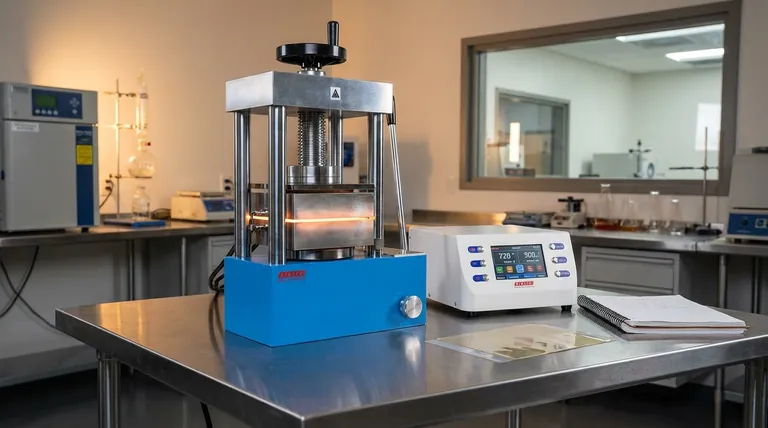
A young materials scientist spends weeks synthesizing a novel polymer. The final step is to press it into a thin film for characterization. They place the precious sample into the lab's shared hot press, dial in the tonnage and temperature from a similar recipe, and wait.
The result is a brittle, discolored wafer—useless. The cause wasn't a flaw in the synthesis, but a flaw in the process. The press, chosen for its impressive maximum tonnage, had poor temperature uniformity and no way to control the cooling rate, creating immense internal stress in the material.
This scenario is a quiet tragedy repeated in labs worldwide. It stems from a fundamental cognitive error: we are drawn to impressive specifications—the maximum force, the highest temperature—while the success of our work depends on something far more subtle: control.
A laboratory hot press is not a brute-force tool. It is a precision instrument for material transformation. To choose the right one, you must stop looking at the machine and start by defining your process with absolute clarity.
The Most Common Error: Confusing Power with Purpose
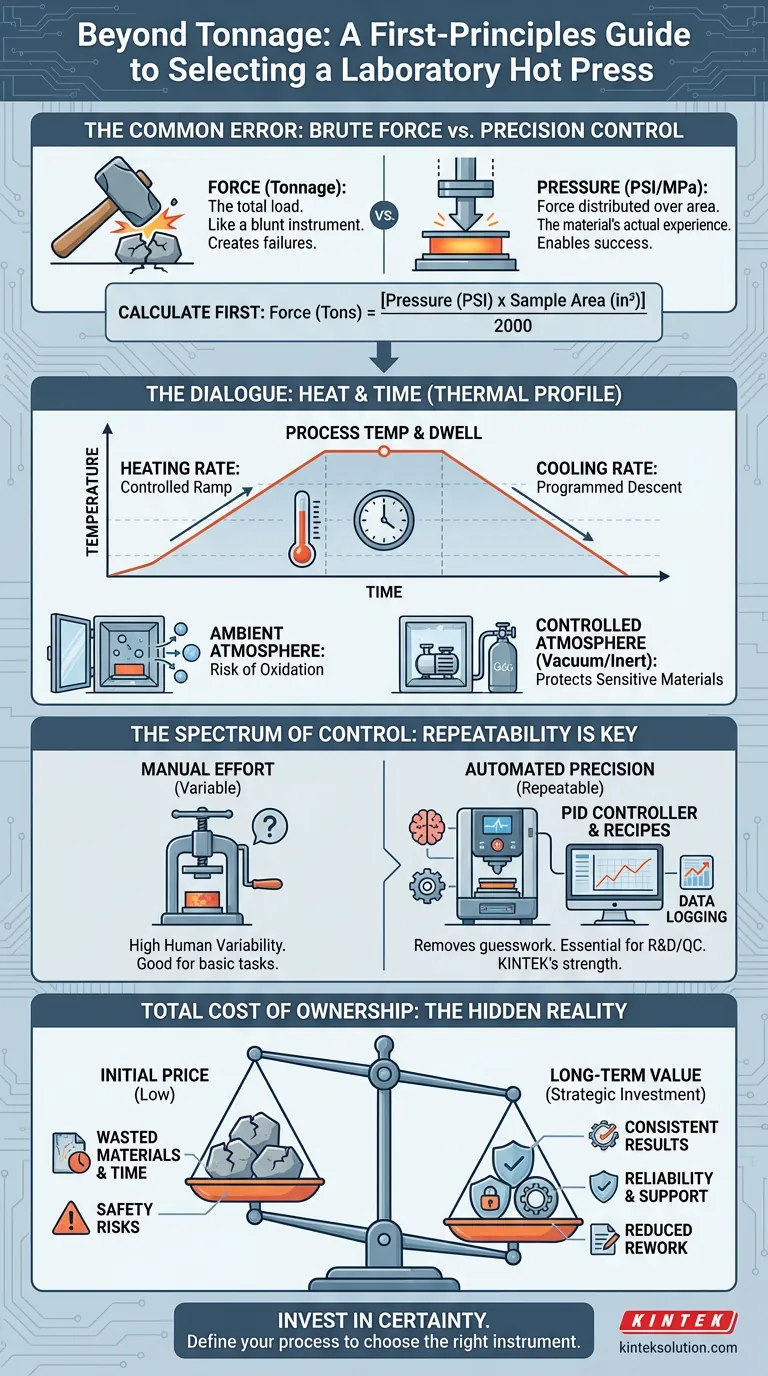
The first and most critical distinction to make is between force and pressure. It's the primary source of failed experiments and misunderstood requirements.
- Force (tons or kN) is the total load the machine can exert. It's the headline number.
- Pressure (PSI or MPa) is the force distributed over the area of your sample. It's the number that your material actually experiences.
Focusing only on tonnage is like buying a sports car to navigate a tight parking garage. You have an excess of power you cannot apply with any precision. You must first calculate the pressure your material requires and then work backward to determine the force needed for your specific sample size.
Force (Tons) = [Pressure (PSI) x Sample Area (in²)] / 2000
Answering this question first filters out 90% of unsuitable options and prevents you from over-investing in force you will never use.
The Dialogue Between Heat and Time
Your material's final properties are dictated by a delicate conversation between temperature and time. The hot press is the medium for that conversation.
The Thermal Profile
The maximum temperature is the obvious parameter, dictated by your material's melting, curing, or glass transition point. But the journey to and from that temperature is equally important.
- Heating Rate (Ramping Up): Does your material need a rapid ramp to minimize degradation, or a slow, gentle heating to ensure uniformity?
- Cooling Rate (Ramping Down): Controlled cooling is often the most overlooked parameter. For polymers and certain composites, a slow, programmed cooling ramp is essential to prevent internal stresses and ensure a stable, usable part.
A press that can only reach a high temperature but cannot control the path it takes to get there is a blunt instrument.
The Invisible Reagent: Atmosphere
Many advanced materials are highly sensitive to oxygen or moisture at elevated temperatures. A standard press operates in ambient air. If you work with sensitive polymers, metal alloys, or composites, oxidation isn't a risk; it's a certainty.
In these cases, the ability to operate under a vacuum or in an inert gas atmosphere is not a luxury feature. It is a fundamental process requirement to protect the integrity of your material.
The Spectrum of Control: From Manual Effort to Autonomous Precision
Once you've defined the physical parameters, the next question is about how you interact with the process. The level of control you require dictates the type of system you need.
Manual vs. Electric: Choosing Your Intervention
- Manual Presses are simple and cost-effective. They are perfect for forgiving applications like KBr pellet preparation, where absolute precision is secondary to function.
- Electric (Electro-Hydraulic) Presses represent a leap in capability. They offer the highest force and, more importantly, the most precise control over pressure, position, and speed.
For any serious R&D or quality control application, the choice is clear. You need a system that removes human variability.
The Soul of the Machine: Repeatability
In science and quality control, repeatability is non-negotiable. If you cannot guarantee that the 100th sample is processed identically to the first, you cannot trust your results.
This is where advanced digital controllers (PIDs) and programmable recipes become essential. The ability to program a multi-step process—heat to T1, hold for X minutes, press to P1, cool at rate Y—is what separates a simple heater from a scientific instrument. This level of automation, found in systems like KINTEK's automatic lab presses, ensures that the process you design is the process that is executed, every single time.
Data logging is the final piece of this puzzle. It provides an unchangeable record of the process, ensuring traceability for publications, quality audits, or troubleshooting.
The Hidden Costs of a "Good Deal"
Finally, we must address the practical realities and the psychology of cost.
A press with a low initial price can become the most expensive piece of equipment in your lab through failed experiments, wasted materials, and the time spent on rework.
Consider the total cost of ownership:
- Safety: Are there adequate safety shields, emergency stops, and over-pressure protection? The cost of an accident is incalculable.
- Utilities: Does your lab have the required electrical service (voltage, phase) and footprint for the machine?
- Reliability: Is the manufacturer reputable? Does they offer technical support? A machine that is down for repairs generates no value.
Your decision should be a strategic investment in your results. For basic preparation, a simple manual press may suffice. But for advanced research or routine QC, a robust, automated press with exceptional control and repeatability is the only logical choice. By defining your process first, you are not just buying equipment; you are investing in certainty.
KINTEK specializes in engineering laboratory press solutions—from heated and isostatic to fully automatic systems—that provide the precise control and reliability your research demands. If you're ready to align your equipment with your ambition, Contact Our Experts.
Visual Guide
Related Products
- 24T 30T 60T Heated Hydraulic Lab Press Machine with Hot Plates for Laboratory
- Laboratory Split Manual Heated Hydraulic Press Machine with Hot Plates
- Heated Hydraulic Press Machine with Heated Plates for Vacuum Box Laboratory Hot Press
- Automatic Heated Hydraulic Press Machine with Hot Plates for Laboratory
- Laboratory Manual Heated Hydraulic Press Machine with Hot Plates
Related Articles
- The Invisible Forge: Why the Laboratory Press is the Soul of Nano-Composites
- The Architecture of Slow: Why Physical Precision Dictates Chemical Destiny
- The Architecture of Density: Why Pressure is the Silent Architect of Solid-State Batteries
- The Physics of Transparency: Why Pressure is the Silent Architect of Spectroscopic Clarity
- The Architecture of Certainty: Why the Laboratory Press is the Anchor of Material Science



















