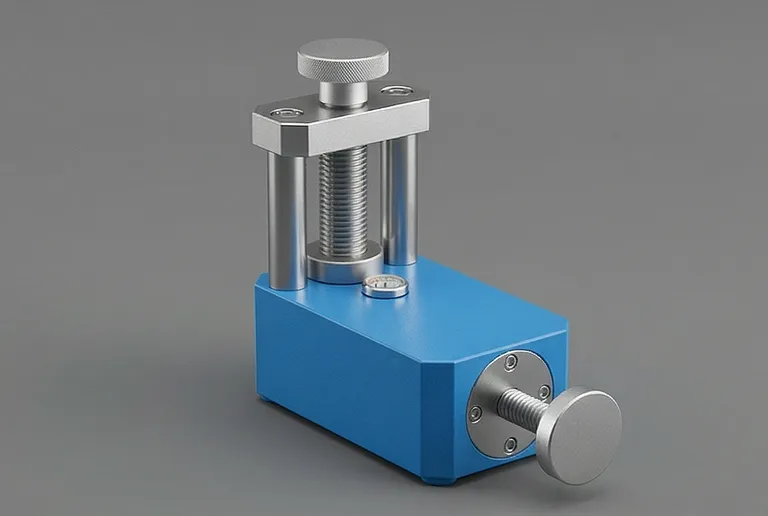
The Invisible Variable
In material science, the most dangerous variables are the ones you cannot see. When a phthalocyanine pigment fails a colorimetric test, or a rubber specimen snaps prematurely, the instinct is to blame the chemistry of the raw materials.
Often, the fault lies not in the "what," but in the "how."
The laboratory electrically heated hydraulic press is the silent arbiter of this process. It is the bridge between a chaotic mixture of raw polymers and pigments and a standardized specimen capable of yielding "truth" in the lab.
The Chemistry of Transition
At its core, the press is a catalyst for a metamorphosis. It transforms a pliable, thermoplastic mixture into a durable, three-dimensional thermoset elastomer. This isn't just "shaping" a material; it is a controlled chemical execution.
Triggering the Molecular Handshake
Using electric heating plates, the press provides the specific activation energy required for sulfur or peroxide curing agents to bond with rubber macromolecules. This creates a cross-linked network that defines the material’s final identity.
The Discipline of the Degrees
Consistency is the only metric that matters.
- The Sweet Spot: Typically between 150°C and 165°C.
- The Risk of "Under-Curing": An incomplete reaction leads to unstable physical properties.
- The Risk of "Over-Curing": Excessive heat degrades the polymer and shifts the pigment’s color profile.
The Geometry of Pressure
Pressure in a hydraulic press serves one primary psychological and technical goal: the elimination of "nothingness."
Internal voids and microscopic air pockets are the enemies of data. If a test plaque contains a single bubble, every mechanical measurement—from tensile strength to Young’s modulus—is an artifact, not a fact.
- Void Elimination: High mechanical pressure (up to 300 KN) forces the mixture into every corner of the steel mold, purging air and ensuring a density that is uniform across the entire specimen.
- Dimensional Standardization: By maintaining a precise 2 mm thickness, the press ensures that when you compare Batch A to Batch B, you are comparing the material properties, not the variations in sample size.
Locking the Micro-Morphology
There is a certain "engineer’s romanticism" in the cooling phase. As the press applies uniform pressure while the material sets, it effectively "freezes" the pigment dispersion in time.
This "locks in" the micro-morphology of the phthalocyanine. It ensures that the color strength you measure is a true reflection of how the pigment was dispersed during mixing, rather than a result of the pigment settling or migrating during an uncontrolled molding process.
The Trade-offs of Precision
Systemic excellence requires managing inherent physical contradictions. Even the best equipment must navigate these two challenges:
| Challenge | Impact on Sample | The Solution |
|---|---|---|
| Thermal Gradients | Uneven vulcanization across the sheet. | High-precision heating plate calibration. |
| Material Flash | Inconsistent density and thickness. | Optimized pressure stepping and mold design. |
| Internal Voids | Structural weakness and data noise. | Sustained, high-tonnage hydraulic force. |
Strategy for Targeted Research
To achieve repeatable results, you must align your pressing protocol with your research goals:
- For Color Stability: Prioritize thermal dwell time and temperature calibration to protect the pigment's integrity.
- For Mechanical Performance: Focus on the "pressure ramp" to ensure interlaminar boundaries are completely erased.
- For Comparative Testing: Standardize the protocol—160°C at 150 bar for exactly 15 minutes—making the equipment a constant so the pigment remains the only variable.
The KINTEK Standard
The difference between a "result" and an "insight" is the reliability of the specimen. At KINTEK, we design our pressing solutions to remove the "noise" from your material research.
From manual and automatic heated presses to specialized isostatic solutions (CIP/WIP) used in cutting-edge battery research, our equipment is built for the rigors of standardized testing. Whether you are working within a glovebox or on a laboratory bench, we provide the tools to ensure your micro-morphology is locked and your data is beyond reproach.
Don't let processing inconsistencies undermine your innovation. Contact Our Experts
Related Products
- Heated Hydraulic Press Machine with Heated Plates for Vacuum Box Laboratory Hot Press
- Automatic High Temperature Heated Hydraulic Press Machine with Heated Plates for Lab
- Heated Hydraulic Press Machine With Heated Plates For Vacuum Box Laboratory Hot Press
- 24T 30T 60T Heated Hydraulic Lab Press Machine with Hot Plates for Laboratory
- Automatic Heated Hydraulic Press Machine with Hot Plates for Laboratory
Related Articles
- The Architecture of Slow: Why Physical Precision Dictates Chemical Destiny
- The Vanishing Boundary: The Hidden Thermodynamics of LTCC Lamination
- The Alchemy of 160°C: Why Precision Pressing is the Silent Backbone of Rubber Science
- The Invisible Forge: Why the Laboratory Press is the Soul of Nano-Composites
- Beyond Tonnage: A First-Principles Guide to Selecting a Laboratory Hot Press



















