The Gap Between Compound and Specimen
Every breakthrough in rubber chemistry begins as a chaotic mess.
You have the raw polymer, the vulcanizing agents, and perhaps a compatibilizer like Liquid Nitrile-Isoprene Rubber (LIR). On the mixing mill, it looks like progress. But in its raw state, rubber is a "plastic" compound—unstable, prone to deformation, and physically incoherent.
The transition from this disorganized state to a high-performance "elastomer" happens in a narrow window of time, temperature, and pressure.
In materials science, we often focus on the recipe. But the Laboratory Heated Hydraulic Press is the kitchen. If the oven temperature fluctuates or the pan doesn't distribute weight evenly, the finest ingredients in the world will still produce a failure.
Thermal Integrity: Locking the Micro-World
The first role of the press is purely energetic. Vulcanization is a chemical marriage, and 160°C is usually the invitation.
The Catalyst of Cross-linking
Thermal energy acts as the catalyst for molecular chains to find one another. Whether dealing with Natural Rubber (NR) or Butadiene Rubber (BR), the heat triggers the agents that "stitch" these chains together.
Freezing the Morphology
When using advanced blends, the press performs a task of "engineer's romance": it locks the micro-morphology. By facilitating interfacial cross-linking, the press ensures that the microscopic structures you designed during the mixing stage are frozen into the final product.
This isn't just heating; it's the architectural stabilization of a material's dynamic modulus.
The Mechanical Mandate: Eliminating the Void
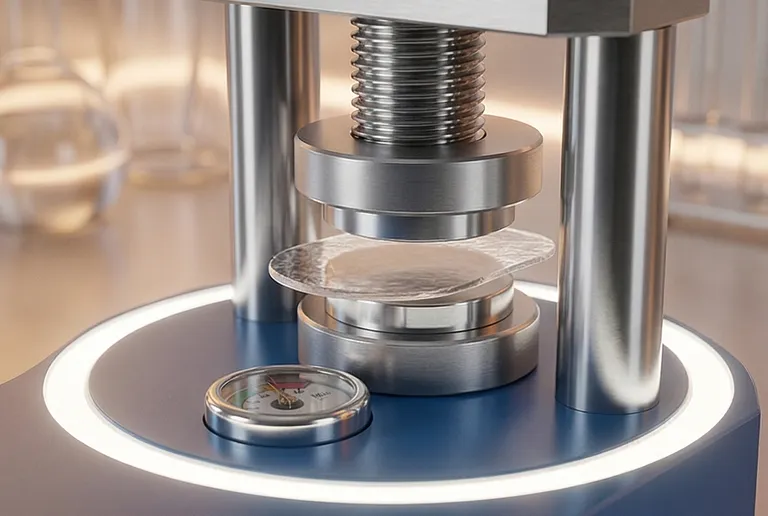
If heat handles the chemistry, pressure handles the honesty of the sample.
At 10–20 MPa, the hydraulic system does more than just flatten rubber. It enforces a standard of truth in three specific ways:
- Dimensional Discipline: It forces the compound into a precise geometric form—usually a standardized 2 mm sheet. Without this uniformity, measurements of mechanical strength or EMI shielding are statistically meaningless.
- The Pursuit of Density: High pressure ensures the compound flows into every corner of the steel mold. It overcomes the material's internal resistance, ensuring the cavity is 100% filled.
- Gas Evacuation: Raw compounds trap air and volatile gases. A press that lacks sufficient force allows these "voids" to remain. In a laboratory setting, an internal bubble isn't just a defect; it's a stress concentrator that leads to premature failure and corrupted data.
The Fragile Equilibrium: Managing Trade-offs
Engineering is the art of managing trade-offs. In rubber pressing, the margins for error are thin, and the psychology of the researcher often leans toward "more is better."
| Variable | The Risk of "Too Little" | The Risk of "Too Much" |
|---|---|---|
| Temperature | Under-curing (soft, weak samples) | Over-curing (brittleness, degradation) |
| Pressure | Porosity and incomplete mold filling | "Flash" (excess leakage) and internal stress |
| Time | Incomplete chemical network | Molecular scission and energy waste |
The greatest technical challenge is Thermal Uniformity. If the heating plates vary by even a few degrees across their surface, you are no longer testing one material; you are testing a gradient of different cure states.
The Systemic Solution for Material Research
Precision in the lab is about reducing variables until only the material remains.
At KINTEK, we recognize that the press is not just a tool, but a controlled environment for molecular transformation. Our equipment is designed to remove the "noise" from your data by providing absolute consistency in heat distribution and pressure application.
Whether you are optimizing the interfacial bonding of LIR/NR blends or developing the next generation of battery components, the integrity of your results depends on the reliability of your press.
Our Specialized Solutions Include:
- Manual & Automatic Heated Presses: Engineered for repeatable 160°C+ environments.
- Glovebox-Compatible Models: Essential for moisture-sensitive battery research.
- Isostatic Pressing (CIP/WIP): For advanced ceramic and battery electrode densification.
The difference between a "good guess" and "scientific proof" lies in the precision of the specimen. Ensure your research stands on a foundation of technical excellence.
Related Products
- Heated Hydraulic Press Machine with Heated Plates for Vacuum Box Laboratory Hot Press
- Automatic High Temperature Heated Hydraulic Press Machine with Heated Plates for Lab
- Heated Hydraulic Press Machine With Heated Plates For Vacuum Box Laboratory Hot Press
- 24T 30T 60T Heated Hydraulic Lab Press Machine with Hot Plates for Laboratory
- Automatic Heated Hydraulic Press Machine with Hot Plates for Laboratory
Related Articles
- The Architecture of Slow: Why Physical Precision Dictates Chemical Destiny
- The Architecture of Certainty: Why the Laboratory Press is the Anchor of Material Science
- The Vanishing Boundary: The Hidden Thermodynamics of LTCC Lamination
- The Invisible Forge: Why the Laboratory Press is the Soul of Nano-Composites
- Beyond Tonnage: A First-Principles Guide to Selecting a Laboratory Hot Press



















