The Moment of Truth is a 13mm Pellet
Imagine a multi-million dollar X-Ray Fluorescence (XRF) spectrometer, calibrated to perfection. Its analytical power is immense, but its accuracy depends entirely on the small, dense pellet placed inside it.
If that pellet is cracked, inhomogeneous, or has inconsistent density, the entire analysis is compromised. The most expensive part of the process is rendered worthless by the failure of the least expensive part.
This is the central challenge in selecting a laboratory pellet press. It’s not a simple purchase; it’s a decision about the reliability of your data. The choice is often framed as a battle between budget and features, but it’s really about managing sources of experimental error.
The Physics of Pressure
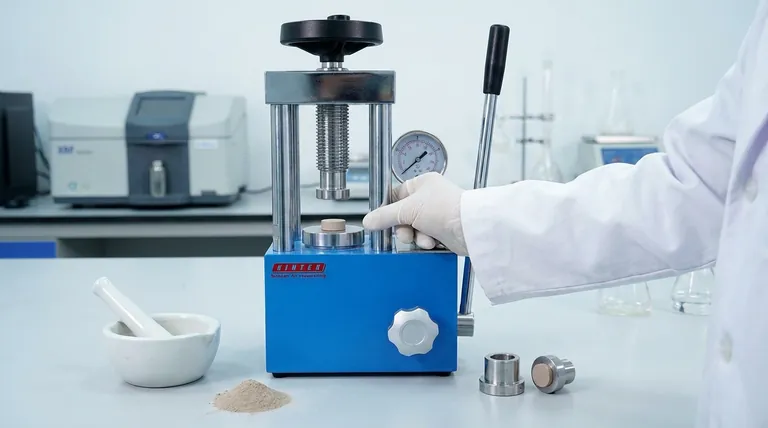
At its heart, a press is a tool for applying force. But how that force is generated, controlled, and delivered determines the quality of your sample preparation.
Force is Non-Negotiable
A press’s tonnage—the maximum force it can apply—is its most fundamental specification. It's tempting to think more is always better, but the reality is more nuanced.
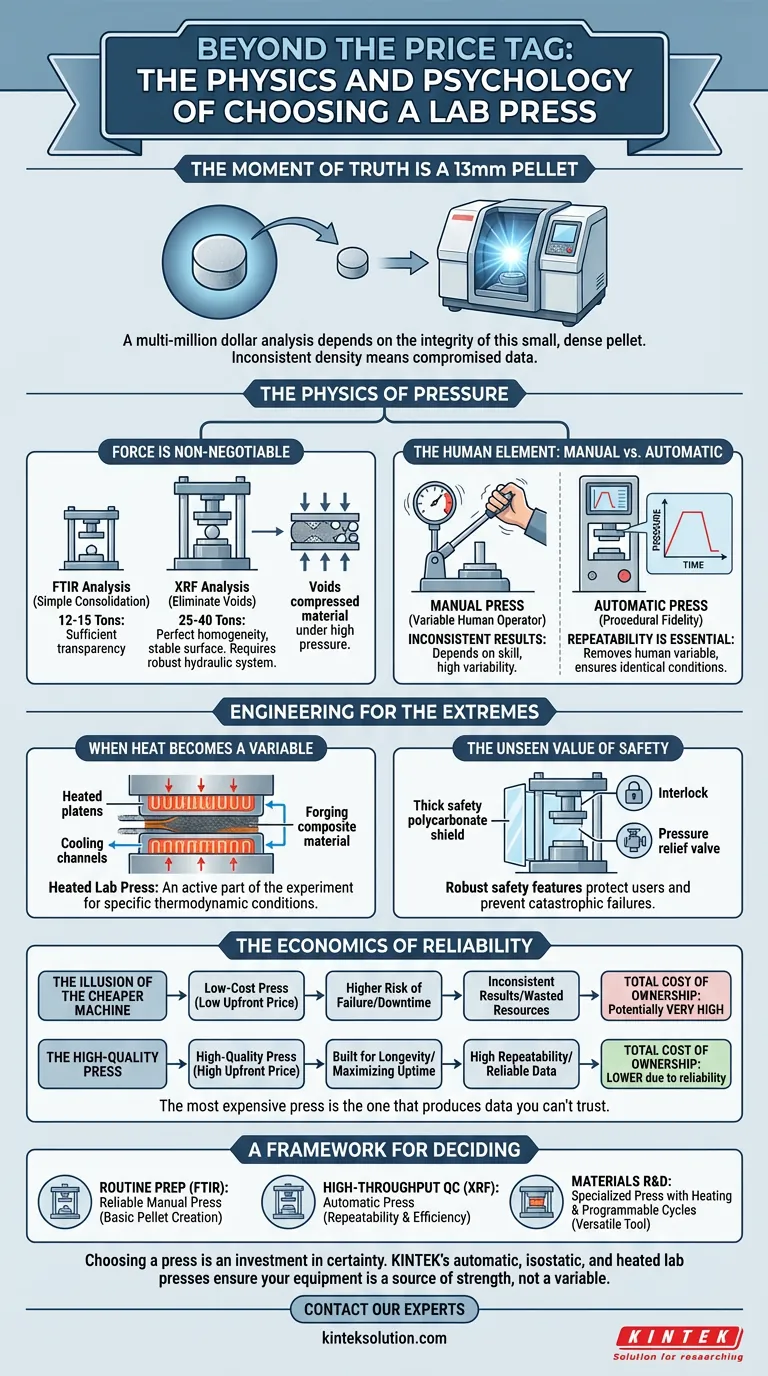
- For simple FTIR analysis, preparing a KBr pellet might only require 12-15 tons to achieve sufficient transparency. The goal is simple consolidation.
- For demanding XRF analysis, preparing a cement or ore sample requires 25-40 tons. Here, the goal isn't just consolidation; it's to eliminate voids and create a perfectly homogenous, stable surface for analysis. Insufficient force leads to inconsistent density, a primary source of analytical error.
The cost difference between a 15-ton and a 40-ton press reflects the more robust frame and hydraulic system required to safely and consistently deliver that force.
The Human Element: Manual vs. Automatic
A manual press is an exercise in human skill. An operator pumps a lever, watching a gauge, attempting to hit a target pressure. For a low-throughput lab where consistency is secondary to cost, this can be acceptable.
But human operators are variable.
An automatic press replaces this variability with procedural fidelity. By using an electro-hydraulic system, it allows an operator to program a precise pressure cycle: ramp up at a specific rate, hold for a set duration, and release.
This isn’t about convenience; it’s about removing a variable from your experiment. For any validated method or high-throughput quality control, the repeatability of an automatic press is essential. It ensures every pellet is made under identical conditions, making your results comparable and reliable.
Engineering for the Extremes
Beyond core mechanics, specialized features transform a press from a simple tool into a sophisticated piece of research equipment.
When Heat Becomes a Variable
For polymer scientists and material researchers, pressure is only one part of the equation. Creating composites or studying material behavior often requires pressing samples at elevated temperatures.
Integrating heating elements, cooling channels, and precise temperature controllers into the platens is a significant engineering feat. A heated lab press is no longer just a sample prep device; it becomes an active part of the experiment, allowing you to forge materials under specific thermodynamic conditions. This capability carries a corresponding price.
The Unseen Value of Safety
A high-pressure hydraulic system stores an enormous amount of potential energy. Premium presses acknowledge this with robust safety features: thick polycarbonate shields, electrical interlocks that prevent operation when the door is open, and automatic pressure relief valves.
These aren't luxury add-ons. They are fundamental design considerations that protect users and prevent catastrophic failures. The investment in safety is a hallmark of a manufacturer who understands the entire laboratory environment, not just the function of the machine.
The Economics of Reliability
Our brains are wired to focus on upfront costs, but this is a dangerous bias in a scientific setting. The true cost of a tool is measured over its lifetime of use.
The Illusion of the Cheaper Machine
A low-cost press might save money on the initial purchase order, but it can introduce hidden costs down the line.
| Cost Factor | Low-Cost Press | High-Quality Press |
|---|---|---|
| Upfront Price | Low | High |
| Downtime | Higher risk of failure, costly delays. | Built for longevity, maximizing uptime. |
| Inconsistent Results | Wasted time, reagents, and instrument use. | High repeatability, reliable data. |
| Total Cost of Ownership | Potentially very high over its lifespan. | Lower due to reliability and longevity. |
The most expensive press is the one that fails during a critical project or produces data you can't trust.
A Framework for Deciding
Choosing the right press means aligning its capabilities with your primary goal.
- For Routine Prep (e.g., FTIR): A reliable, low-tonnage manual press is a cost-effective workhorse. Your primary need is basic pellet creation.
- For High-Throughput QC (e.g., XRF): An automatic press is non-negotiable. Your primary need is repeatability and efficiency to ensure data integrity across hundreds of samples.
- For Materials R&D: A specialized press with heating and programmable cycles is required. Your primary need is a versatile tool that can be part of the experiment itself.
Ultimately, the choice of a press is an investment in certainty. It's about ensuring the simple act of preparing a sample doesn't undermine the complex science that follows. KINTEK's range of automatic, isostatic, and heated lab presses is engineered to provide this certainty, ensuring your equipment is a source of strength, not a variable.
To find a solution that matches the rigor of your research, Contact Our Experts.
Visual Guide
Related Products
- 24T 30T 60T Heated Hydraulic Lab Press Machine with Hot Plates for Laboratory
- Manual Heated Hydraulic Lab Press with Integrated Hot Plates Hydraulic Press Machine
- Laboratory Hydraulic Pellet Press for XRF KBR FTIR Lab Press
- Lab Infrared Press Mold for Laboratory Applications
- Laboratory Hydraulic Press Lab Pellet Press Machine for Glove Box
Related Articles
- The Invisible Forge: Why the Laboratory Press is the Soul of Nano-Composites
- The Architecture of Slow: Why Physical Precision Dictates Chemical Destiny
- The Architecture of Density: Why Pressure is the Silent Architect of Solid-State Batteries
- The Physics of Transparency: Why Pressure is the Silent Architect of Spectroscopic Clarity
- The Architecture of Certainty: Why the Laboratory Press is the Anchor of Material Science



















