The Moment of Failure is Never Convenient
It happens in the final stage of a multi-week experiment. A hydraulic press, the unsung workhorse of the lab, suddenly fails to hold pressure. The gauge flickers, a warning light flashes, and a critical process is compromised.
The first instinct is a frantic search for a solution. The pressure is on—not just in the hydraulic lines, but to meet deadlines and salvage research. This moment is a critical junction, and the path chosen next reveals more about a lab's philosophy on risk than any mission statement.
The temptation is to find the fastest, cheapest fix. But in the world of precision equipment, the immediate solution is often the seed of a much larger, future problem.
The Allure of the Quick Fix and Its Hidden Costs
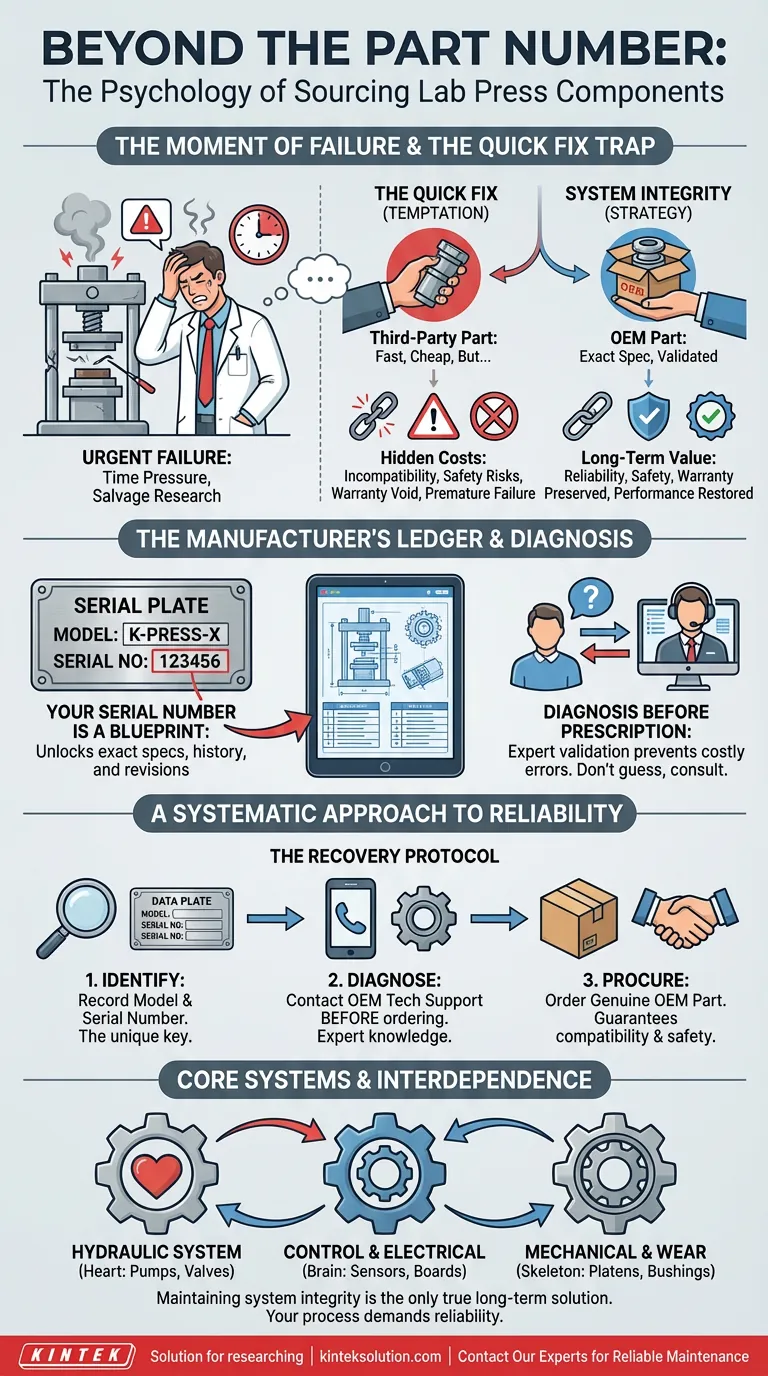
We are psychologically wired to solve immediate problems. A broken machine is a tangible, urgent issue. A third-party component available for next-day delivery at half the price feels like a decisive victory.
This is the cognitive trap of focusing on first-order consequences (cost, speed) while ignoring the second- and third-order consequences (compatibility, safety, warranty, long-term reliability).
Sourcing a spare part isn't a simple purchase; it's a decision about system integrity.
- Original Equipment Manufacturer (OEM) Parts: These are components built to the exact specifications, materials, and tolerances of the original design. They represent certainty. You are restoring the machine to its documented state of performance and safety.
- Third-Party Parts: These are approximations. They may look identical but can differ in material composition, heat treatment, or dimensional tolerance. They introduce uncertainty and risk into a system designed for precision.
The short-term savings from a third-party part are often dwarfed by the long-term costs of premature failure, damage to adjacent components, or—worst of all—a safety incident. Using a non-verified part almost universally voids your manufacturer's warranty, turning a small component failure into a catastrophic financial liability.
The Manufacturer's Ledger: Your Serial Number is a Blueprint
On the frame of every laboratory press is a small metal plate. On it, a model and serial number. These are not just administrative tags; they are the keys to the machine's identity.
For a manufacturer like KINTEK, that serial number unlocks a precise digital blueprint: the exact bill of materials used, the specific firmware version installed, and any mid-production revisions made to that particular unit. It's the machine's complete history and design specification.
When you provide the OEM with this number, you aren't just ordering a "pump." You are ordering the specific pump, with the correct fittings and performance curve, that was designed and validated for the ecosystem of your exact press.
Diagnosis Before Prescription: The Expert in the Loop
You wouldn't take medication without a doctor's diagnosis. Why would you replace a component in a complex machine without an expert's validation?
A flickering pressure gauge could be a faulty sensor, a failing seal, a problematic valve, or an issue with the control board. Ordering the wrong part is not just a waste of money; it's a waste of the most valuable resource: time.
Contacting the manufacturer's technical support first is the most crucial step. A trained technician has a mental library built from thousands of similar cases. They can often diagnose the issue remotely, ensuring you order the right part the first time. This simple conversation transforms a guess into a data-driven decision.
A Systematic Approach to Reliability
Restoring a high-performance lab press is a systematic process, not an emergency scramble. It respects the engineering that went into the machine from the start.
The Core Systems
Understanding the machine helps in communicating the problem. Most issues fall into one of three categories:
- Hydraulic System: The heart of the press. Includes pumps, seals, hoses, and valves that are subject to high stress.
- Control & Electrical System: The brain of the press. Includes sensors, controllers, heating elements, and relays that govern its operation.
- Mechanical & Wear Parts: The skeleton of the press. Includes platens and bushings that endure physical wear over time.
The Recovery Protocol
| Step | Action | The Rationale |
|---|---|---|
| 1. Identify | Locate the data plate. Record the model & serial number. | This is the unique key to your machine's specific design and parts list. |
| 2. Diagnose | Contact the OEM's technical support team before ordering. | Leverage expert knowledge to prevent misdiagnosis and costly errors. |
| 3. Procure | Order the genuine OEM part from the manufacturer. | Guarantees compatibility, preserves warranty, and upholds safety standards. |
This structured approach minimizes downtime, ensures safety, and protects the significant investment your laboratory has made in its equipment. A precision instrument, whether it's an automatic, isostatic, or heated lab press, is a system where every component is interdependent. Maintaining that system's integrity is the only true long-term solution.
If your process demands reliability and precision, ensure your maintenance strategy does too. Contact Our Experts
Visual Guide
Related Products
- Lab Round Bidirectional Press Mold
- Special Shape Lab Press Mold for Laboratory Applications
- Lab Infrared Press Mold for Laboratory Applications
- Laboratory Hydraulic Press Lab Pellet Press Button Battery Press
- Assemble Square Lab Press Mold for Laboratory Use
Related Articles
- The Physics of Trust: A Disciplined Approach to Laboratory Press Safety and Reliability
- The Anatomy of Repeatability: Deconstructing the Modern Laboratory Press
- The Unseen Variable: Why Your Lab Press Dictates Your Data's Integrity
- The First Principle: Why Lab Press Installation Governs a Decade of Data
- From Powder to Proof: The Unseen Force in Material Science



















