In the world of material science, power is easy to come by.
Hydraulic presses can exert hundreds of tons of force with the push of a button. But in the delicate dance of composite manufacturing, raw power is often the enemy of precision. Without a "governor," that force becomes a source of variance rather than a tool for excellence.
The metal spacer is that governor. It is the simple, unyielding physical limit that transforms a blunt force into a repeatable system.
The Geometry of Control
At its core, a hydraulic press is a machine of movement. Without a physical stop, the press continues until it reaches a specific pressure or runs out of travel.
In composite board production, relying solely on pressure sensors is a gamble. Variations in the moisture of a mat, the age of a resin, or the ambient temperature can change how a material "resists" the press.
Metal spacers eliminate this ambiguity.
By placing precision-ground steel blocks—standardized to dimensions like 5mm or 10mm—between the press platens, you create a mechanical "hard stop." The press no longer stops when it thinks it has exerted enough force; it stops when it physically cannot go any further.
Why This Matters for Precision:
- Target Thickness: Ensures every board in a 100-unit run is identical to the first.
- Mechanical Paradox: It allows you to apply high pressure to ensure consolidation without the risk of crushing the material’s structural integrity.
- Compliance: Meeting standards like EN 312 requires a level of thickness uniformity that human monitoring cannot achieve alone.
Density as a Function of Volume
Material strength is rarely about the "stuff" itself; it is about the spaces between the stuff.
The internal porosity of a composite dictates its thermal conductivity, wear resistance, and structural lifespan. If you over-compress a high-performance fungal-based or metal-matrix composite, you destroy the very pores that give it its unique properties.
Spacers act as a volume regulator. By fixing the final height of the press, you are essentially fixing the volume of the material. Since the mass of your raw mat is known, fixing the volume guarantees a predictable density.
This is the "Engineer’s Romanticism"—using a rigid piece of steel to curate the invisible void spaces inside a material.
The Hidden Variables

Even a perfect system has its shadows. While spacers provide geometric certainty, they introduce thermal complexity.
- The Heat Sink Effect: Metal spacers, usually high-grade steel, can act as thermal drains. They pull heat away from the edges of the composite mat, potentially creating a "curing gradient" where the center of the board is perfectly set, but the edges are slightly under-processed.
- The Debris Margin: Precision is fragile. A single stray fiber or a drop of cured resin on the surface of a spacer can result in a 0.5mm deviation. In high-stakes research, that 0.5mm is the difference between a breakthrough and a failed batch.
Selecting Your System
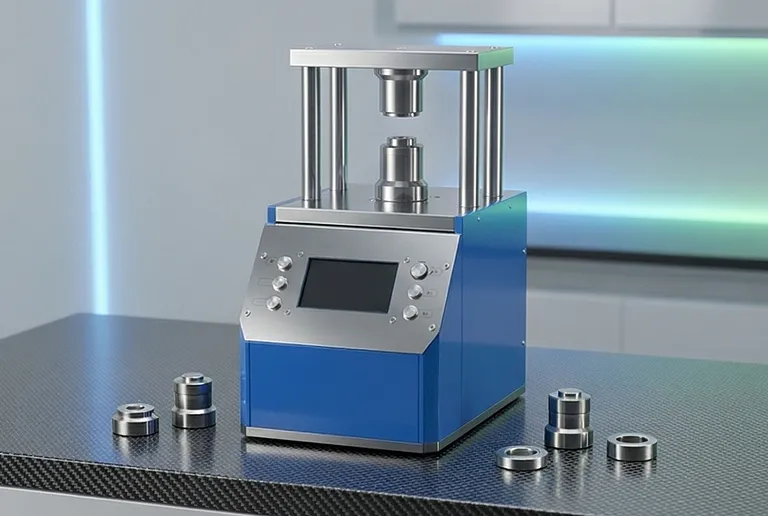
Precision in the lab requires a harmony between the press and the constraints.
| Feature | Function | Strategic Benefit |
|---|---|---|
| Mechanical Stop | Limits platen travel | Guarantees batch-to-batch uniformity |
| Porosity Control | Manages internal void space | Optimizes strength-to-weight ratios |
| Thermal Sintering | Facilitates pressure-assisted bonding | Eliminates microscopic structural defects |
The KINTEK Advantage

At KINTEK, we understand that the press is only as good as the control systems surrounding it. Our laboratory solutions are engineered for researchers who refuse to leave the "last millimeter" to chance.
Whether you are working with vacuum-sealed glovebox environments for battery research or high-temperature multifunctional presses for advanced composites, our equipment provides the stability required for absolute precision. From manual hydraulic units to automated isostatic presses, we design for the rigorous standards of modern material science.
Precision is not an accident; it is the result of intentional constraints.
Ready to achieve total control over your material morphology? Contact Our Experts
Related Products
- Lab Button Battery Disassembly and Sealing Mold
- Lab Cylindrical Press Mold for Laboratory Use
- Button Battery Sealing Machine for Button Batteries
- Manual Button Battery Sealing Machine for Battery Sealing
- Lab Button Battery Tablet Press Sealing Mold