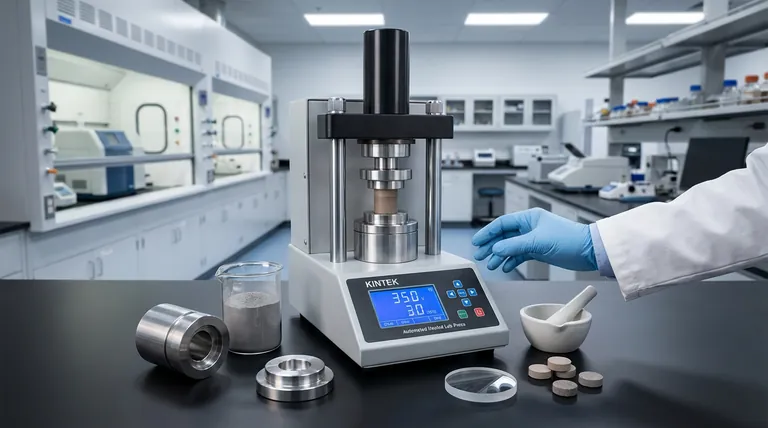
The Analyst's Dilemma: A Signal Hidden in Noise
Imagine a materials scientist with a beaker of promising gray powder. This powder could be the key to a stronger composite, a more efficient battery, or a novel ceramic. But in its raw, powdered state, it's a vessel of silent potential. It holds answers, but it cannot speak.
How do you ask it questions? How do you measure its elemental makeup, its structural integrity, its reaction to heat and stress?
This is the fundamental challenge of material science. The search for truth is a battle against inconsistency. A non-uniform sample is like a noisy room; the true signal—the material's intrinsic properties—is drowned out by the chaos of its form. The greatest enemy of discovery is not a failed experiment, but an unreliable one.
This is where the laboratory press enters. It is not merely a tool for applying force. It is an instrument for creating order. Its job is to transform a chaotic substance into a uniform, measurable, and honest specimen.
Three Transformations: What a Lab Press Really Does
At its core, a lab press solves one problem: applying a known amount of force in a controlled, repeatable way. This simple function enables three critical transformations in research, development, and quality control.
Transformation 1: Creating a Window for Analysis
Sophisticated analytical instruments require a perfect sample. They are unforgiving. A sample that is uneven, too porous, or inconsistent will yield misleading data. The press acts as the preparer, creating a clear window into the material's soul.
- For FTIR Spectroscopy: Powder is mixed with potassium bromide (KBr) and compressed into a small, transparent disc. The press creates a solid-state medium that light can pass through cleanly, revealing the material's molecular fingerprint without interference.
- For X-ray Fluorescence (XRF): Powder is pressed into a dense, flat pellet. This ensures a consistent surface and density, which is non-negotiable for obtaining accurate data on the material's elemental composition. A poorly pressed pellet lies.
In this role, the press is an enforcer of truth. It removes the variable of form so that only the variable of substance remains.
Transformation 2: Asking a Material How It Breaks
To understand a material, you must understand its limits. A lab press allows us to conduct a controlled, structured dialogue with a material about its strength and resilience.
By applying force methodically, we ask fundamental questions:
- Compressive Strength: At what exact point do you fail under pressure? This is the essential question for ceramics, concrete, and load-bearing components.
- Flexural Strength: How far can you bend before you snap? Using a three-point bend fixture, the press measures the material's ability to resist fracture under flexion, a key metric for both rigid and flexible materials.
This isn't destruction for its own sake. It is a precise and repeatable process of discovering a material's character by pushing it to its breaking point.
Transformation 3: From Abstract Idea to Tangible Prototype
The press is also an engine of creation. For researchers developing new polymers, composites, or alloys, it is the tool that bridges the gap between a chemical formula and a physical object.
Heated presses, or hot presses, use a combination of precise force and temperature to mold materials into specific shapes. This allows for:
- Rapid Prototyping: Testing a new polymer formulation by molding it into a standardized test puck or bar.
- Small-Scale Production: Creating small batches of components for performance testing or assembly.
- Laminating: Fusing layers of different materials together to create novel composites with unique properties.
This is where R&D accelerates. The ability to quickly and repeatably create tangible forms from new materials collapses the cycle between idea, test, and iteration.
The Physics and Philosophy of the Right Tool
A press is deceptively simple, but its effectiveness lies in the details of its application. Choosing the right system is a choice about what you need to control.
The Press Is Only the Engine
The press itself only provides force. Its function is defined by the tooling—the dies, molds, and platens—used with it. A press configured to make KBr pellets is useless for molding a polymer part. The tooling directs the force, shaping its purpose. The system is only as versatile as the tools you have for it.
The Spectrum of Control: From Human Hand to Programmed Cycle
The crucial difference between press systems comes down to control.
- Manual Presses: These are robust workhorses, perfect for routine tasks like making spectroscopy pellets. The control is in the operator's hands. They are simple, reliable, and cost-effective for when the task is repeatable.
- Automated Presses: When the process itself is the experiment, automation is essential. For developing advanced polymers, programmable control over pressure ramps, temperature holds, and cycle times is critical. Automation removes human inconsistency, ensuring that the results reflect the material's behavior, not the operator's.
For cutting-edge research and quality control, this level of precision isn't a luxury; it's a prerequisite for valid data. The precise control offered by KINTEK’s automatic and heated lab presses provides this exact foundation, ensuring that complex molding and testing protocols are executed with unwavering repeatability.
Choosing Your Instrument of Truth
The right laboratory press is the one that best serves your primary goal. By defining the job to be done, the choice becomes clear.
| Application Area | Key Goal | Recommended Press Type |
|---|---|---|
| Routine Analysis | Create consistent FTIR/XRF pellets | Manual Hydraulic Press |
| Material R&D | Mold polymers, composites, test formulas | Heated Lab Press (Hot Press) with programmable controls |
| QC & Process Dev. | Ensure strength, test small batches | Automatic Lab Press with custom tooling options |
Ultimately, a laboratory press is an investment in certainty. It is the quiet, powerful force that turns the potential held within a raw material into the hard proof of verifiable data and tangible innovation.
The quality of your press dictates the reliability of your insights. Whether preparing samples or pioneering the next generation of materials, the foundation of your work rests on the ability to apply force with absolute control. For laboratories where precision is non-negotiable, exploring a system designed for that purpose is the first step toward better results. Contact Our Experts
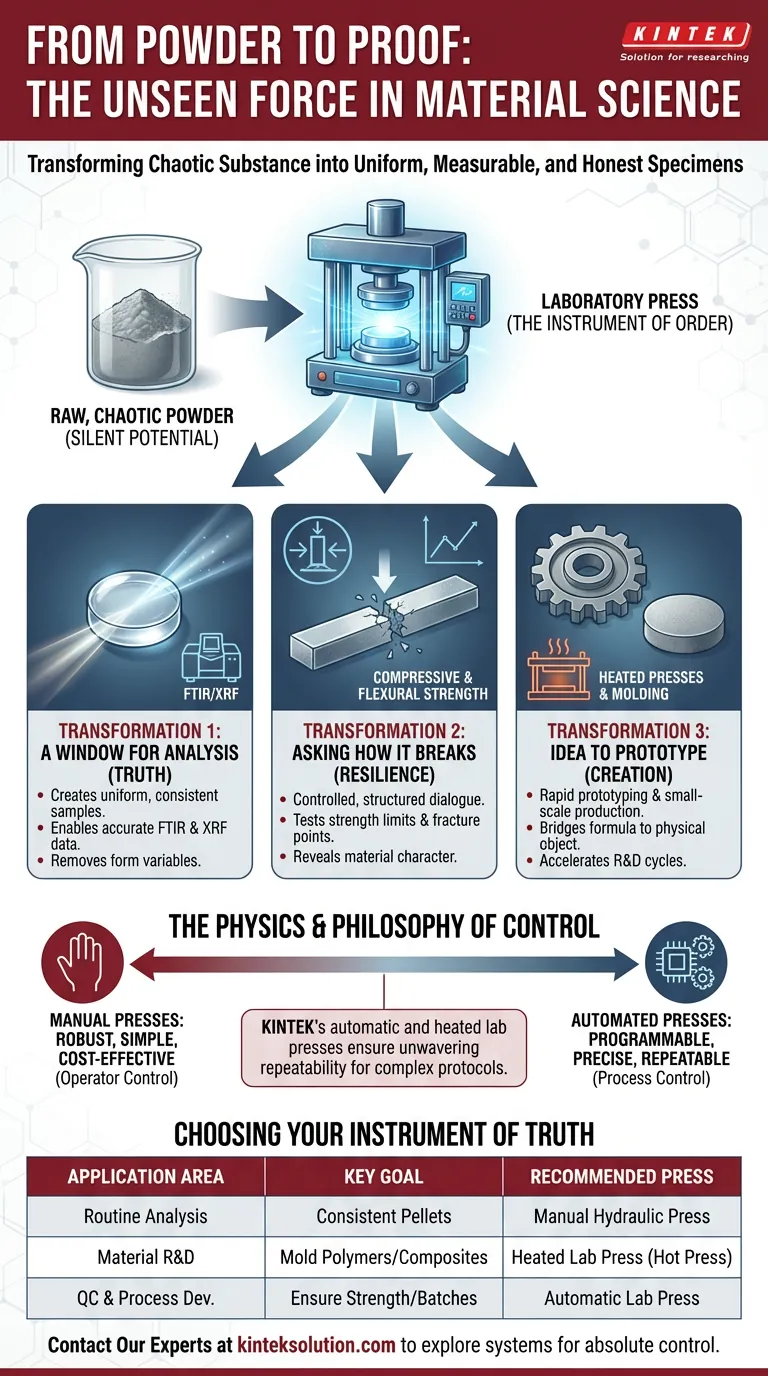
Visual Guide
Related Products
- 24T 30T 60T Heated Hydraulic Lab Press Machine with Hot Plates for Laboratory
- Manual Heated Hydraulic Lab Press with Integrated Hot Plates Hydraulic Press Machine
- Laboratory Hydraulic Pellet Press for XRF KBR FTIR Lab Press
- Lab Infrared Press Mold for Laboratory Applications
- Laboratory Hydraulic Press Lab Pellet Press Machine for Glove Box
Related Articles
- The Invisible Forge: Why the Laboratory Press is the Soul of Nano-Composites
- The Architecture of Slow: Why Physical Precision Dictates Chemical Destiny
- The Architecture of Density: Why Pressure is the Silent Architect of Solid-State Batteries
- The Physics of Transparency: Why Pressure is the Silent Architect of Spectroscopic Clarity
- The Architecture of Certainty: Why the Laboratory Press is the Anchor of Material Science



















