The Illusion of the Raw Sample
Imagine a scientist examining a new powdered compound. To the naked eye, it appears uniform, a homogenous substance ready for analysis. But this is a psychological trap. We are biased to trust what we see.
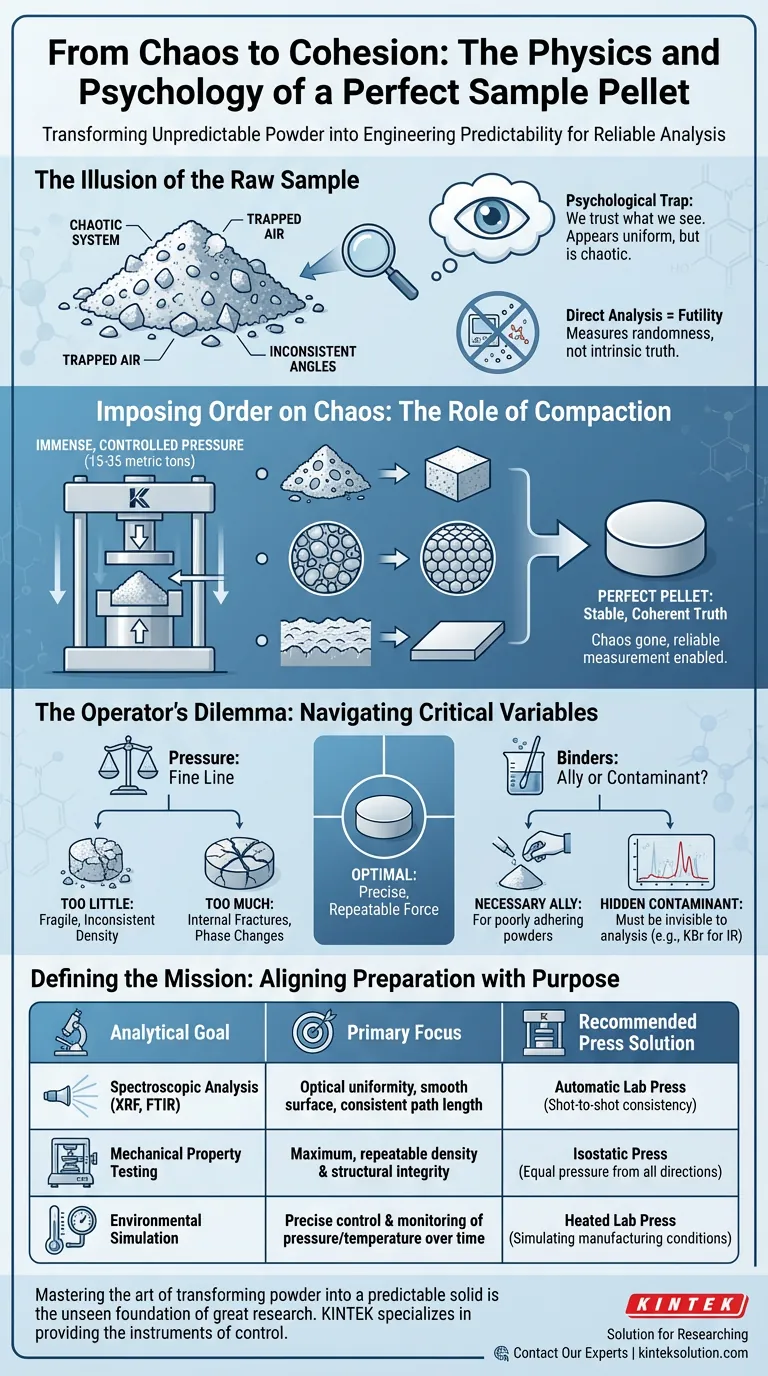
In reality, that pile of powder is a chaotic system. It's a mixture of solid particles, trapped air, and inconsistent surface angles. Direct analysis is an exercise in futility; the results will reflect this physical randomness more than the material's intrinsic chemical or mechanical truth.
The first step in any meaningful discovery is not analysis, but the imposition of order.
Imposing Order on Chaos: The Role of Compaction
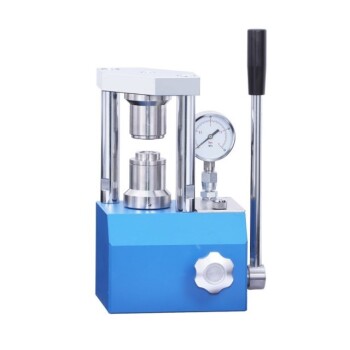
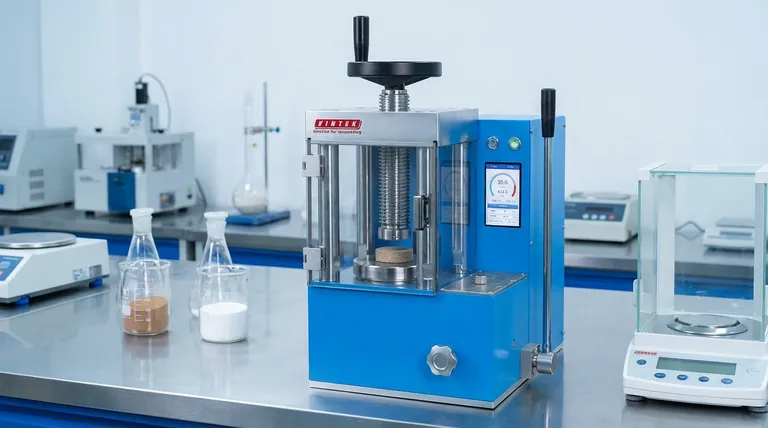
A laboratory press is an instrument of control. Its purpose is to transform a physically unpredictable powder into a dense, geometrically uniform sample—a pellet. This isn't just about squishing material; it's about engineering a predictable state to enable reliable measurement.
The Deception of Loose Powder
Analyzing loose powder is like trying to listen to a single voice in a roaring crowd. The inconsistent density and uneven surface create "noise" that overwhelms the "signal."
For spectroscopic methods like X-ray fluorescence (XRF) or Fourier-transform infrared spectroscopy (FTIR), this chaos is disastrous. Energy beams scatter unpredictably, absorption varies wildly across the sample, and the data becomes inconsistent and non-repeatable. You end up measuring the powder's randomness, not its properties.
Engineering Predictability with Pressure
A lab press applies immense, controlled pressure—often between 15 and 35 metric tons—within a shaping tool called a die. This force systematically eliminates the variables.
- Voids are eliminated: Trapped air is forced out.
- Density becomes uniform: Particles are compacted into a homogenous solid.
- A smooth surface is created: A flat, consistent plane is formed for analysis.
The result is a stable pellet that offers a uniform path for analytical beams. The chaos is gone, leaving only the coherent truth of the material behind.
The Operator's Dilemma: Navigating Critical Variables
Achieving the perfect pellet is a science in itself. The process is a series of critical decisions where precision and control are paramount.
Pressure: The Fine Line Between Cohesion and Destruction
The amount of pressure applied is a delicate balance.
- Too little pressure: The pellet is fragile and may crumble, its density still inconsistent.
- Too much pressure: The sample can fracture internally. In some cases, extreme pressure can even induce phase changes, fundamentally altering the material you set out to study.
Finding the optimal pressure requires a machine capable of delivering precise, repeatable force every single time.
Binders: The Necessary Ally or Hidden Contaminant?
For powders that don't adhere well, a binder is mixed in to create a durable pellet. But this introduces another variable. The binder must be mixed with perfect homogeneity; any clumps create weak spots or uneven density.
Furthermore, the binder itself is a potential contaminant. It must be chosen carefully to be invisible to the specific analysis being performed (e.g., KBr for IR spectroscopy). The ally can quickly become the enemy if not managed with care.
Defining the Mission: Aligning Preparation with Purpose
The ideal preparation strategy is not universal; it is dictated entirely by the final analytical goal. The "perfect" pellet for one test is unsuitable for another.
| Analytical Goal | Primary Focus | Key Preparation Parameters |
|---|---|---|
| Spectroscopic Analysis | Optical uniformity, smooth surface, consistent path length. | Repeatable pellet thickness, flawless surface finish. |
| Mechanical Property Testing | Maximum, repeatable density and structural integrity. | Achieving optimal compaction without inducing internal fractures. |
| Environmental Simulation | Precise control and monitoring of pressure/temperature over time. | A press that is the testing environment itself. |
This is where the choice of equipment becomes critical. For simulating manufacturing conditions, a heated lab press is necessary. For creating samples with perfectly uniform density, an isostatic press applies pressure equally from all directions. For ensuring shot-to-shot consistency and removing human error, an automatic lab press is the gold standard.
The Right Instrument for a Predictable Future
The challenges of sample preparation—navigating pressure, ensuring homogeneity, and aligning methods with goals—all point to a single need: control. Without a reliable, precise, and versatile laboratory press, researchers are fighting against variability instead of focusing on discovery.
KINTEK specializes in providing the instruments of control required for modern material science. Our range of automatic, isostatic, and heated lab presses is engineered to eliminate the physical chaos, allowing you to create the perfect foundation for your analysis. By removing the guesswork from sample preparation, we empower you to generate data that is not just accurate, but true.
Mastering the art of transforming powder into a predictable solid is the unseen foundation of great research. Let us help you build it. Contact Our Experts
Visual Guide
Related Products
- Automatic Laboratory Hydraulic Press for XRF and KBR Pellet Pressing
- Lab XRF Boric Acid Powder Pellet Pressing Mold for Laboratory Use
- Laboratory Hydraulic Pellet Press for XRF KBR FTIR Lab Press
- Manual Cold Isostatic Pressing CIP Machine Pellet Press
- Automatic Laboratory Hydraulic Press Lab Pellet Press Machine
Related Articles
- The Physics of Transparency: Why Pressure is the Silent Architect of Spectroscopic Clarity
- The Architecture of Density: Why Pressure is the Silent Architect of Solid-State Batteries
- The Architecture of Density: Why Pressure is the Foundation of Precision
- The Architecture of Heat: Why Sample Density Dictates the Truth in Metal Hydride Research
- The Geometry of Electrons: Why Surface Precision is the Silent Partner in SECM Research