The Silence After the Whir
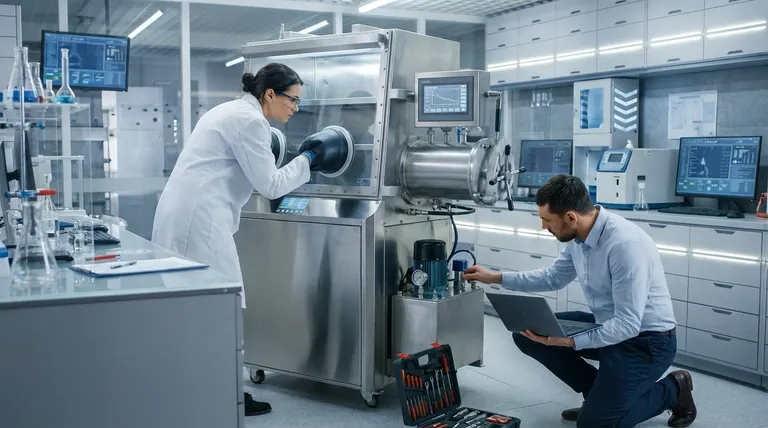
Every lab technician knows the sound. The low, powerful hum of a hydraulic press, the steady whir of its motor—these are the sounds of progress. But more jarring is the silence that follows an unexpected stop. A flicker on the control panel, an error code, and a multi-ton piece of precision engineering becomes an immovable object.
In that moment, the experiment is paused. The schedule is disrupted. And a critical question arises: what happens next?
The quality of your answer depends less on the machine's manual and more on the relationship you have with the people who built it. The path to resolving downtime is paved not with generic troubleshooting guides, but with a direct line to the source.
The Two Conversations That Matter
When a laboratory press fails, you are never just solving one problem. You are managing two distinct challenges that require two different, but related, conversations with your manufacturer.
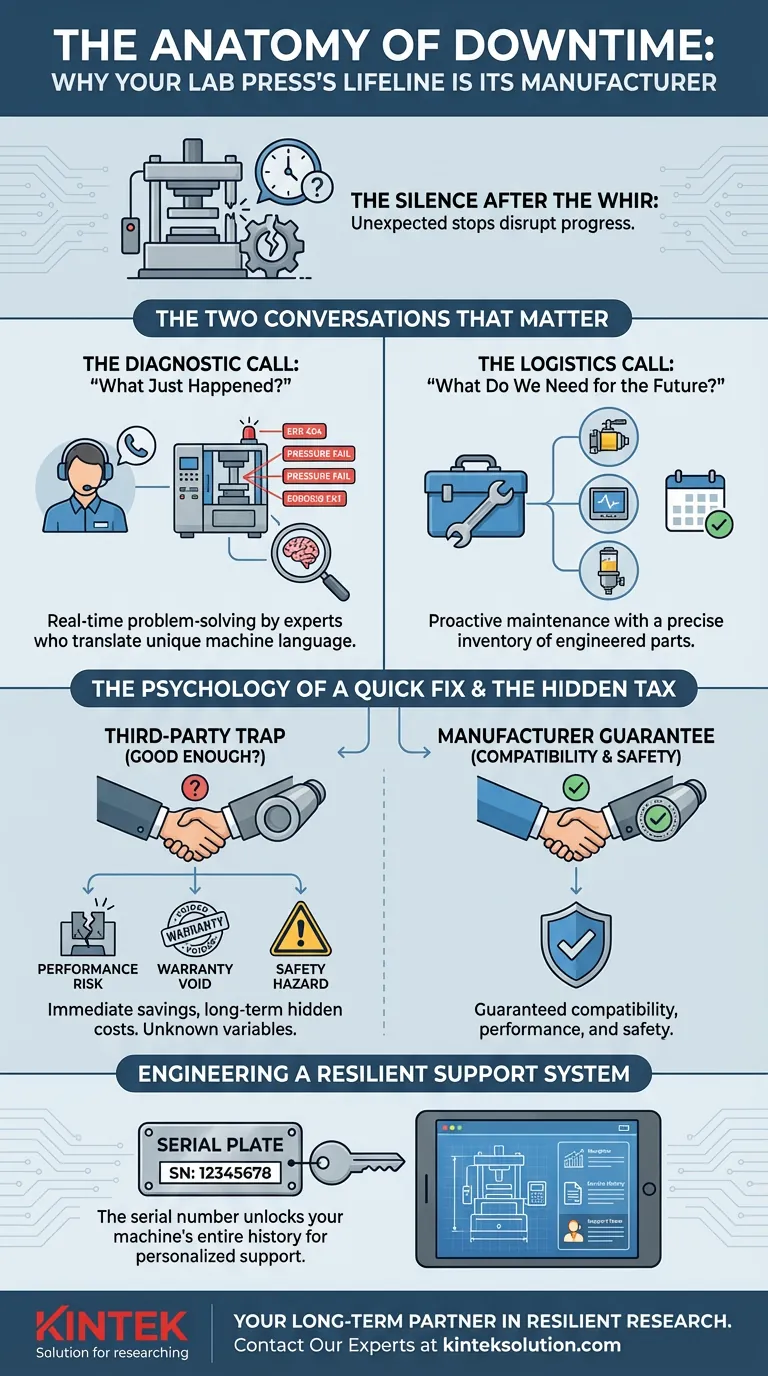
The Diagnostic Call: "What Just Happened?"
This is the emergency call. Something has gone wrong, and you need to understand the why and how. An experienced support technician from the manufacturer doesn't just follow a script; they understand the machine's unique language.
They translate the cryptic error codes, interpret the sounds it made before failing, and diagnose the issue with a precision born from seeing hundreds of similar cases. This is a partnership in real-time problem-solving.
The Logistics Call: "What Do We Need for the Future?"
This conversation is about foresight. Components in a high-pressure system experience wear. It is a physical certainty. Sourcing spare parts isn't just a reactive task; it's proactive maintenance.
Your manufacturer maintains a precise inventory of parts engineered for your specific machine. This includes:
- Hydraulic System Components: Seals, pumps, and valves designed for the exact pressure and fluid specifications.
- Control Panel Elements: Screens, buttons, and boards with the correct firmware.
- Lubrication Devices: Components critical to reducing friction and preventing premature wear.
This conversation ensures the long-term integrity of your equipment.
The Psychology of a Quick Fix
In the face of downtime, the temptation for a quick, cheap fix is immense. Sourcing a seemingly identical part from a third-party supplier can feel like a savvy shortcut. This is a common cognitive trap.
Our minds often prioritize immediate, visible costs (the price of the part) over abstract, future risks (cascading failure, safety hazards).
The Allure of "Good Enough"
A non-genuine part might look the same. It might even fit. But a laboratory press is a system of extreme forces and fine tolerances. A component made with a slightly different alloy, a seal with a lower durometer rating, or a sensor with a wider margin of error is not "good enough." It is an unknown variable introduced into a finely tuned equation.
The Hidden Tax of Incompatibility
The true cost of an unofficial part is paid later, and it's always higher than the initial savings.
| Risk Category | Consequence |
|---|---|
| Performance | Incorrect specifications lead to subpar results, equipment damage, or complete system failure. |
| Warranty | The use of non-authorized parts almost universally voids the manufacturer's warranty. |
| Safety | In a high-pressure environment, component failure can be a significant safety hazard for operators. |
The original manufacturer's part isn't just a piece of metal; it's a guarantee of compatibility, performance, and safety.
Engineering a Resilient Support System
The best manufacturers understand that their responsibility doesn't end when the machine leaves the factory. They build a support infrastructure that is as robust as the equipment itself.
This begins with a simple, powerful piece of data: the serial number.
That number, stamped on a small metal plate, is the key. It unlocks your machine's entire history—its specific bill of materials, its configuration, and its service record. When you provide it to a support team, you aren't just identifying a model; you're referencing a unique individual.
At KINTEK, we view our lab presses—whether they are our automatic, isostatic, or heated models—as the start of a long-term partnership. Our support system is designed to minimize your downtime and protect your investment by ensuring you have direct access to the people and parts that know your machine best.
True operational resilience comes from knowing who to call and trusting that they understand your equipment as well as you understand your research. To build that partnership for your laboratory, Contact Our Experts.
Visual Guide
Related Products
- 24T 30T 60T Heated Hydraulic Lab Press Machine with Hot Plates for Laboratory
- Manual Heated Hydraulic Lab Press with Integrated Hot Plates Hydraulic Press Machine
- Laboratory Hydraulic Pellet Press for XRF KBR FTIR Lab Press
- Lab Infrared Press Mold for Laboratory Applications
- Laboratory Hydraulic Press Lab Pellet Press Machine for Glove Box
Related Articles
- The Invisible Forge: Why the Laboratory Press is the Soul of Nano-Composites
- The Architecture of Slow: Why Physical Precision Dictates Chemical Destiny
- The Architecture of Density: Why Pressure is the Silent Architect of Solid-State Batteries
- The Physics of Transparency: Why Pressure is the Silent Architect of Spectroscopic Clarity
- The Architecture of Certainty: Why the Laboratory Press is the Anchor of Material Science



















