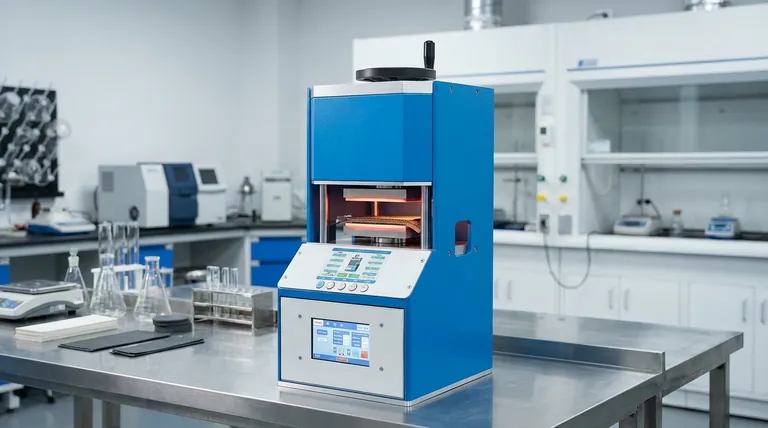
The Unseen Battle in Material Science
Imagine a researcher developing a new polymer composite. The goal is a material that is both lightweight and incredibly strong. Yet, sample after sample fails. One piece delaminates under stress; another has inconsistent density. The raw materials are correct, but the final product is flawed.
This isn't a failure of chemistry. It's a failure of physics.
The core challenge in creating advanced materials isn't just about the ingredients. It's about forcing them to bond under perfect conditions. The real battle is waged against microscopic inconsistencies—tiny pockets of air, uneven temperature gradients, and fluctuating pressure points that ruin an otherwise promising formula. It’s a battle for control.
Orchestrating Chaos: The Principle of Controlled Transformation
A hot press machine is often misunderstood as a simple device that just heats and squeezes. Its true function is far more elegant. It is an instrument for orchestrating the simultaneous application of thermal and mechanical energy.
Heat makes a material pliable, lowering its resistance to change. Pressure provides the directive, forcing molecules to realign, bond, or cure. Applied together, with extreme precision, they transform a material's fundamental structure without breaking it.
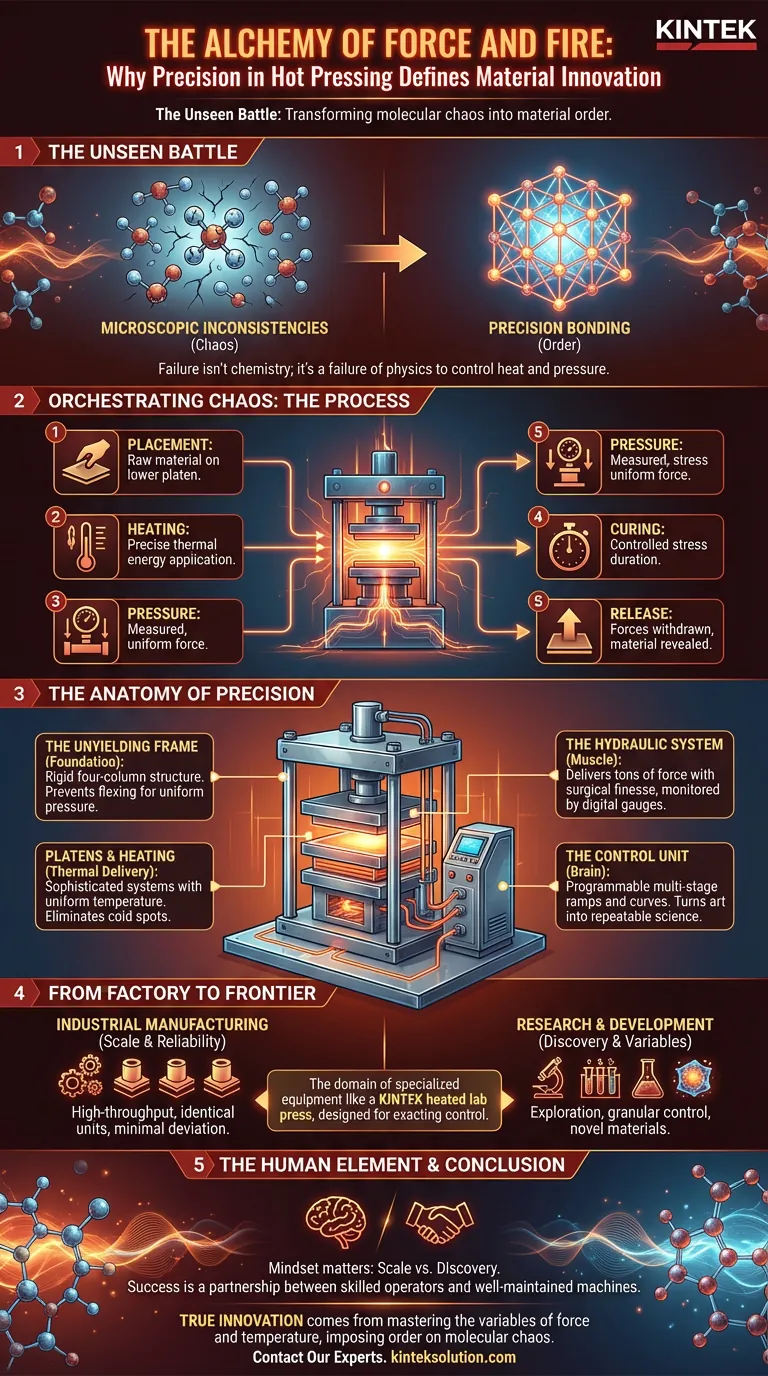
This process is a carefully choreographed sequence:
- Placement: The raw material is positioned on the lower platen.
- Heating: The platens reach a precise, pre-programmed temperature.
- Pressure: A hydraulic system applies a measured, uniform force.
- Curing: The material is held in this state of controlled stress for a specific duration.
- Release: The forces are withdrawn, and the newly formed material is revealed.
Each step is a controlled variable in an equation that defines the final outcome.
The Anatomy of Precision
The ability to achieve this orchestration is not accidental; it is engineered into the machine's very core. Several key systems work in unison to guarantee a repeatable, uniform result.
The Unyielding Frame: A Foundation for Force
Most high-precision presses are built on a rigid four-column, three-plate structure. Its purpose is singular: to withstand immense force without flexing. Any distortion in the frame would lead to uneven pressure on the workpiece, compromising the entire process. This stoic foundation is the bedrock of consistency.
The Heart of the Matter: Platens and Heating
The platens are where the transformation happens. They are not just hot plates; they are sophisticated thermal delivery systems. Advanced models use technologies like pulse heating and titanium indenters to ensure absolute temperature uniformity across every square millimeter. A single cold spot can be the origin point of a catastrophic failure in the final material.
The Gentle Giant: The Hydraulic System
Delivering tons of force is easy. Delivering it with the finesse of a surgeon is the challenge. The hydraulic system is the muscle, but it is controlled with incredible precision. Monitored by digital gauges, it applies and maintains pressure without shock or fluctuation, ensuring the material is coerced, not crushed.
The Conductor: The Control Unit
If the frame is the foundation and the hydraulics are the muscle, the electronic control unit is the brain. This is where a scientist's hypothesis becomes a repeatable physical process. It allows for programming multi-stage temperature ramps and precise pressure curves, turning the art of material creation into a science.
From the Factory Floor to the Frontier of Discovery
The need for this technology spans industries, but the type of precision required changes with the goal.
- Industrial Manufacturing: In producing plywood or particle board, the goal is high-throughput and reliability. Precision means creating millions of identical units with minimal deviation.
- Research & Development: In a laboratory, the goal is exploration. Scientists aren't trying to make a thousand of the same thing; they are trying to discover the one perfect combination of parameters for a novel material.
This is where the distinction becomes critical. For researchers pushing the boundaries of what's possible, the demands on the machine are immense. Success hinges on granular control over every variable. This is the domain of specialized equipment like a KINTEK heated lab press, which is specifically designed for the exacting control and repeatability that scientific discovery demands.
The Human Element: Mindset and Mastery
Choosing and using a hot press involves navigating key trade-offs, which are as much about psychology as they are about engineering.
- Scale vs. Discovery: The mindset of a production manager is focused on yield and uptime. The mindset of a researcher is focused on variables and hypotheses. The right tool depends entirely on which mindset you are serving.
- Complexity as a Partnership: These are sophisticated machines. They demand respect, requiring skilled operators and strict maintenance. Success is a partnership between a knowledgeable user and a well-maintained instrument.
- Knowing Your Limits: Wisdom lies in understanding that not all materials can be tamed by heat and pressure. The process is powerful, but not universal.
Key Considerations at a Glance
| Aspect | Description |
|---|---|
| Primary Function | Applies controlled heat and pressure to bond, shape, cure, or sinter materials. |
| Key Components | Frame/platens, heating system, pressure mechanism, control unit. |
| Core Benefit | Achieves high-quality, uniform results through precise process control. |
| Primary Trade-off | The deep precision required for R&D vs. the high throughput needed for industry. |
Ultimately, true innovation in materials science comes from mastering the variables of force and temperature. A hot press isn't just a machine; it's an instrument for imposing order on molecular chaos. For researchers and engineers dedicated to this mastery, having the right instrument is the critical first step. If you're ready to bring this level of precision to your lab, Contact Our Experts.
Visual Guide
Related Products
- 24T 30T 60T Heated Hydraulic Lab Press Machine with Hot Plates for Laboratory
- Manual Heated Hydraulic Lab Press with Integrated Hot Plates Hydraulic Press Machine
- Automatic High Temperature Heated Hydraulic Press Machine with Heated Plates for Lab
- Automatic Heated Hydraulic Press Machine with Hot Plates for Laboratory
- Heated Hydraulic Press Machine with Heated Plates for Vacuum Box Laboratory Hot Press
Related Articles
- The Invisible Forge: Why the Laboratory Press is the Soul of Nano-Composites
- The Architecture of Slow: Why Physical Precision Dictates Chemical Destiny
- The Architecture of Density: Why Pressure is the Silent Architect of Solid-State Batteries
- The Physics of Transparency: Why Pressure is the Silent Architect of Spectroscopic Clarity
- The Architecture of Certainty: Why the Laboratory Press is the Anchor of Material Science



















