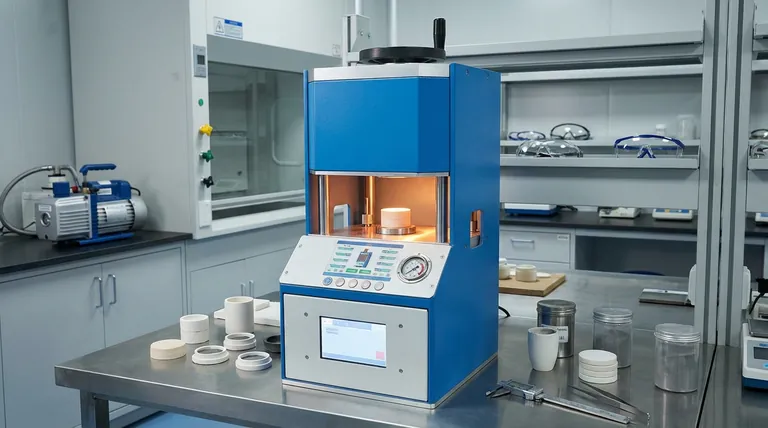
The Invisible Enemy in Every Material
At the heart of every high-performance material—from a ceramic turbine blade to a composite armor plate—lies a hidden struggle. It’s a battle against an invisible enemy: empty space.
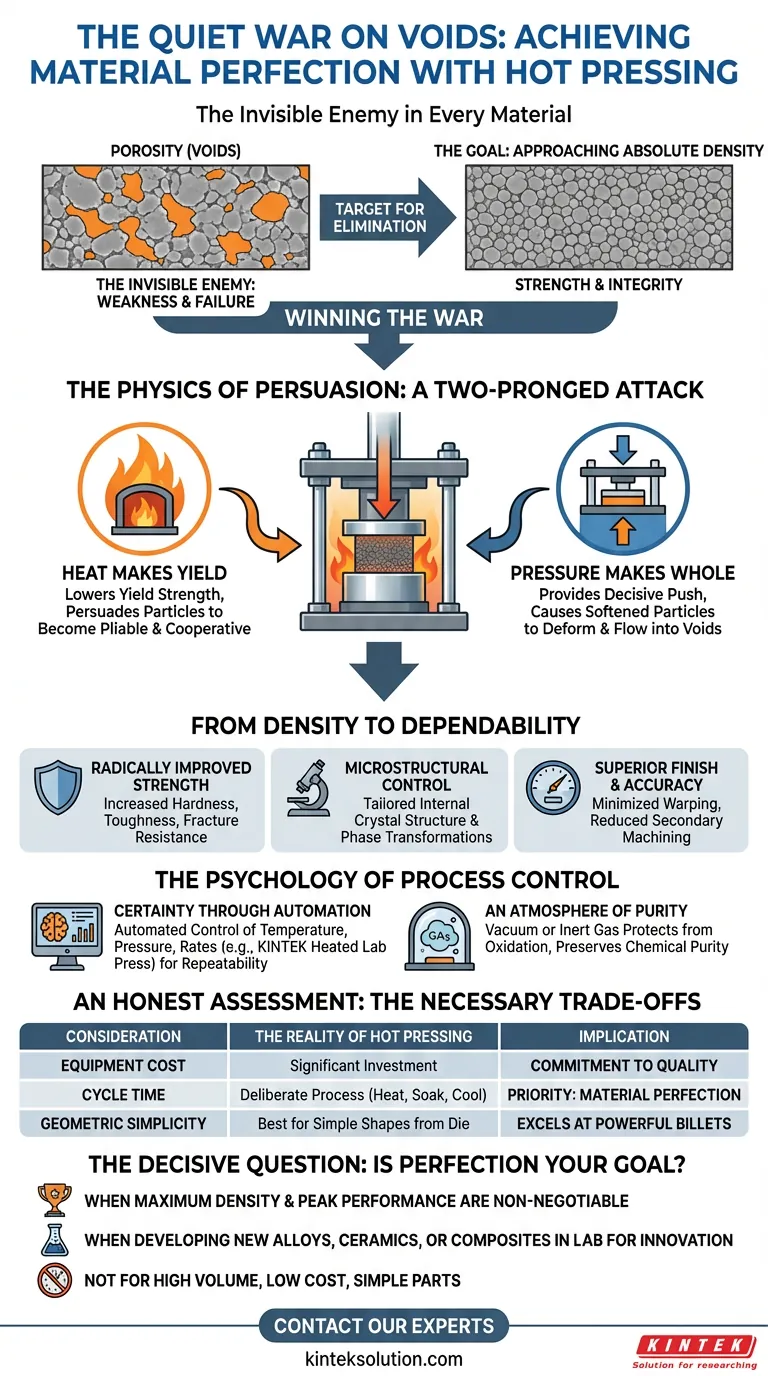
This space, known as porosity, consists of microscopic voids between material particles. To the naked eye, a component may look solid. But at a microscopic level, these gaps are the starting points for fracture, the pathways for corrosion, and the fundamental source of weakness.
Engineering advanced materials isn't just about choosing the right elements. It's about winning the war against these voids.
The Physics of Persuasion: A Two-Pronged Attack
Most manufacturing processes try to solve this problem with brute force or heat alone. Hot pressing employs a more elegant strategy: it uses heat and pressure simultaneously.
This isn't just a matter of efficiency. It's a synergistic attack that fundamentally changes how the material behaves.
Heat Makes Yield, Pressure Makes Whole
Heat lowers a material's yield strength. It persuades the rigid, stubborn particles to become pliable and cooperative.
While the material is in this receptive state, pressure is applied. This force doesn't just compact the powder; it provides the final, decisive push, causing the softened particles to deform and flow into the voids, eliminating them completely. This is a level of consolidation that sequential processes can rarely match.
The Goal: Approaching Absolute Density
The result of this synergy is a material with incredibly high density, often approaching 100% of its theoretical maximum.
This isn't just a number on a spec sheet. It's a measure of integrity. A fully dense part is a predictable part. It's a component where the properties of the material itself, not the flaws from its processing, dictate its performance.
From Density to Dependability
Achieving high density is the cause. Enhanced performance is the effect. By winning the war on voids, hot pressing unlocks a cascade of mechanical improvements.
- Radically Improved Strength: With no voids to act as stress concentrators, the material's hardness, toughness, and fracture resistance increase dramatically.
- Microstructural Control: The process allows engineers to control not just density but also the material's internal crystal structure, facilitating beneficial phase transformations that can be tailored for specific applications.
- Superior Finish and Accuracy: Because pressure is applied uniformly within a rigid die, the process minimizes the warping and distortion common in other high-temperature methods, often reducing the need for costly secondary machining.
The Psychology of Process Control
In high-stakes fields like aerospace, defense, and medical implants, success depends on repeatability. The fear of a single, unpredictable failure drives an obsession with process control. Hot pressing addresses this psychological need for certainty.
Certainty Through Automation
Modern systems, like the KINTEK heated lab press, offer meticulous, automated control over every critical variable—temperature, pressure, and their application rates. This removes variability, ensuring that the 100th part is identical to the first. It transforms manufacturing from an art into a science.
An Atmosphere of Purity
Many advanced materials are vulnerable to oxidation at high temperatures. Hot pressing is often performed in a vacuum or an inert gas environment, creating a sanctuary that protects the material from atmospheric corruption. This ensures the chemical purity and intrinsic properties of the material are preserved.
An Honest Assessment: The Necessary Trade-offs
No single process is a universal solution. The discipline of hot pressing requires acknowledging its specific trade-offs.
| Consideration | The Reality of Hot Pressing |
|---|---|
| Equipment Cost | The required machinery is a significant investment, reflecting its precision and capability. It is a commitment to quality over commodity. |
| Cycle Time | The process is deliberate. Heating, soaking, and cooling within a single cycle takes time. It prioritizes material perfection over mass-production speed. |
| Geometric Simplicity | Hot pressing is best suited for geometries that can be ejected from a die. It excels at creating powerful billets and simple shapes, not complex, net-shape parts. |
The Decisive Question: Is Perfection Your Goal?
The choice to use hot pressing is a choice about priorities.
- When achieving maximum density and peak mechanical performance is non-negotiable, hot pressing is often the superior method.
- When you are developing new alloys, advanced ceramics, or composites in a laboratory setting, the control offered by this process is essential for true innovation.
- When your primary constraints are high volume and low cost for a simple part, other methods might be more suitable.
For researchers and engineers pushing the boundaries of what's possible, the precision and capability of a laboratory hot press are not just tools, but extensions of their ambition. They allow material properties to be dictated by design, not limited by process.
If your work demands the highest levels of density, strength, and process control, exploring this technology is the logical next step. Contact Our Experts
Visual Guide
Related Products
- Automatic High Temperature Heated Hydraulic Press Machine with Heated Plates for Lab
- Heated Hydraulic Press Machine with Heated Plates for Vacuum Box Laboratory Hot Press
- Automatic Heated Hydraulic Press Machine with Hot Plates for Laboratory
- Heated Hydraulic Press Machine With Heated Plates For Vacuum Box Laboratory Hot Press
- Laboratory Manual Heated Hydraulic Press Machine with Hot Plates
Related Articles
- The Architecture of Slow: Why Physical Precision Dictates Chemical Destiny
- The Architecture of Certainty: Why the Laboratory Press is the Anchor of Material Science
- The Vanishing Boundary: The Hidden Thermodynamics of LTCC Lamination
- The Alchemy of 160°C: Why Precision Pressing is the Silent Backbone of Rubber Science
- The Invisible Forge: Why the Laboratory Press is the Soul of Nano-Composites



















