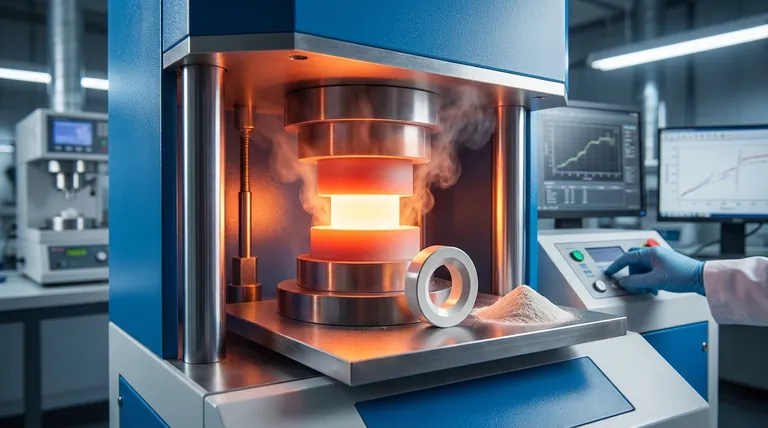
The Hidden Enemy in Advanced Materials
Imagine a team of engineers designing a critical automotive component from an advanced ceramic. The material itself is a marvel of science—incredibly hard, wear-resistant, and stable at high temperatures. Yet, after manufacturing, a significant percentage of the parts fail under stress testing.
The culprit is not a design flaw. It's invisible. Microscopic voids, tiny pockets of nothingness left deep within the material, act as stress concentrators. Under load, these voids become the starting points for catastrophic cracks.
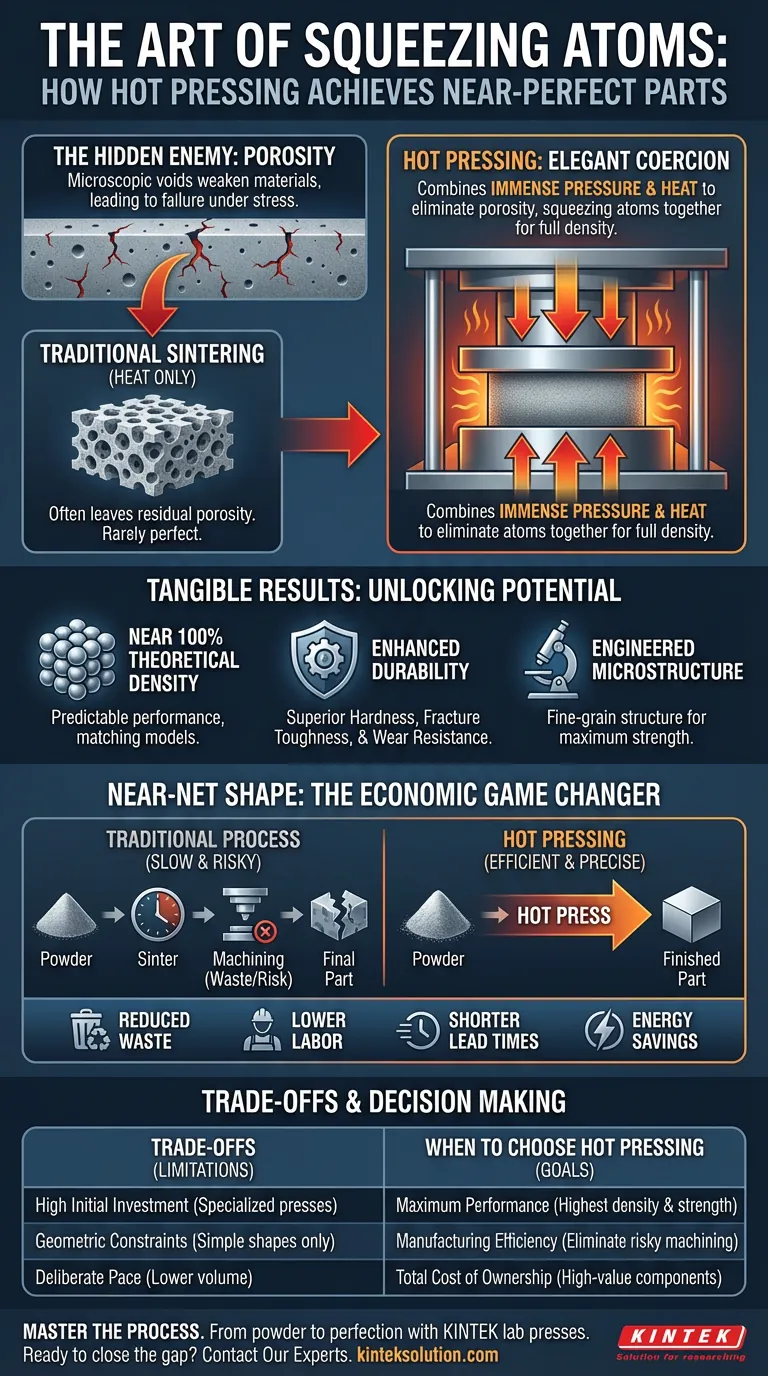
This is the central challenge of powder metallurgy and ceramics: the material's potential is only as good as the process used to consolidate it. Traditional sintering, which uses heat alone, coaxes powder particles to bond, but it often leaves behind residual porosity. It’s a process of persuasion, and it's rarely perfect.
An Elegant Solution: Combining Persuasion with Force
Direct hot pressing is a fundamentally different philosophy. Instead of just persuading particles to bond with heat, it applies immense, uniform pressure at the same time.
It’s an act of elegant coercion.
The heat lowers the material's yield strength, making the particles malleable. The pressure then physically forces them together, closing the gaps and promoting diffusion bonding at an atomic level. This simultaneous action doesn't just reduce porosity; it actively eliminates it.
The process transforms a loose powder into a fully dense, monolithic solid in a single, highly controlled step.
The Tangible Results of Full Density
Achieving near-perfect density is the foundation for a cascade of performance improvements. When you remove the empty space, you unlock the material's true potential.
1. Approaching Theoretical Perfection
The primary benefit of hot pressing is its ability to produce components with near 100% of their theoretical density. This isn't an incremental improvement; it's a transformative one. A fully dense part behaves predictably and reliably, matching the performance predicted by material science models.
2. From Density to Durability
Porosity undermines strength. By eliminating voids, hot pressing dramatically enhances key mechanical properties:
- Hardness: A denser surface is more resistant to scratching and abrasion.
- Fracture Toughness: The absence of internal stress points makes the material far less susceptible to cracking.
- Wear Resistance: Superior hardness and toughness result in components that last longer in demanding applications.
3. Engineering the Microstructure
The process offers precise control over the material’s final grain structure. The combination of high pressure and rapid heating rates can suppress unwanted grain growth. This results in a fine-grained microstructure, which is a key factor in maximizing strength and toughness in many ceramics and metals.
The Psychology of "Finished": Why Near-Net Shape Changes Everything
Perhaps the most significant economic and psychological benefit of hot pressing is its ability to produce near-net shape parts.
This means the component emerges from the press so close to its final dimensions that it requires little to no subsequent machining. For hard-to-machine materials like technical ceramics or refractory metals, this is a revolutionary advantage.
Escaping the Tyranny of Post-Processing
Machining a nearly finished, high-value ceramic part is a high-stakes, nerve-wracking process. It’s slow, requires expensive diamond tooling, and carries the constant risk of inducing a micro-crack that scraps the entire component.
Hot pressing sidesteps this risk. It replaces a complex, multi-stage workflow with a single, predictable operation. It shifts the mindset from "making a blank to be finished later" to "making the finished part now."
The Economics of a Single Step
By integrating consolidation and shaping, the manufacturing workflow becomes radically more efficient.
- Reduced Waste: Less material is machined away.
- Lower Labor Costs: The need for highly skilled machinists is minimized.
- Shorter Lead Times: Eliminating entire steps in the production chain accelerates delivery.
- Energy Savings: Combining heating and forming is often more energy-efficient than long, separate furnace cycles.
An Honest Look at the Trade-Offs
No technology is a universal solution. The power of hot pressing comes with a clear set of limitations.
- High Initial Investment: The specialized presses and robust tooling needed to handle extreme temperatures and pressures represent a significant capital cost.
- Geometric Constraints: The process is ideal for shapes that can be ejected from a rigid die. It is not suitable for parts with complex internal cavities or undercuts.
- Deliberate Pace: Cycle times are typically longer than for high-volume methods like injection molding, making it best suited for high-value components rather than mass-market parts.
Making the Right Decision
Choosing hot pressing means aligning its unique strengths with your primary goal.
| Your Primary Goal | Why Hot Pressing is the Answer |
|---|---|
| Maximum Performance | To achieve the highest possible density, strength, and durability for mission-critical applications. |
| Manufacturing Efficiency | To create precise parts from hard materials while eliminating costly, risky secondary machining. |
| Total Cost of Ownership | For high-value components where the savings from reduced waste and processing steps outweigh the initial tooling costs. |
Mastering the process—from powder to a perfect, finished part—begins with understanding and controlling these variables at a smaller scale. For researchers and product developers, a laboratory press is the essential tool for validating materials and perfecting parameters before scaling up. KINTEK's specialized heated lab presses provide the precision and power needed to turn theoretical benefits into tangible, high-performance components.
If you are ready to close the gap between powder and perfection, Contact Our Experts.
Visual Guide
Related Products
- Automatic High Temperature Heated Hydraulic Press Machine with Heated Plates for Lab
- Heated Hydraulic Press Machine with Heated Plates for Vacuum Box Laboratory Hot Press
- Automatic Heated Hydraulic Press Machine with Hot Plates for Laboratory
- Heated Hydraulic Press Machine With Heated Plates For Vacuum Box Laboratory Hot Press
- Laboratory Manual Heated Hydraulic Press Machine with Hot Plates
Related Articles
- The Architecture of Slow: Why Physical Precision Dictates Chemical Destiny
- The Architecture of Certainty: Why the Laboratory Press is the Anchor of Material Science
- The Vanishing Boundary: The Hidden Thermodynamics of LTCC Lamination
- The Alchemy of 160°C: Why Precision Pressing is the Silent Backbone of Rubber Science
- The Invisible Forge: Why the Laboratory Press is the Soul of Nano-Composites



















