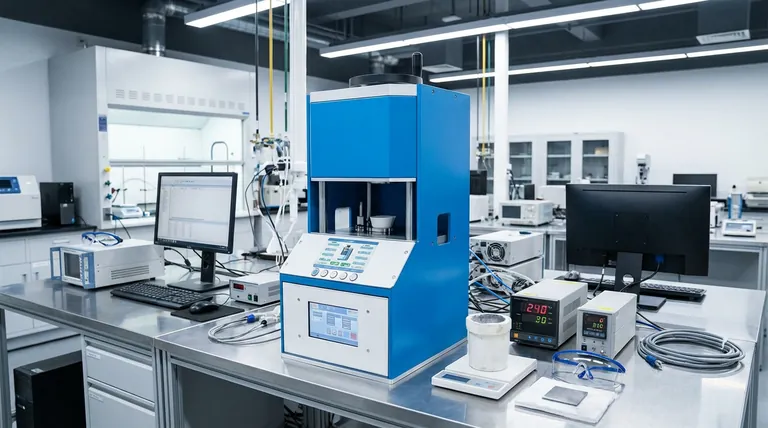
The Engineer's Dilemma: Potential vs. Reality
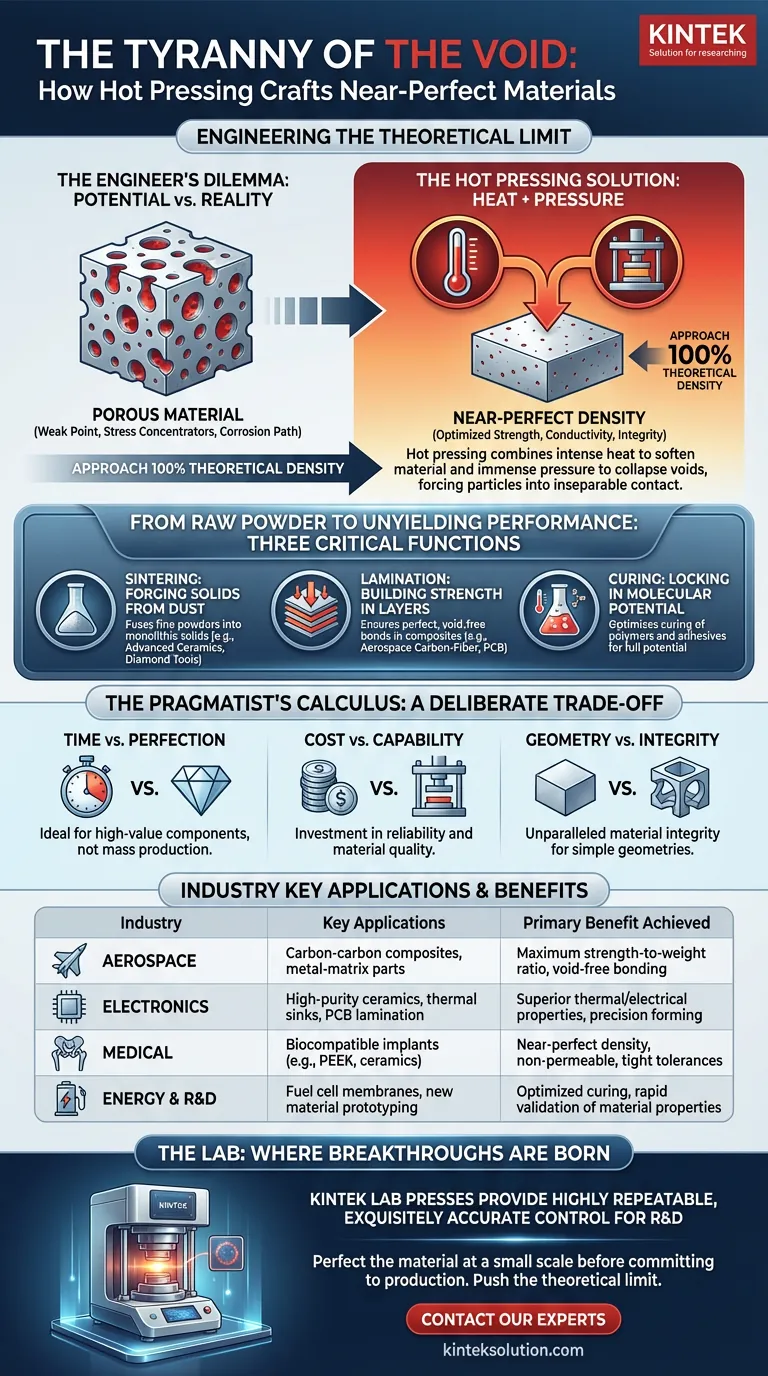
Every material has a theoretical limit—a perfect state of strength, conductivity, or hardness defined by its atomic structure. Yet, the materials we use in the real world rarely reach this potential.
The culprit is often invisible: empty space.
Porosity, the presence of microscopic voids, acts as the material's built-in weak point. These tiny gaps become stress concentrators, pathways for corrosion, and barriers to thermal and electrical flow. For an engineer, this gap between a material's promise and its performance is a constant battle.
Hot pressing is the definitive weapon in this war. It is not merely a shaping process; it's a method of fundamentally re-engineering a material to force it toward its theoretical best self.
The First Principles of Material Integrity
Hot pressing operates on a simple but powerful premise: combine intense heat with immense pressure. This combination achieves what neither can do alone.
The Uncompromising Combination
Heat makes a material pliable. It softens the constituent particles, whether they are ceramic powders or composite layers, allowing them to deform and flow.
Pressure does the rest. It relentlessly compacts the material, squeezing out the air and collapsing the voids, forcing particles into intimate, inseparable contact.
The War on Porosity
The ultimate goal is to approach 100% of the material's theoretical density. By eliminating empty space, you eliminate the starting points for fracture and failure.
This creates components that aren't just shaped correctly but are intrinsically superior. The structural integrity of a turbine blade, the biocompatibility of a medical implant, or the thermal efficiency of a heat sink all depend on this foundational density.
From Raw Powder to Unyielding Performance
Hot pressing is a versatile technique that performs several distinct functions, each aimed at achieving a new level of material performance across critical industries.
Sintering: Forging Solids from Dust
This is the most fundamental application, where fine powders are fused into a monolithic solid. Heat and pressure dramatically accelerate the sintering process, creating dense, high-performance parts from materials that are difficult to process otherwise.
- Advanced Ceramics: For electronics and armor, where hardness and electrical properties are paramount.
- Diamond Tools: Where diamond grit is locked into a metal matrix, creating a new, unified material far stronger than its parts.
- Powder Metallurgy: For creating novel alloys and components with unique properties.
Lamination: Building Strength in Layers
In composite manufacturing, the bond between layers is just as important as the layers themselves. Hot pressing ensures a perfect, void-free bond.
The pressure guarantees intimate contact while the heat cures the matrix or adhesive, creating a single, integrated structure. This is non-negotiable in aerospace for carbon-fiber components and in electronics for multi-layer circuit boards.
Curing: Locking in Molecular Potential
For advanced thermosetting polymers and adhesives, the hot press is more than a press—it's a reactor. It provides the precisely controlled thermal and pressure environment needed to optimize a chemical curing reaction, ensuring the final material achieves its full design potential.
The Pragmatist's Calculus: A Deliberate Trade-Off
Hot pressing is powerful, but it is not universal. Its adoption is a deliberate choice, an acknowledgment that performance sometimes outweighs speed and cost.
- Time vs. Perfection: It is a batch process, often with long cycle times. This makes it ideal for high-value components where failure is not an option, not for mass-produced goods.
- Cost vs. Capability: The equipment required to safely manage extreme temperatures and pressures is complex and expensive. The investment is in reliability and material quality.
- Geometry vs. Integrity: The process is best suited for parts with relatively simple geometries. While 3D printing offers geometric freedom, hot pressing offers unparalleled material integrity. The choice depends on which factor is more critical to your design.
The decision to use hot pressing is a strategic one, made when the intrinsic quality of the material itself is the most important variable.
| Industry | Key Applications | Primary Benefit Achieved |
|---|---|---|
| Aerospace | Carbon-carbon composites, metal-matrix parts | Maximum strength-to-weight ratio, void-free bonding |
| Electronics | High-purity ceramics, thermal sinks, PCB lamination | Superior thermal/electrical properties, precision forming |
| Medical | Biocompatible implants (e.g., PEEK, ceramics) | Near-perfect density, non-permeable, tight tolerances |
| Energy & R&D | Fuel cell membranes, new material prototyping | Optimized curing, rapid validation of material properties |
The Lab: Where Breakthroughs Are Born
Before a new composite finds its way onto a jet wing or a new ceramic is used in a satellite, it begins its life as a small sample in a laboratory. This is where the foundational work of materials science happens, and it demands equipment built for precision and discovery.
This is the role of a dedicated lab press. Systems like KINTEK's heated and automatic lab presses are not just smaller industrial machines; they are instruments. They provide the highly repeatable, exquisitely accurate control over temperature, pressure, and time that researchers need to test a hypothesis, validate a new formulation, and de-risk innovation. They make it possible to perfect the material at a small scale before committing to large-scale production.
When your work depends on pushing a material to its absolute theoretical limit, the essential first step is proving it's possible. To explore that frontier in your own research and development, Contact Our Experts.
Visual Guide
Related Products
- Automatic High Temperature Heated Hydraulic Press Machine with Heated Plates for Lab
- Heated Hydraulic Press Machine with Heated Plates for Vacuum Box Laboratory Hot Press
- Automatic Heated Hydraulic Press Machine with Hot Plates for Laboratory
- Heated Hydraulic Press Machine With Heated Plates For Vacuum Box Laboratory Hot Press
- Laboratory Split Manual Heated Hydraulic Press Machine with Hot Plates
Related Articles
- The Architecture of Slow: Why Physical Precision Dictates Chemical Destiny
- The Architecture of Certainty: Why the Laboratory Press is the Anchor of Material Science
- The Vanishing Boundary: The Hidden Thermodynamics of LTCC Lamination
- The Alchemy of 160°C: Why Precision Pressing is the Silent Backbone of Rubber Science
- The Invisible Forge: Why the Laboratory Press is the Soul of Nano-Composites



















