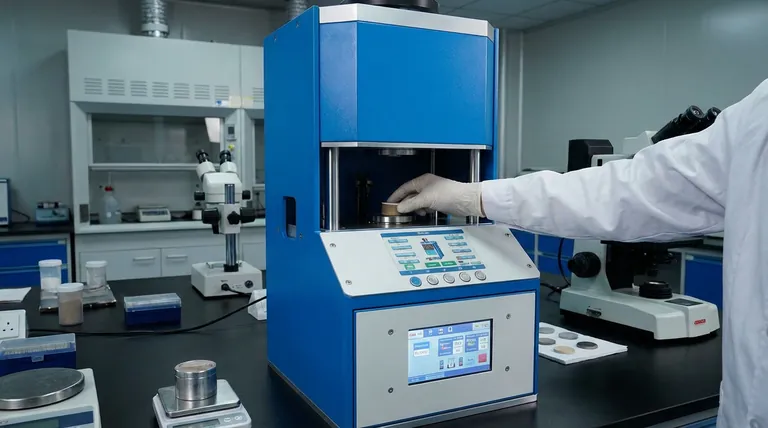
The Engineer's Gambit: A Quest for Perfect Density
An aerospace engineer holds a design for a turbine blade. It must survive temperatures that would melt steel, yet be impossibly light. Across the campus, a materials scientist prepares a sample for an X-ray diffractometer. The analysis could unlock a new battery technology, but only if the sample is perfectly uniform, free of the voids and inconsistencies that create false signals.
Both are chasing a form of perfection. Both are limited by the fundamental nature of their materials.
At the heart of their challenge is a question of structure. Not the visible, macro structure, but the hidden, microscopic architecture of the material—the arrangement of grains, the presence of pores, the quality of the bond between particles. This is where failure begins, and where performance is born. To control this inner world, they need more than just brute force. They need a tool of persuasion.
Beyond Heat and Pressure
A laboratory hot press is often misunderstood as a simple combination of a heater and a hydraulic clamp. This is like calling a scalpel just a sharp piece of metal. The true function of a hot press is not to crush, but to convince. It coaxes individual particles of a powder to surrender their boundaries and merge into a single, dense, monolithic solid.
It applies heat to excite atoms and make them more mobile. It applies pressure to eliminate the spaces between them. By precisely controlling the temperature, pressure, and timing, a researcher is orchestrating a transformation at the atomic level.
From Dust to Density: The Art of Sintering
Sintering is the primary work of a hot press. Imagine trying to build a solid wall from a pile of fine sand. A hot press achieves this without melting the sand. For advanced ceramics or refractory metals like tungsten, which have melting points in the thousands of degrees, melting isn't a viable option.
Instead, the press creates components with near-total density directly from powder. This process is fundamental for creating:
- Ultra-hard ceramics (boron carbide, silicon nitride) for cutting tools and armor.
- Transparent ceramics for high-performance lenses and optical windows.
- High-strength metal alloys for demanding aerospace applications.
The goal is to create a final part so dense and uniform it behaves as if it were never a powder to begin with.
Catalyzing Bonds: Curing and Adhesion
The same principles of controlled energy can be used to initiate chemical reactions. In the world of polymers and composites, a hot press acts as a catalyst for creating strength.
It cures thermosetting resins, transforming them from a liquid into a hard, durable solid. It vulcanizes rubber. It activates adhesives to bond layers of different materials into a laminate, creating composites that are stronger and lighter than their individual parts. The uniform application of heat and pressure ensures this bond is flawless and free of weak points.
The Pursuit of Certainty: Crafting the Perfect Sample
In an analytical lab, uncertainty is the enemy. A poorly prepared sample can invalidate an entire experiment, wasting time and resources. Techniques like X-Ray Fluorescence (XRF) and Scanning Electron Microscopy (SEM) are highly sensitive to sample density, surface finish, and homogeneity.
A hot press removes these variables. It transforms loose powder into a standardized, mirror-smooth pellet with a known density. This act of preparation is not a chore; it is the foundation of reliable data and, by extension, of scientific discovery itself.
Where Microstructure Defines Success
The ability to dictate the internal structure of a material makes the lab hot press an indispensable tool across industries where performance is non-negotiable.
| Field | Primary Objective | Key Outcomes |
|---|---|---|
| Materials Science | Develop novel materials with exceptional properties | Transparent armor, ultra-hard tools, new composites |
| Aerospace/Defense | Consolidate high-temperature superalloys | High-strength, heat-resistant components |
| Analytical Labs | Ensure sample uniformity and repeatability | Accurate, reliable data for XRF, XRD, SEM |
| Energy & Electronics | Fabricate dense components for new devices | Improved solid-state batteries, fuel cells, thermoelectrics |
The Researcher's Dilemma: A Dialogue with a Machine
Using a hot press is a process of discovery, filled with its own psychological challenges. Success is not guaranteed by the press of a button.
-
The Parameter Maze: Finding the perfect recipe—the exact temperature ramp rate, the precise pressure curve, the optimal hold time—is an iterative journey. It is a dialogue between the researcher's hypothesis and the material's response. Each experiment reveals a piece of the puzzle.
-
Patience and Precision: The process is not designed for mass production. It is designed for meticulous R&D and small-batch production, where the integrity of one component is more important than the quantity. It trades speed for perfection.
-
Knowing Your Material: The hot press is powerful, but it cannot change the intrinsic nature of a substance. The researcher must understand the material's temperament—how it behaves under stress and heat—to guide it toward the desired state.
Achieving this level of microstructural control isn't just about theory; it requires an instrument capable of translating ambition into reality. The precision, reliability, and control of the lab press are paramount. KINTEK's range of automatic, isostatic, and heated lab presses provides the stability and accuracy researchers need to navigate the complexities of material transformation. These machines are the bridge between a pile of powder and a high-performance, functional reality.
If your work demands the highest levels of material density, strength, and uniformity, exploring the right processing technology is your critical next step. Contact Our Experts
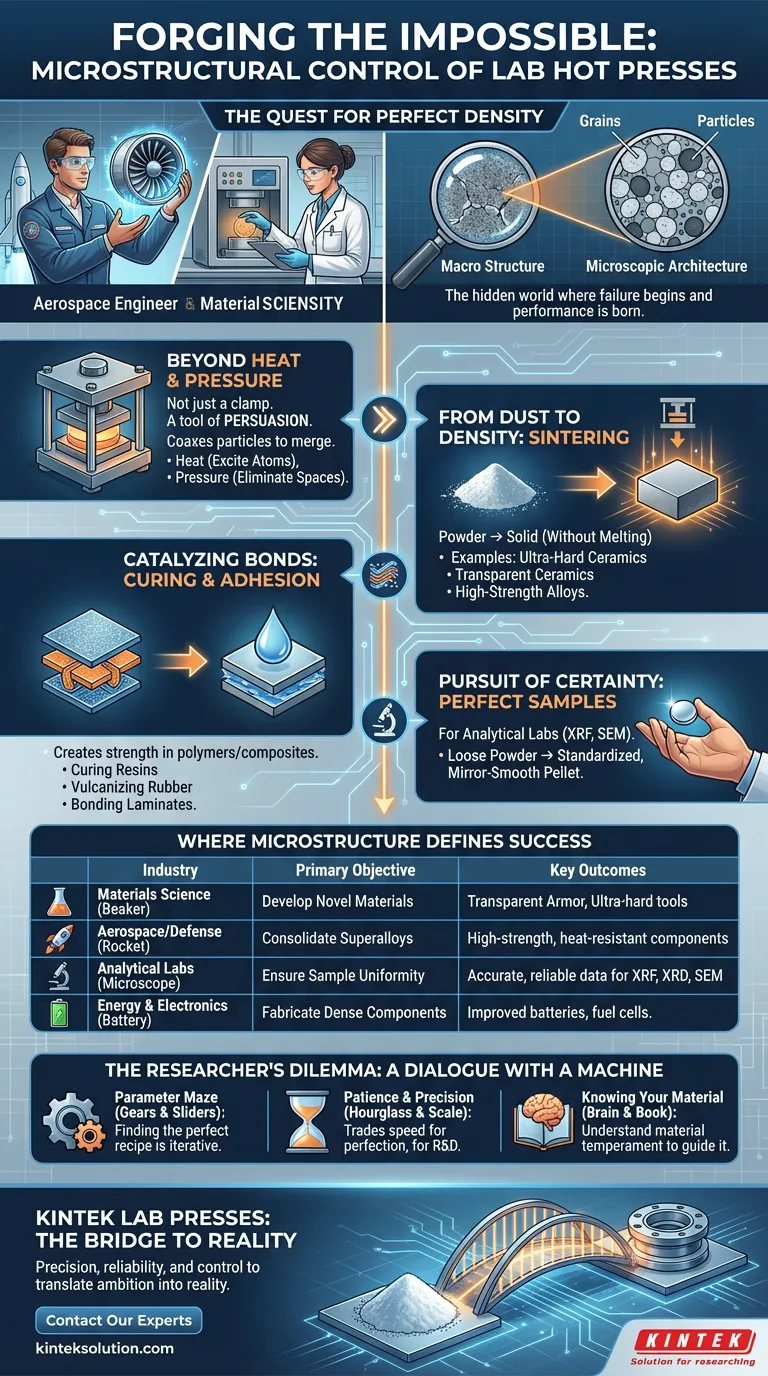
Visual Guide
Related Products
- 24T 30T 60T Heated Hydraulic Lab Press Machine with Hot Plates for Laboratory
- Manual Heated Hydraulic Lab Press with Integrated Hot Plates Hydraulic Press Machine
- Automatic High Temperature Heated Hydraulic Press Machine with Heated Plates for Lab
- Laboratory Split Manual Heated Hydraulic Press Machine with Hot Plates
- Automatic Heated Hydraulic Press Machine with Hot Plates for Laboratory
Related Articles
- The Invisible Forge: Why the Laboratory Press is the Soul of Nano-Composites
- The Architecture of Slow: Why Physical Precision Dictates Chemical Destiny
- The Architecture of Density: Why Pressure is the Silent Architect of Solid-State Batteries
- The Physics of Transparency: Why Pressure is the Silent Architect of Spectroscopic Clarity
- The Architecture of Certainty: Why the Laboratory Press is the Anchor of Material Science



















