
The Allure of the Fixed Schedule
There is a comforting certainty to a calendar. We mark a date for a task—"Annual Service"—and our mind files it away as handled. This approach feels organized, responsible, and efficient.
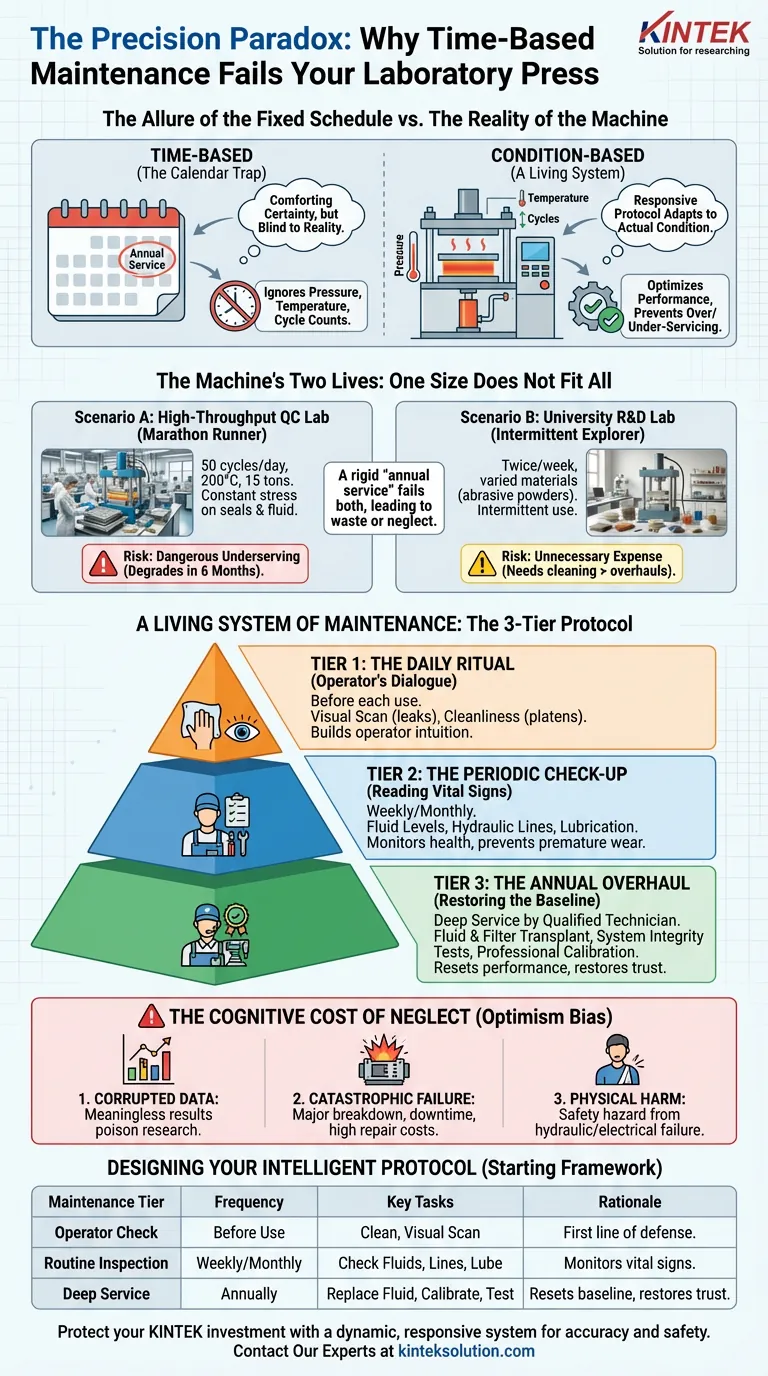
But a laboratory press doesn't know the date. It knows pressure, temperature, and cycle counts. The seductive simplicity of a fixed maintenance schedule is a cognitive trap that ignores the dynamic reality of the machine's life, leading to either wasteful over-servicing or, far worse, catastrophic neglect.
The Machine's Two Lives
To understand why a one-size-fits-all schedule fails, consider two labs operating identical heated lab presses.
Scenario A: The High-Throughput QC Lab Here, the press runs fifty cycles a day, hot-pressing polymer plaques at 200°C and 15 tons of pressure. It’s a workhorse. Seals are constantly expanding and contracting. Hydraulic fluid is perpetually under stress. Every day is a marathon.
Scenario B: The University R&D Lab This press is used twice a week to synthesize novel composites. The work is intermittent but crucial. One week it might run cool isostatic cycles; the next, it could be used with abrasive ceramic powders that create fine, airborne dust.
A rigid "annual service" plan would dangerously underserve the QC lab's press, whose seals and fluid might degrade in six months. Conversely, it might be an unnecessary expense for the R&D press, which may need more frequent cleaning but less frequent hydraulic overhauls. The context of its work, not the passage of time, dictates its needs.
A Living System of Maintenance
The most robust approach is not a schedule, but a system—a responsive protocol with tiers of attention that adapt to the machine's actual condition.
H3: The Daily Ritual: A Dialogue with the Machine
This isn't a chore; it's a five-minute conversation. Before the day's first cycle, the operator becomes the first line of defense.
- Visual Scan: A quick look for hydraulic fluid weeping around fittings. A single drop is a symptom, a signal that a seal is beginning to fatigue under pressure.
- Cleanliness: Wiping down the platens and work area isn't just about housekeeping. It prevents sample contamination and ensures uniform heat transfer—the foundation of repeatable results.
This daily ritual builds an operator's intuition. They learn the machine's normal state, making them acutely aware when something is even slightly amiss.
H3: The Periodic Check-up: Reading the Vital Signs
On a weekly or monthly basis, a trained technician performs a more deliberate inspection, much like a regular health check-up.
- Fluid Levels: Low hydraulic fluid is like low blood pressure; it forces the pump to work harder, risking cavitation and damage. Checking the reservoir is a critical vital sign.
- Hydraulic Lines: Inspecting hoses for bulges or abrasions is preemptive care. A failing hose doesn't just leak; under immense pressure, it can rupture violently.
- Lubrication: Applying grease to guide rods and other moving parts is the simple act that prevents the slow, grinding wear of metal on metal.
H3: The Annual Overhaul: Restoring the Baseline
This is the deep, essential service best performed by a qualified technician. It's not just about fixing things; it's about restoring the machine to its known, reliable baseline.
- Fluid & Filter Transplant: Hydraulic fluid is the lifeblood. Over time, it degrades and accumulates microscopic contaminants. Replacing it annually protects the system's heart—the pump and precision valves.
- System Integrity Tests: Verifying that safety interlocks and emergency stops are functioning isn't just a box-ticking exercise. It's a confirmation of the machine's promise to protect its operator.
- Professional Calibration: For work that demands precision, annual calibration is non-negotiable. It restores trust. It verifies that when the gauge reads "10 tons," the platens are delivering 10 tons. Without this, every piece of data the machine produces is fundamentally suspect.
The Cognitive Cost of Neglect
We often skip these small checks due to a psychological flaw: optimism bias. We think, "It won't fail today." We trade the abstract, long-term risk of a major breakdown for the concrete, short-term gain of saving five minutes.
This thinking leads directly to the three great costs of neglect:
- Corrupted Data: An uncalibrated press produces meaningless results, poisoning research and invalidating quality control.
- Catastrophic Failure: The small leak you ignored becomes a ruptured hose, shutting down operations for days and costing thousands to repair.
- Physical Harm: A failed hydraulic or electrical system is a profound safety hazard, capable of causing serious injury.
Designing Your Intelligent Maintenance Protocol
A reliable, high-performance machine from a manufacturer like KINTEK is an investment in precision. Protecting that investment requires a maintenance protocol tailored to its reality. Use this framework as your starting point.
| Maintenance Tier | Frequency | Key Tasks | Rationale |
|---|---|---|---|
| Operator Check | Before Each Use | Clean platens, visual scan for leaks/damage | First line of defense; builds operator intuition. |
| Routine Inspection | Weekly / Monthly | Check hydraulic lines, fluid levels, lubricate parts | Monitors vital signs; prevents premature wear. |
| Deep Service | Annually | Replace hydraulic fluid/filter, test systems, calibrate | Resets performance baseline; restores trust in data. |
Ultimately, a laboratory press is more than a tool; it's a partner in discovery and quality. Treating its maintenance as a dynamic, responsive system ensures it can perform its role with the accuracy and safety you depend on. To discuss how to implement the best practices for your specific equipment, including automatic, isostatic, or heated lab presses, Contact Our Experts.
Visual Guide
Related Products
- Laboratory Hydraulic Press 2T Lab Pellet Press for KBR FTIR
- Laboratory Hydraulic Press Lab Pellet Press Button Battery Press
- Laboratory Hydraulic Press Lab Pellet Press Machine for Glove Box
- Laboratory Split Manual Heated Hydraulic Press Machine with Hot Plates
- Laboratory Hydraulic Pellet Press for XRF KBR FTIR Lab Press
Related Articles
- The Physics of Transparency: Why Pressure is the Silent Architect of Spectroscopic Clarity
- The Architecture of Density: Why Pressure is the Silent Architect of Solid-State Batteries
- The Architecture of Heat: Why Sample Density Dictates the Truth in Metal Hydride Research
- The Geometry of Electrons: Why Surface Precision is the Silent Partner in SECM Research
- The Geometry of Ionic Flow: Why Precision Pressing Dictates Material Truth



















