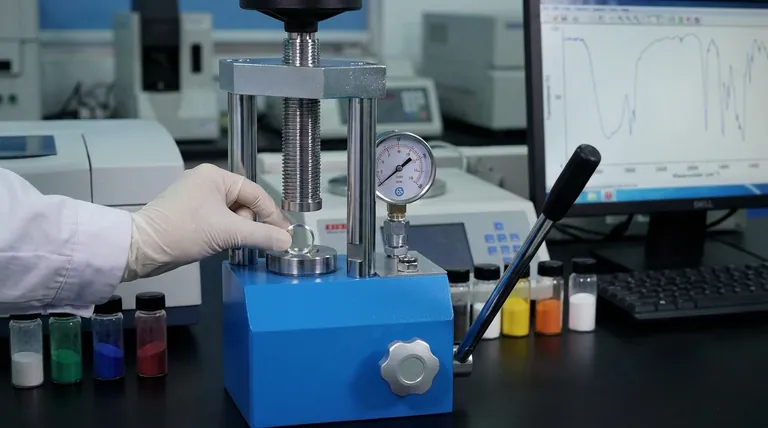
The Illusion of Brute Force
When you see a hydraulic press, your mind instinctively thinks of immense, crushing power. It’s a tool associated with brute force—the flattening of objects, the compression of industrial components.
But in the quiet, methodical world of the laboratory, this perception is misleading.
The true value of a lab press is not its strength, but its subtlety. It’s an instrument of transformation, valued for its ability to apply that immense force with quantifiable precision and unwavering repeatability. Its job isn't to destroy, but to create clarity.
The Transformation: From Opaque Powder to Clear Insight
Imagine a researcher with a newly synthesized powder. In its raw form, it’s a chaotic collection of crystals, opaque to the analytical instruments that could reveal its molecular secrets. The problem isn’t chemical; it’s physical.
This is the first, and most common, role of the lab press: sample preparation.
Forging a Window for Spectroscopy
For techniques like FTIR (Fourier-transform infrared) spectroscopy, the press is used to create KBr pellets. The sample is mixed with pure potassium bromide powder and compressed under tons of pressure.
The result is not just a compacted disc. The intense, uniform pressure forces the salt to fuse into a thin, glass-like window, with the sample molecules perfectly suspended within. The press turns an opaque mess into a transparent medium, allowing infrared light to pass through and generate a clean, accurate spectrum.
The same principle applies to XRF (X-ray fluorescence) analysis, where powders are pressed into dense, homogenous pellets to ensure every measurement is taken from an identical surface, eliminating physical variables.
The Interrogation: Finding a Material's True Character
Materials science is a conversation with the physical world. We create new alloys, polymers, and composites, but then we must ask them a fundamental question: "How strong are you? When will you fail?"
The laboratory press is the interrogator.
By applying a slow, measured, and increasing compressive force, researchers can precisely map a material's response to stress. They can identify the exact point of deformation and failure, generating hard data for properties like compressive strength and elastic modulus.
This isn't just about breaking things. It's about understanding them. Every data point generated by a press informs the design of safer airplanes, more durable medical implants, and more resilient infrastructure.
The Genesis: Giving Form to New Ideas
Innovation often begins as a concept or a formulation on paper. A lab press is one of the first tools to give that idea physical form.
In R&D, it’s used to form novel materials by compacting specialized powders into unique composites. In pharmaceuticals, it mimics the industrial tableting process on a small scale, allowing scientists to study powder compaction behavior, which is critical for drug delivery and stability.
The press takes a theoretical mixture and creates a tangible prototype that can be held, measured, and tested, marking the first step from abstract concept to real-world application.
The Psychology of Precision: Why Hydraulic Control Is King
Other tools can apply force. But the hydraulic press dominates the laboratory for reasons that are deeply tied to the psychology of scientific inquiry: the need for certainty.
Removing the Human Variable
Science is built on the foundation of repeatability. An experiment that cannot be repeated is merely an anecdote.
A hydraulic press is the antidote to anecdote. By delivering a precise, documented amount of force every single time, it removes operator-dependent variables. Whether preparing a sample on a Monday morning or a Friday afternoon, the conditions are identical. This ensures that any observed differences come from the sample itself, not an inconsistency in preparation.
Force Multiplication as an Elegant Solution
There is an engineering romance to hydraulics. A small, manual effort on a pump is quietly and efficiently multiplied into tons of controlled force.
Modern presses, equipped with clear gauges or digital displays, make this force not just immense but also known. This calm, managed application of power is inherently safer than purely mechanical systems, often featuring built-in relief valves to prevent overloading. It’s a system designed for control, not just power.
Choosing the Right Instrument for Your Question
The press you need is defined by the question you are asking.
| Primary Goal | Key Application | Recommended Tool |
|---|---|---|
| Spectroscopic Analysis | FTIR, XRF Pellets | 12-15 Ton Manual Benchtop Press |
| Material Strength Testing | Polymers, Composites | 25+ Ton Press with Accurate Digital Force Display |
| Versatile R&D | Prototyping, Compaction | 25-40 Ton Manual or Programmable Press |
| Advanced Processing | Polymer Curing, Bonding | Heated Lab Press with Temperature Control |
A mismatch between the question and the tool leads to unreliable answers. That’s why selecting the right press is a critical decision.
KINTEK specializes in providing the precise instrument for your laboratory's questions. For routine sample preparation, our manual benchtop presses offer tactile control and reliability. For complex R&D or quality control requiring precise pressure ramps and hold times, our automatic lab presses deliver unparalleled repeatability.
For more advanced challenges, such as studying polymers under specific thermal conditions or achieving perfectly uniform density in complex parts, our heated lab presses and isostatic presses provide the specialized capabilities you need.
Ultimately, a laboratory press is a fundamental instrument of conversion. It converts messy, raw material into clean, uniform samples. It converts physical stress into quantifiable data. And most importantly, it converts uncertainty into insight.
To find the right instrument to answer your research questions, Contact Our Experts.
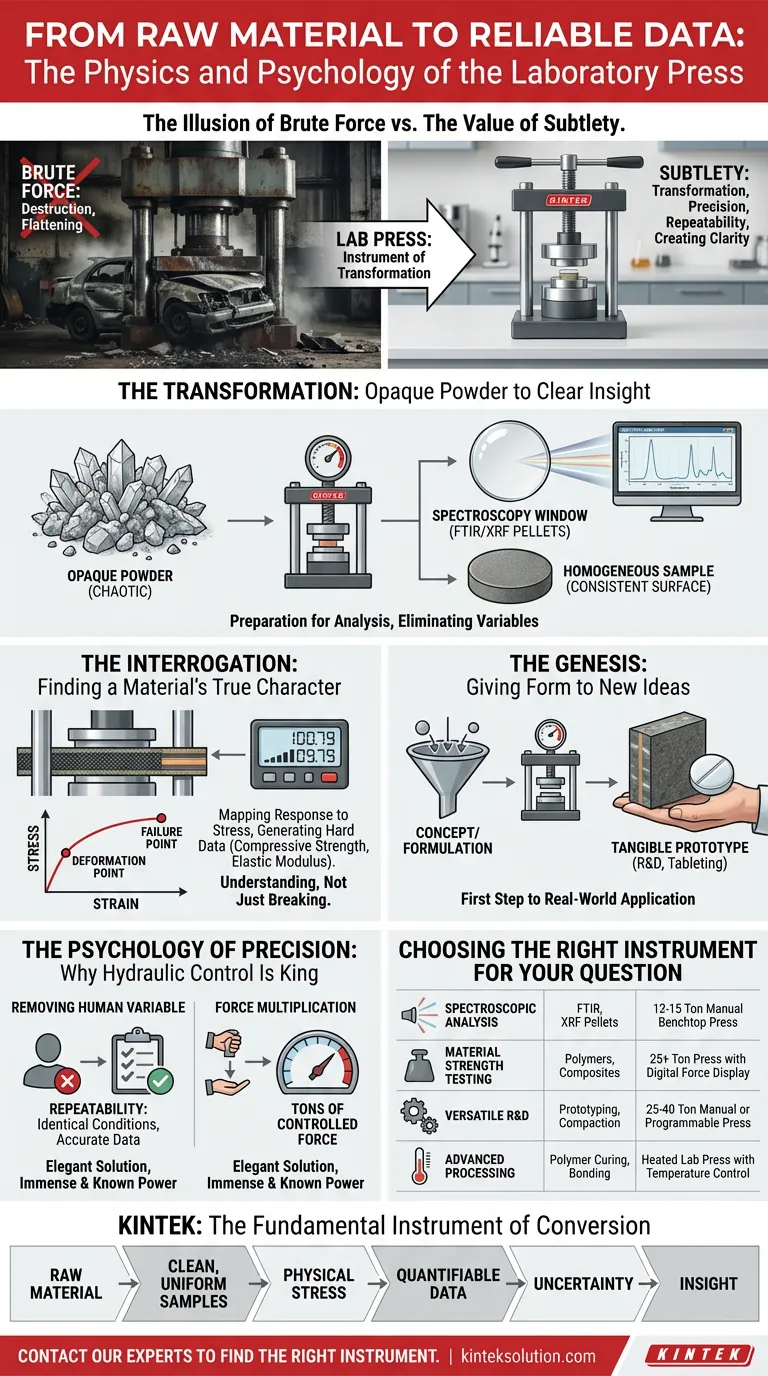
Visual Guide
Related Products
- Laboratory Hydraulic Press Lab Pellet Press Button Battery Press
- Laboratory Hydraulic Press 2T Lab Pellet Press for KBR FTIR
- Laboratory Hydraulic Press Lab Pellet Press Machine for Glove Box
- Laboratory Split Manual Heated Hydraulic Press Machine with Hot Plates
- Laboratory Hydraulic Pellet Press for XRF KBR FTIR Lab Press
Related Articles
- The Architecture of Density: Why Pressure is the Silent Architect of Solid-State Batteries
- The Physics of Transparency: Why Pressure is the Silent Architect of Spectroscopic Clarity
- The Architecture of Heat: Why Sample Density Dictates the Truth in Metal Hydride Research
- The Geometry of Ionic Flow: Why Precision Pressing Dictates Material Truth
- The Geometry of Electrons: Why Surface Precision is the Silent Partner in SECM Research



















