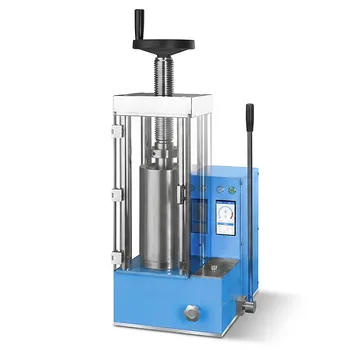
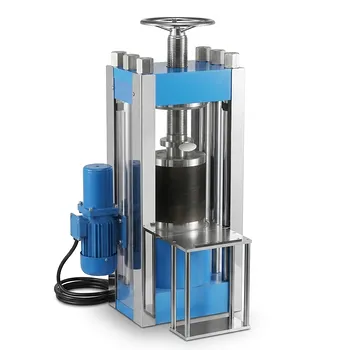
The laboratory press is the foundational tool for densification in Fe-Si-B magnetic core production. It applies extreme molding pressures—often reaching up to 2.40 GPa—to consolidate loose amorphous powders into a high-density "green body." This process is essential for achieving the structural integrity and high magnetic permeability required for high-performance soft magnetic applications.
The laboratory press serves as the critical bridge between raw amorphous powder and a functional magnetic component by using extreme pressure to maximize packing density. This physical consolidation is the primary driver for optimizing the magnetic flux path and ensuring the mechanical stability of the core.
Achieving Peak Magnetic Performance
Maximizing Magnetic Permeability
High molding pressure is directly responsible for increasing the packing density of the Fe-Si-B particles. By forcing particles into closer proximity, the laboratory press reduces the magnetic reluctance of the core, which significantly enhances its magnetic permeability.
Minimizing Internal Porosity
The pressing process effectively exhausts air trapped between powder particles. Eliminating these internal pores creates a more continuous medium for magnetic flux, preventing the "air gaps" that would otherwise degrade the core's magnetic efficiency.
Ensuring Uniform Signal Acquisition
In a laboratory setting, the press ensures that every sample has a consistent shape and density. This repeatability is vital for accurate mass normalization and reliable measurement of magnetic properties in instruments like SQUID magnetometers.
Structural Consolidation and Preparation
Creating the Green Body
Before any thermal treatment, the laboratory press provides the loose powder with its initial mechanical strength. By compressing the mixture into a specific geometric shape, the press creates a "green body" that can be safely handled and transferred to sintering furnaces.
Enhancing Particle Contact
Precise axial pressure increases the contact area between the amorphous powder particles. This intimate contact is a prerequisite for efficient atomic diffusion during subsequent sintering stages, allowing the particles to bond effectively.
Facilitating Heterostructure Formation
When used in specialized setups like hot pressing, the machine allows for the creation of tight interfaces between different phases, such as a magnetic core and an insulating shell. This thermo-mechanical coupling allows for high densification at lower temperatures, preserving the desired amorphous state of the Fe-Si-B.
Understanding the Trade-offs
Pressure Limits and Material Stress
While high pressure (up to 2.40 GPa) is necessary for density, exceeding the mechanical limits of the powder can lead to internal micro-cracking. These structural defects can act as pinning sites for magnetic domain walls, potentially increasing core losses.
Density Gradients
Uniaxial pressing in a laboratory setting can sometimes result in non-uniform density distributions within the pellet. If the pressure is not applied evenly, the core may exhibit different magnetic properties at the edges versus the center, leading to inconsistent experimental data.
Risk of Premature Crystallization
Amorphous Fe-Si-B is metastable; if the mechanical energy from the press is combined with excessive heat (as in hot pressing), there is a risk of unwanted crystallization. This transition from an amorphous to a crystalline state would drastically alter the soft magnetic properties of the core.
Applying Pressing Techniques to Your Project
Recommendations for Implementation
To achieve the best results when preparing Fe-Si-B powder cores, tailor your pressing strategy to your specific performance requirements.
- If your primary focus is Maximum Magnetic Permeability: Utilize the highest safe pressure setting, up to 2.40 GPa, to ensure the highest possible packing density.
- If your primary focus is Structural Homogeneity: Use a precision mold and consider lubricants or binders to reduce friction and minimize internal density gradients.
- If your primary focus is Preserving the Amorphous State: Opt for "cold" pressing at high pressures rather than hot pressing to avoid triggering crystallization during the compaction phase.
The laboratory press is not merely a shaping tool, but a precision instrument that dictates the final magnetic and mechanical efficacy of the amorphous core.
Summary Table:
| Feature/Process | Impact on Fe-Si-B Cores |
|---|---|
| Molding Pressure | Up to 2.40 GPa for maximum packing density |
| Densification | Increases magnetic permeability and minimizes internal porosity |
| Green Body Creation | Provides essential mechanical strength for post-press handling |
| Particle Contact | Enhances atomic diffusion for efficient sintering stages |
| Thermal Coupling | Facilitates heterostructure formation while preserving amorphous states |
Elevate Your Magnetic Material Research with KINTEK
Achieving the perfect Fe-Si-B amorphous core requires more than just pressure—it requires precision. KINTEK specializes in comprehensive laboratory pressing solutions tailored for high-performance research. Whether you need manual, automatic, heated, or multifunctional models, or advanced cold and warm isostatic presses, our equipment ensures the density and uniformity your battery research demands.
Our Value to Your Laboratory:
- Versatile Solutions: Specialized models including glovebox-compatible and isostatic systems.
- Precision Performance: Accurate axial pressure to optimize magnetic flux paths.
- Expert Support: Equipment designed for the rigorous needs of soft magnetic material development.
Ready to enhance your lab's efficiency and sample quality? Contact KINTEK today to find your ideal pressing solution!
References
- F. G. Cuevas. Metals Powders: Synthesis and Processing. DOI: 10.3390/met9121358
This article is also based on technical information from Kintek Solution Knowledge Base .
Related Products
- Electric Isostatic Pressing Machine 40 Tons Automatic Laboratory Powder Compacting Press
- XRF KBR Steel Ring Lab Powder Pellet Pressing Mold for FTIR
- XRF KBR Plastic Ring Lab Powder Pellet Pressing Mold for FTIR
- Lab XRF Boric Acid Powder Pellet Pressing Mold for Laboratory Use
- Split Warm Isostatic Lab Press 200 Ton Powder Compaction Chamber for Battery Research and Material Science
People Also Ask
- What are the key characteristics of the isostatic pressing process? Unlock Uniform Density and Complex Geometries
- Why is vacuum-sealed packaging necessary before isostatic pressing of CuPc thin films? Protect Integrity & Uniformity
- How is pressure applied to the material during isostatic pressing? Master Uniform Density and Complex Geometries
- How does pressure distribute during isostatic pressing of aluminum? Achieve Uniform Density for Your Lab Materials
- What are the applications of isostatic pressing in the automotive industry? Precision Manufacturing for High-Performance Parts