The thickness of a pressed pellet is a fundamental variable in X-ray Fluorescence (XRF) spectroscopy because it determines whether the detector is measuring the sample or the background. X-rays penetrate materials to specific depths; if the pellet is too thin, the emitted radiation will depend on the total mass of the sample rather than purely its elemental composition.
To ensure analytical reliability, a pressed pellet must achieve "infinite thickness"—a specific depth beyond which increasing the sample thickness produces no change in the measured X-ray signal. This guarantees the results represent the sample's true chemistry without interference from the underlying substrate.
The Physics of "Infinite Thickness"
X-ray Penetration Depth
When an XRF instrument analyzes a sample, the primary X-rays penetrate the surface to a certain depth.
This depth varies depending on the atomic number of the elements present and the density of the matrix. Lighter elements generally emit lower-energy fluorescence that escapes only from very shallow depths.
Defining "Infinite" in XRF
In this context, "infinite" does not mean physically endless.
It refers to a sample thickness sufficient to absorb all primary X-rays before they reach the back of the pellet. Once this threshold is reached, the detector sees only the sample, ensuring the data is "saturation thick."
The Risk of Thin Samples
If a pellet falls below this critical thickness threshold, the analysis becomes compromised.
The detector may pick up signals from the sample holder or background, or simply fail to report the full concentration of the elements. This leads to non-linear calibrations and significant quantitative errors.
Critical Factors in Pellet Preparation
Impact of Density and Pressure
Creating a pellet involves compressing powder into a solid disc, typically using loads between 10 and 20 tonnes.
This compression minimizes particle size effects and increases density. However, because higher density reduces the physical volume of the powder, you must ensure the initial mass is sufficient to maintain infinite thickness after compression.
The Role of Binders
Geological or brittle materials often require a binder, such as cellulose or boric acid, to prevent the pellet from crumbling.
While binders are essential for structural integrity, they dilute the sample. A binder-to-sample ratio of 20% to 30% is standard; this ratio must be consistent to maintain accurate thickness and density across all samples.
Standardization of Dimensions
Pellets are commonly pressed to diameters of 32 mm or 40 mm to provide adequate surface area for the X-ray beam.
Using a standardized die size ensures that the geometry remains constant. This consistency eliminates surface roughness and edge effects that could otherwise scatter the X-ray beam unpredictably.
Understanding the Trade-offs
Dilution vs. Signal Intensity
Adding a binder improves the mechanical stability of the pellet, preventing it from breaking inside the sensitive spectrometer.
However, binders are generally made of light elements which do not fluoresce at the energies of interest, effectively diluting the sample. If the pellet is too thin and highly diluted, the signal-to-noise ratio drops, making trace analysis difficult.
Pressed Pellets vs. Fused Beads
Pressed pellets are the industry standard for cost-effective, high-throughput analysis.
They offer better homogeneity than loose powders but are susceptible to mineralogical effects that fused beads eliminate. While fused beads provide superior accuracy, they require higher energy and maintenance costs; therefore, ensuring the correct thickness of pressed pellets is the most efficient way to maximize accuracy without incurring the costs of fusion.
Making the Right Choice for Your Goal
To maximize the quality of your XRF data, you must align your preparation method with your analytical priorities.
- If your primary focus is Precision: Ensure every pellet exceeds the infinite thickness threshold for the highest energy line you are measuring.
- If your primary focus is Durability: Maintain a binder ratio of at least 20% to prevent equipment damage, even if it slightly dilutes the signal.
- If your primary focus is Reproducibility: Standardize the specific weight of the sample and the pressure load (e.g., 20 tonnes) to ensure identical density and thickness across batches.
Consistency in pellet thickness is the invisible baseline that transforms raw data into actionable chemical insight.
Summary Table:
| Factor | Influence on XRF Analysis | Recommended Standard |
|---|---|---|
| Sample Thickness | Prevents background signal interference | Must reach "Infinite Thickness" |
| Compression Load | Increases density and reduces particle effects | 10 to 20 tonnes |
| Binder Ratio | Ensures structural integrity and durability | 20% to 30% ratio |
| Pellet Diameter | Standardizes surface area for X-ray beam | 32 mm or 40 mm |
| Matrix Density | Affects X-ray penetration depth | Higher density = shallower penetration |
Optimize Your Spectroscopy with KINTEK Precision Pellets
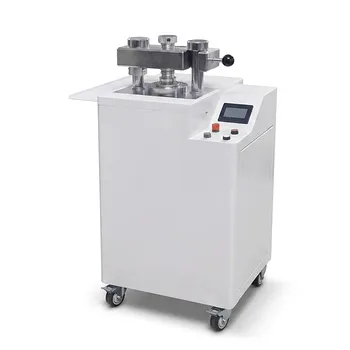
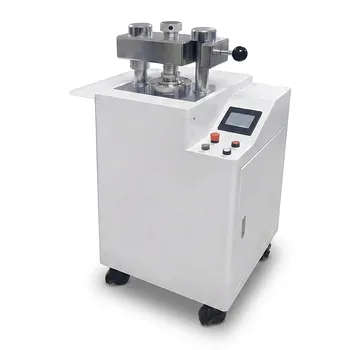
Don't let sample preparation errors compromise your XRF data. KINTEK specializes in comprehensive laboratory pressing solutions, offering manual, automatic, heated, multifunctional, and glovebox-compatible models, as well as cold and warm isostatic presses widely applied in battery research.
Whether you are preparing geological samples or advanced battery materials, our high-performance equipment ensures the consistent density and "infinite thickness" required for reliable analytical results.
Ready to elevate your lab's accuracy? Contact us today to find the perfect press for your research!
Related Products
- XRF KBR Plastic Ring Lab Powder Pellet Pressing Mold for FTIR
- XRF KBR Steel Ring Lab Powder Pellet Pressing Mold for FTIR
- Automatic XRF Pellet Press for Laboratory Spectrometry Sample Preparation
- Lab XRF Boric Acid Powder Pellet Pressing Mold for Laboratory Use
- Automatic Fluorescence Sample Preparation Press 40 Ton Lab Pellet Press for XRF Analysis
People Also Ask
- What is the purpose of making KBr pellets for FTIR? Achieve Precise Molecular Analysis with Solid Samples
- What factors should be considered when choosing a lab press for XRF pellet preparation? Ensure Accurate and Consistent Results
- Why are pellets used in XRF analysis, and what is their limitation? Boost Accuracy and Speed in Your Lab
- How are pellets prepared for XRF analysis and what is a potential drawback? Master XRF Sample Prep and Accuracy
- What should be included in a checklist for making XRF pellets? Ensure Accurate and Repeatable XRF Analysis