
XRF pellet preparation methods focus on transforming pulverized samples into solid, uniform disks using varying degrees of automation and pressure. The primary methods are differentiated by the machinery used to apply force—specifically manual, hydraulic, and automated presses—which determine the throughput, consistency, and density of the final sample.
Core Takeaway: The goal of XRF pellet preparation is to create a chemically homogenous, dense, and flat surface that improves analytical accuracy compared to loose powders. While the equipment varies from manual to fully automated, the underlying principle is maximizing sample integrity through high-pressure compaction.
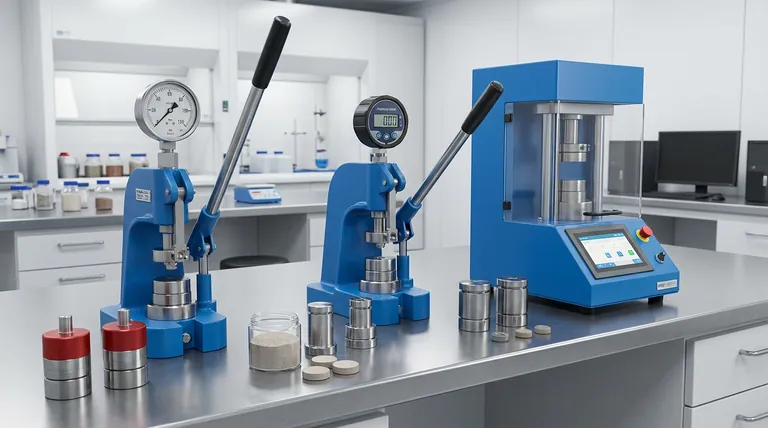
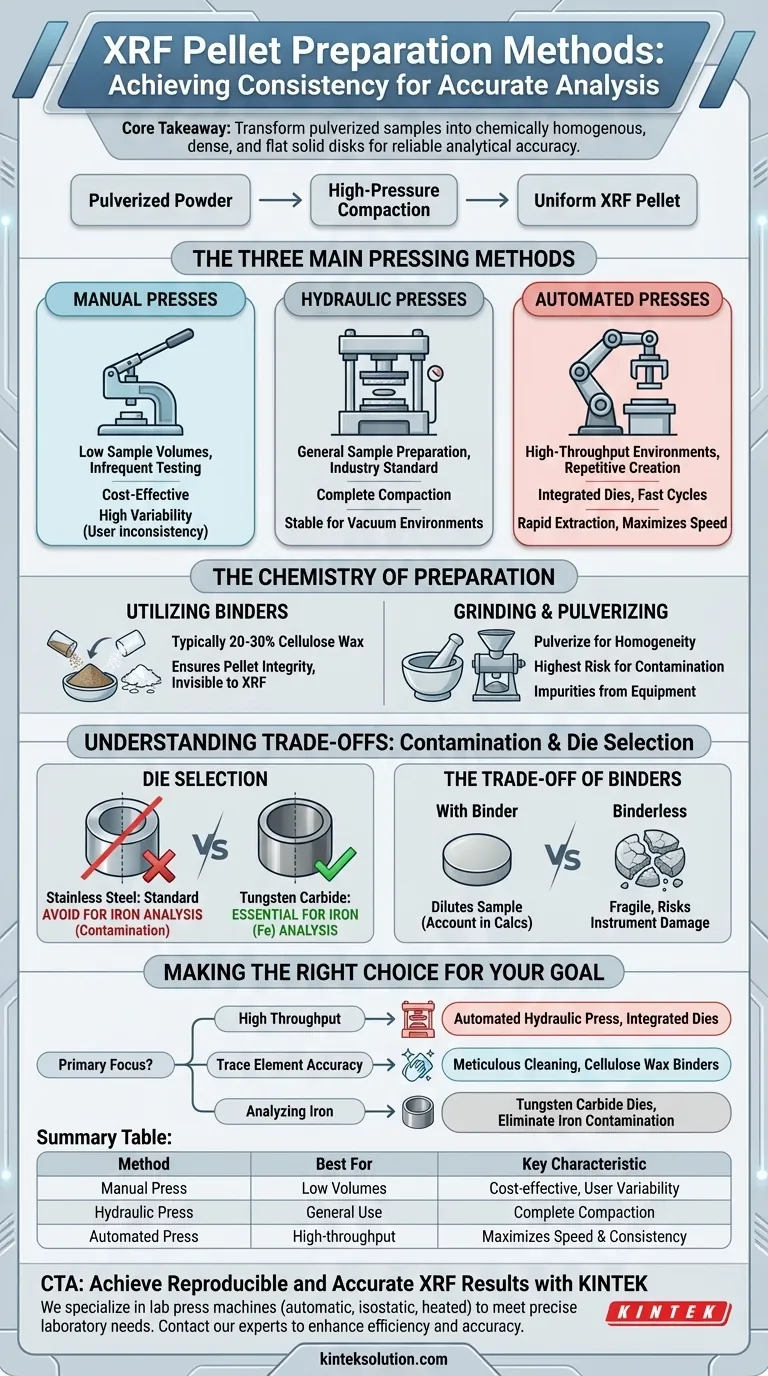
The Three Main Pressing Methods
The quality of a pressed pellet relies heavily on the mechanical method used to compress the powder.
Manual Presses
Manual presses rely on the operator to generate force, typically via a hand lever.
These are best suited for laboratories with low sample volumes or infrequent testing needs. While cost-effective, they introduce higher variability between samples due to human inconsistency in applying pressure.
Hydraulic Presses
Hydraulic presses are the industry standard for creating general sample pellets.
By squeezing the sample between two pressure plates at high pressure, these machines ensure complete compaction. This process maintains the structural integrity of the sample, rendering it stable enough for vacuum environments in XRF spectrometers.
Automated Presses
Automated presses are engineered for high-throughput environments requiring repetitive pellet creation.
These units often feature integrated pellet dies and faster operational cycles. The focus on mechanical automation allows for the rapid extraction of finished pellets, immediately freeing the machine for the next sample.
The Chemistry of Preparation
Beyond the machinery, the method of preparing the sample mixture itself is critical for data integrity.
Utilizing Binders
To ensure the pellet holds together, a binder—such as cellulose wax—is often mixed with the sample powder.
A typical mixture ratio is 20% to 30% binder. This particular binder is advantageous because it is not detected by XRF, ensuring the analysis reflects only the elemental composition of the sample.
Grinding and Pulverizing
Before pressing, the sample must be pulverized into a fine powder to ensure homogeneity.
This stage presents the highest risk for contamination. Impurities can originate from the grinding equipment itself or via cross-contamination from previously processed samples.
Understanding the Trade-offs: Contamination and Die Selection
Achieving a stable pellet requires balancing physical strength with chemical purity. A critical "hidden" method in pellet prep is the selection of the pressing die material.
Stainless Steel vs. Tungsten Carbide
Standard pressing dies are often made of stainless steel, but these can interfere with results if you are analyzing for specific elements.
If your analysis includes Iron (Fe), you must use Tungsten Carbide dies instead. Using stainless steel dies for iron analysis inevitably leads to contamination from the die surface, skewing your results.
The Trade-off of Binders
While binders are necessary for non-cohesive powders, they dilute the sample.
You must account for this dilution in your calculations. However, using a "binderless" method often results in fragile pellets that may crumble inside the spectrometer, risking damage to the instrument.
Making the Right Choice for Your Goal
Selecting the correct preparation method depends on your volume requirements and the specific elements you need to measure.
- If your primary focus is High Throughput: Invest in an automated hydraulic press with integrated dies to maximize speed and free up operator time.
- If your primary focus is Trace Element Accuracy: Minimize contamination by meticulously cleaning grinding equipment and selecting cellulose wax binders that are invisible to XRF.
- If your primary focus is Analyzing Iron: You must utilize Tungsten Carbide dies to eliminate the risk of iron contamination from standard steel equipment.
Consistency in preparation is the single most important factor in achieving reproducible XRF data.
Summary Table:
| Method | Best For | Key Characteristic |
|---|---|---|
| Manual Press | Low sample volumes, infrequent testing | Cost-effective, but introduces user variability |
| Hydraulic Press | General sample preparation, industry standard | Ensures complete compaction for stable pellets |
| Automated Press | High-throughput, repetitive production | Maximizes speed and consistency, frees operator time |
Achieve Reproducible and Accurate XRF Results with KINTEK
Choosing the right pellet press is critical for the integrity of your XRF analysis. Whether your laboratory prioritizes high throughput, trace element accuracy, or specific analysis like iron content, KINTEK has the solution.
We specialize in lab press machines—including automatic lab presses, isostatic presses, and heated lab presses—designed to meet the precise needs of modern laboratories. Our equipment ensures the consistent, high-pressure compaction required to create perfect pellets, minimizing contamination and maximizing your data's reliability.
Ready to optimize your sample preparation? Contact our experts today to discuss your specific requirements and discover how KINTEK can enhance your laboratory's efficiency and accuracy.
Visual Guide
Related Products
- XRF KBR Plastic Ring Lab Powder Pellet Pressing Mold for FTIR
- Lab XRF Boric Acid Powder Pellet Pressing Mold for Laboratory Use
- XRF KBR Steel Ring Lab Powder Pellet Pressing Mold for FTIR
- Laboratory Hydraulic Pellet Press for XRF KBR FTIR Lab Press
- Automatic Laboratory Hydraulic Press for XRF and KBR Pellet Pressing
People Also Ask
- What are the different pellet pressing options for XRF sample preparation? Choose the Best Method for Accurate Analysis
- What factors should be considered when choosing a lab press for XRF pellet preparation? Ensure Accurate and Consistent Results
- What are specialized XRF pellet preparation presses designed for? Boost Lab Efficiency with High-Throughput Automation
- What should be included in a checklist for making XRF pellets? Ensure Accurate and Repeatable XRF Analysis
- How are pellets prepared for XRF analysis and what is a potential drawback? Master XRF Sample Prep and Accuracy



















