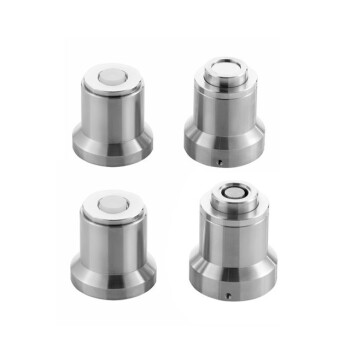
Specialized sleeve and piston fixtures are utilized to impose strict physical constraints on Bulk Metallic Glass (BMG) during the Thermoplastic Forming (TPF) process. By confining the bulk material, these fixtures ensure that high pressure generates viscoplastic flow only at the contact interface, smoothing surface roughness without altering the part's overall shape.
The core function of this fixture is to decouple surface finishing from bulk deformation. It forces the material to flow microscopically to eliminate roughness while mechanically preventing any macroscopic distortion of the part's geometry.
The Mechanics of Constraint
Controlling Viscoplastic Flow
In Thermoplastic Forming, BMG softens and becomes capable of flowing like a viscous fluid. Without containment, applying the high pressure necessary to flatten surface irregularities would inevitably crush or distort the entire component.
The sleeve and piston combination acts as a boundary condition. It mechanically locks the "bulk" of the material in place.
Targeting the Contact Interface
Because the bulk material cannot expand outward due to the sleeve, the applied energy is focused entirely on the contact interface.
This is the region where the piston face meets the part's surface. The fixture ensures that the viscoplastic flow remains localized here, effectively redistributing material only where necessary to fill valleys and flatten peaks.
Preserving Macroscopic Geometry
The primary advantage of this setup is the preservation of dimensional accuracy.
While the surface texture changes significantly—becoming smoother as it conforms to the polished piston—the fixture prevents macro-geometric deformation. The part retains its original global dimensions and tolerances, avoiding the "squish" effect common in unconstrained pressing.
Understanding the Trade-offs
Reliance on Precision Fit
The effectiveness of this method depends entirely on the precision of the fixture itself.
If the clearance between the piston and sleeve is too large, material may "flash" or extrude into the gap. If the fit is too tight, friction may impede the pressure transfer required for smoothing.
Limitation of Flow
This fixture design is specifically intended for surface modification, not bulk reshaping.
It restricts the material's ability to flow into new complex shapes. Therefore, it is strictly a finishing or calibration tool, rather than a primary forming tool for complex geometries.
Applying This to Your Process
If your primary focus is Dimensional Fidelity: Ensure the sleeve provides a rigid, near-zero tolerance constraint to prevent any lateral expansion of the bulk material.
If your primary focus is Surface Quality: Maximize the pressure transferred through the piston, knowing the fixture will prevent this force from distorting the component's shape.
By utilizing this fixture, you transform a potentially destructive high-pressure process into a precise surface finishing operation.
Summary Table:
| Feature | Function in BMG Flattening | Key Benefit |
|---|---|---|
| Sleeve Constraint | Provides rigid boundary conditions | Prevents lateral expansion and distortion |
| Piston Pressure | Focuses energy on contact interface | Drives viscoplastic flow for smoothing |
| Zero-Tolerance Fit | Minimizes clearance between parts | Eliminates material flash and extrusion |
| Localized Flow | Decouples surface from bulk | Preserves dimensional accuracy/tolerances |
Precision Lab Pressing for Advanced Materials
Are you struggling with dimensional distortion during thermoplastic forming? KINTEK specializes in comprehensive laboratory pressing solutions designed to meet the rigorous demands of material science research.
Whether you are working on Bulk Metallic Glass or battery research, our range of manual, automatic, heated, and multifunctional models—including specialized cold and warm isostatic presses—provides the stability and precision needed for flawless surface finishing and material synthesis.
Let KINTEK help you achieve perfect dimensional fidelity. Contact us today to find the ideal pressing solution for your lab.
References
- Maximilian Frey, Ralf Busch. Thermoplastic forming of additively manufactured Zr-based bulk metallic glass: A processing route for surface finishing of complex structures. DOI: 10.1016/j.matdes.2020.109368
This article is also based on technical information from Kintek Solution Knowledge Base .
Related Products
- Lab Button Battery Disassembly and Sealing Mold
- Button Battery Sealing Machine for Button Batteries
- Lab Cylindrical Press Mold for Laboratory Use
- Laboratory Hydraulic Press Lab Pellet Press Machine for Glove Box
- Laboratory Hydraulic Split Electric Lab Pellet Press
People Also Ask
- How does a sealed battery mold facilitate the assembly and testing of asymmetric supercapacitors using VO2?
- What is the function of specialized battery molds and sealing consumables? Optimize Your In-situ XRD Testing Today
- How does the geometry of laboratory molds influence mycelium-based composites? Optimize Density and Strength
- Why are specialized battery test molds used? Ensure Peak Performance for All-Solid-State Sodium Batteries (ASSIBs)
- What role do battery testing molds play in electrolyte performance? Exploring Pressure vs. Viscoelasticity