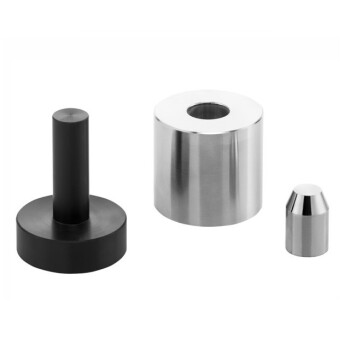
The selection of a precision cylindrical mold is the single most critical variable determining the structural integrity and density uniformity of laboratory-pressed charcoal briquettes. While the hydraulic press provides the force, the mold acts as the essential constraint system that dictates how that pressure is distributed, directly influencing the briquette's ability to withstand drying and combustion without failing.
Core Takeaway A precision mold does more than define shape; it governs the internal physics of the briquette. By minimizing wall friction and preventing deformation, a high-quality mold ensures uniform density distribution, which is the primary defense against micro-cracks and bursting during post-processing.
The Mechanics of Pressure Distribution
Regulating Internal Density
The primary function of a precision mold is to ensure uniform pressure distribution throughout the charcoal powder.
When pressure is applied, the powder acts somewhat like a fluid. A precise mold ensures that force is transmitted deeply into the center of the briquette, rather than being lost at the edges.
This uniformity eliminates severe density gradients, where the outside is hard but the inside remains loose.
Preventing Micro-Cracking
Density gradients are the root cause of structural failure.
If the mold allows uneven pressure, the resulting briquette will have internal stress points.
The primary reference confirms that eliminating these gradients reduces the formation of micro-cracks, ensuring the briquette remains solid.
The Role of Wall Friction
High-quality mold materials are designed to offer high hardness and wear resistance.
This minimizes friction between the powder and the inner mold wall during the pressing phase.
Lower friction allows the hydraulic force to transmit effectively to the powder's center, preventing "delamination" defects where layers of the briquette separate.
Geometric Stability and Measurement
Rigid Confinement
The mold serves as a physical constraint that must resist deformation under high loads.
As the hydraulic plunger compresses the loose biomass, the mold’s inner wall must remain perfectly static.
Any expansion or warping of the mold would result in irregular shapes, rendering density calculations and volume assessments inaccurate.
Surface Finish and Edge Definition
A precision cylindrical mold ensures the final output has smooth surfaces and sharp edges.
This aesthetic consistency is not just cosmetic; it indicates a tight, uniform bond between particles.
Smooth surfaces also reduce the likelihood of abrasion or crumbling during subsequent handling and transport.
Impact on Post-Processing Performance
Surviving the Drying Phase
The quality of the molding process directly dictates the briquette's performance during drying.
Briquettes with uniform density allow for consistent moisture evaporation.
Without this uniformity, differential shrinkage occurs, causing the briquettes to burst or fracture as they dry.
Combustion Stability
Structural integrity is essential for reliable combustion.
A well-molded briquette maintains its shape while burning, providing a predictable heat output.
Defects caused by poor molding, such as internal cracks, can lead to premature disintegration in the fire.
Understanding the Trade-offs
The Risk of High Wall Friction
If a mold has a poor internal finish or uses inferior material, wall friction losses increase significantly.
This results in a "skin effect," where the outer surface of the briquette is dense, but the core remains low-density.
While the briquette may look solid initially, it will likely fail structurally during transport or combustion.
Dimensional Accuracy vs. Cost
Standard molds may be cheaper, but they often lack the high-strength inner wall design required for high-pressure applications.
Using a mold that deforms even slightly compromises the data validity of the entire experiment.
For laboratory research, the cost of a precision mold is an investment in reproducible data.
Making the Right Choice for Your Goal
To ensure your laboratory results are valid and scalable, select your molding tools based on your specific analytical needs.
- If your primary focus is fundamental density research: Prioritize a mold with high-strength, non-deformable walls to ensure the volume remains constant for accurate density calculations.
- If your primary focus is combustion testing: Prioritize a mold with a polished, wear-resistant interior to minimize friction and ensure the structural homogeneity required to prevent bursting during burning.
Ultimately, the mold is not just a container; it is the precision instrument that translates raw force into structural reliability.
Summary Table:
| Factor | Impact on Briquette Quality | Result of High-Precision Mold |
|---|---|---|
| Pressure Distribution | Eliminates density gradients | Uniform density from core to surface |
| Wall Friction | Reduces internal stress and delamination | Enhanced particle bonding and smooth finish |
| Rigid Confinement | Prevents warping under high loads | High dimensional accuracy and data validity |
| Post-Processing | Facilitates even moisture evaporation | Prevents bursting or fracturing during drying |
| Combustion Performance | Maintains shape while burning | Consistent heat output and structural stability |
Optimize Your Research with KINTEK Precision Solutions
Don’t let inferior molds compromise your data. KINTEK specializes in comprehensive laboratory pressing solutions designed to meet the rigorous demands of material science and battery research. Whether you need manual, automatic, heated, or glovebox-compatible models—or advanced cold and warm isostatic presses—we provide the tools necessary for perfect structural integrity.
Enhance your lab’s efficiency and reproducibility today.
References
- Wilfred Chipangura, Marko Chigondo. Fabrication of briquettes from charcoal fines using tannin formaldehyde resin as a binder. DOI: 10.29333/ejosdr/14125
This article is also based on technical information from Kintek Solution Knowledge Base .
Related Products
- Lab Cylindrical Press Mold for Laboratory Use
- Lab Cylindrical Press Mold with Scale
- Assemble Lab Cylindrical Press Mold for Laboratory Use
- Cylindrical Lab Electric Heating Press Mold for Laboratory Use
- Lab Polygon Press Mold
People Also Ask
- What is the purpose of incorporating cartridge heaters into a lab press mold for MLCC block compression? Optimize Results
- Why is precise cooling management of the lab press mold necessary? Protect Core Integrity in Thermoforming
- What is the function of a pressing tool in thermoplastic panels? Master Precision Shaping & Fusion Bonding
- Why is a high-performance laboratory molding press critical for in-situ electrolyte formation? Unlock Battery Success
- How does the geometry of laboratory molds influence mycelium-based composites? Optimize Density and Strength