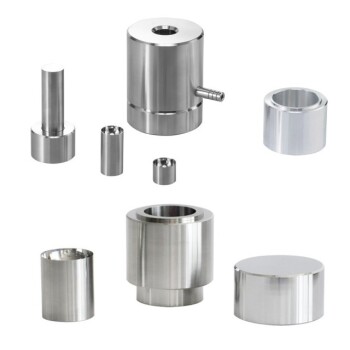
The use of standard cylindrical molds is the cornerstone of experimental validity in material testing. Specifically, utilizing molds with precise specifications, such as 50 mm by 100 mm, ensures that every mineralized filling material sample possesses identical geometric dimensions. This uniformity is required to eliminate physical variables that would otherwise corrupt the data gathered during mechanical and thermal testing.
Standardization in molding is not merely a procedural step; it is the fundamental control that allows laboratory samples to accurately reflect the behavior of real underground filling bodies. By neutralizing geometric variations, you ensure that test results represent the material's intrinsic properties rather than artifacts of the sample's size or shape.
Achieving Experimental Accuracy
Simulating Underground Stress States
To derive meaningful insights from a laboratory setting, you must be able to replicate the conditions found in the field. Standard cylindrical molds are essential for simulating the stress states of actual underground filling bodies. By controlling the geometry, you create a consistent baseline that mimics the load-bearing environment of the mine fill.
Eliminating Size Effects
One of the most significant risks in material testing is the "size effect," where the physical dimensions of a sample influence its perceived strength. Using standard molds eliminates size effects as a variable. This ensures that the data observed is a true reflection of the material, not a result of inconsistent sample volume or aspect ratios.
Optimizing UCS Testing
For Uniaxial Compressive Strength (UCS) testing, geometry is critical. Standardized molds ensure that the height-to-diameter ratio is constant across all samples. This consistency prevents geometric disparities from interfering with the failure mechanics of the sample, leading to reliable strength data.
Ensuring Data Validity
Enhancing Infrared Monitoring
Beyond mechanical strength, standardization is vital for advanced monitoring techniques. Consistent sample dimensions are necessary for accurate infrared radiation temperature monitoring. A uniform surface area and volume ensure that thermal emissions are comparable, allowing for precise detection of temperature changes during loading.
Guaranteeing Comparability
Scientific rigor depends on the ability to compare apples to apples. By adhering to a standard mold specification, you ensure the comparability and accuracy of your experimental data. This allows results to be cross-referenced with other studies or distinct sample batches with confidence.
Understanding the Trade-offs
Rigorous Preparation Requirements
While standard molds eliminate geometric variables, they transfer the burden of accuracy to the preparation phase. The reliability of the data is entirely dependent on how well the material is compacted into these specific dimensions. Poor preparation technique can introduce density variations that negate the benefits of the standard geometry.
The Limits of Simulation
It is important to remember that a standard cylinder is an idealization. While it allows for accurate stress simulation in a general sense, it may not perfectly capture the behavior of filling materials in highly irregular or non-uniform underground cavities.
Optimizing Your Experimental Strategy
To ensure your testing yields actionable data, approach the molding process with your specific end-goals in mind:
- If your primary focus is Mechanical Strength (UCS): Prioritize the 50 mm by 100 mm ratio to strictly adhere to rock mechanics standards and eliminate size-effect bias.
- If your primary focus is Thermal/Infrared Analysis: Ensure the surface finish of the molded samples is consistent, as the standard geometry is crucial for reliable thermal emissivity readings.
Adopting standard cylindrical molds is the single most effective step to transition from rough approximations to scientifically robust conclusions.
Summary Table:
| Key Importance | Technical Benefit | Scientific Value |
|---|---|---|
| Geometry Control | Uniform 50mm x 100mm dimensions | Eliminates physical variables & size effects |
| Stress Simulation | Replicates underground load environments | Accurately predicts real-world field behavior |
| Data Integrity | Constant height-to-diameter ratio | Ensures Uniaxial Compressive Strength (UCS) validity |
| Thermal Precision | Consistent surface area/volume | Enables accurate infrared radiation monitoring |
Maximize Your Research Precision with KINTEK
Elevate your material science experiments with industry-leading laboratory pressing solutions. At KINTEK, we specialize in providing comprehensive equipment tailored for battery research and mineralized material studies.
Our range includes:
- Manual & Automatic Presses for consistent sample preparation.
- Heated & Multifunctional Models for complex thermal analysis.
- Glovebox-Compatible Systems for sensitive research environments.
- Cold & Warm Isostatic Presses to achieve superior material density.
Don't let inconsistent sample preparation compromise your data. Contact KINTEK today to find the perfect pressing solution for your lab and ensure every sample meets the highest standards of scientific rigor.
References
- Guanghui Cao, Zezhou Guo. Assessing the Performance of CO2-Mineralized Underground Backfilling Materials through the Variation Characteristics of Infrared Radiation Temperature Index. DOI: 10.3390/min14060566
This article is also based on technical information from Kintek Solution Knowledge Base .
Related Products
- Cylindrical Lab Electric Heating Press Mold for Laboratory Use
- Lab Cylindrical Press Mold for Laboratory Use
- Lab Cylindrical Press Mold with Scale
- Assemble Lab Cylindrical Press Mold for Laboratory Use
- Square Lab Press Mold for Laboratory Use
People Also Ask
- How does a laboratory electric heated press ensure sample quality? Optimize SiR-EPDM vulcanization and molding.
- What role does a laboratory electric heated press play in polymer composite fabrication? Key for Standardized Specimens
- What role does a laboratory electric heating press play in NBR molding? Master Vulcanization & Material Density
- Why is a laboratory electric heating press required for PP/EPDM molding? Achieve Superior Specimen Integrity
- What is the purpose of incorporating cartridge heaters into a lab press mold for MLCC block compression? Optimize Results