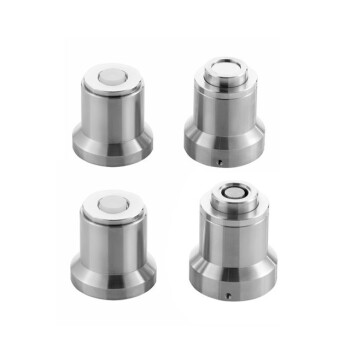
Selecting the right laboratory press mold for specific electrode areas requires prioritizing high-precision tooling made from hard alloys with superior surface finishes. To ensure valid experimental results for a 1 cm² target, the mold must be capable of delivering direct, uniform pressure while preventing physical defects like edge burrs.
Core Insight: Precision in the physical mold is the prerequisite for precision in data analysis. Without exact area control, calculations for active material mass loading are flawed, rendering energy density and capacity comparisons scientifically invalid.
Material Composition and Surface Quality
The Necessity of Hard Alloys
When targeting a specific area like 1 cm², the mold material must possess exceptional rigidity.
Hard alloys are the standard requirement. They withstand the high pressures needed for solid-state battery pellets without deforming, ensuring the geometric integrity of the electrode is maintained throughout the process.
Superior Surface Finishes
The internal surface of the mold dictates the quality of the electrode interface.
A superior surface finish is critical to minimize friction and prevent material adhesion. This ensures that the pressure applied is transferred efficiently to the powder, rather than being lost to sidewall friction.
Mechanical Dynamics During Compression
Achieving Uniform Pressure
The primary mechanical goal is to apply pressure directly and uniformly across the entire electrode surface.
If the mold faces are not perfectly parallel or the fit is loose, pressure gradients will occur. This leads to density variations within the pellet, which can cause inconsistent ionic conductivity.
Preventing Stress Concentrations
Poorly designed molds can introduce stress risers within the pellet.
Stress concentrations create weak points in the solid electrolyte or electrode layer. These weak points are often the origin sites for cracks or mechanical failure during battery cycling.
Eliminating Edge Burrs
A critical consideration is the tolerance between the plunger and the die sleeve.
High-precision molds are designed to eliminate edge burrs. Burrs not only affect the physical shape of the pellet but can also create short circuits or structural instability in the final cell assembly.
The Impact on Scientific Validity
Precise Area Control
The physical area of the electrode is a variable that must remain constant.
In scientific experiments, the assumed area (e.g., 1 cm²) is used as a constant in calculations. If the mold expands or allows material to flash (leak) around the edges, the actual area deviates from the theoretical area, introducing immediate error.
Accurate Mass Loading Calculations
Validating battery performance relies heavily on knowing exactly how much active material is present per unit area.
Precise area control allows for the accurate calculation of active material mass loading. This metric is the denominator for many key performance indicators.
Validating Energy Density Comparisons
Ultimately, the credibility of your research depends on the reliability of your metrics.
Ensuring the geometric precision of the electrode is the only way to guarantee the scientific validity of energy density and capacity comparisons. Without this, you cannot reliably compare your results against other studies or benchmarks.
Common Pitfalls to Avoid
Overlooking Manufacturing Tolerances
Not all "1 cm" molds are created equal.
Using molds with loose tolerances may seem cost-effective, but they often result in imprecise areas. This forces you to estimate rather than measure your electrode dimensions, degrading data quality.
Ignoring Surface Defects
A rough mold surface is not just a cosmetic issue.
Surface imperfections transfer to the electrode, creating contact resistance issues. Furthermore, rough surfaces increase the likelihood of pellets cracking upon ejection, leading to wasted samples and time.
Making the Right Choice for Your Experiment
To ensure your solid-state battery research stands up to peer review, prioritize the following based on your specific goals:
- If your primary focus is mechanical integrity: Select molds made of hard alloys with superior surface finishes to prevent edge burrs and stress concentrations.
- If your primary focus is data accuracy: Prioritize high-precision molds that guarantee precise area control to ensure valid mass loading and capacity calculations.
Your mold is not merely a vessel for compression; it is a precision instrument that defines the baseline accuracy of your entire study.
Summary Table:
| Feature | Importance for Electrode Design | Impact on Experimental Data |
|---|---|---|
| Material (Hard Alloy) | Prevents mold deformation under high pressure | Ensures consistent geometric area (e.g., 1 cm²) |
| Surface Finish | Minimizes friction and material adhesion | Reduces contact resistance and pellet cracking |
| Tight Tolerances | Eliminates edge burrs and material flashing | Critical for accurate active material mass loading |
| Parallel Alignment | Ensures uniform pressure distribution | Prevents density variations and ionic conductivity loss |
Elevate Your Research Precision with KINTEK
Don't let subpar tooling compromise your scientific data. KINTEK specializes in comprehensive laboratory pressing solutions, offering manual, automatic, heated, multifunctional, and glovebox-compatible models, alongside high-precision cold and warm isostatic presses.
Whether you are refining battery mass loading calculations or scaling solid-state electrolyte research, our hard-alloy molds deliver the geometric integrity you need. Contact us today to find the perfect press mold for your lab!
References
- Vishnu Surendran, Venkataraman Thangadurai. Solid-State Lithium Metal Batteries for Electric Vehicles: Critical Single Cell Level Assessment of Capacity and Lithium Necessity. DOI: 10.1021/acsenergylett.4c03331
This article is also based on technical information from Kintek Solution Knowledge Base .
Related Products
- Lab Cylindrical Press Mold for Laboratory Use
- Lab Infrared Press Mold for Laboratory Applications
- Carbide Lab Press Mold for Laboratory Sample Preparation
- Lab Button Battery Tablet Press Sealing Mold
- Cylindrical Lab Electric Heating Press Mold for Laboratory Use
People Also Ask
- What is the purpose of incorporating cartridge heaters into a lab press mold for MLCC block compression? Optimize Results
- What is the function of a pressing tool in thermoplastic panels? Master Precision Shaping & Fusion Bonding
- Why is precise cooling management of the lab press mold necessary? Protect Core Integrity in Thermoforming
- Why is a high-performance laboratory molding press critical for in-situ electrolyte formation? Unlock Battery Success
- How does the geometry of laboratory molds influence mycelium-based composites? Optimize Density and Strength