
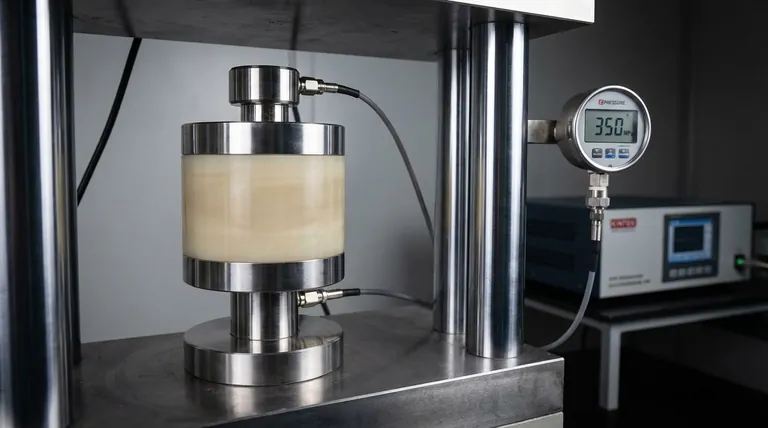
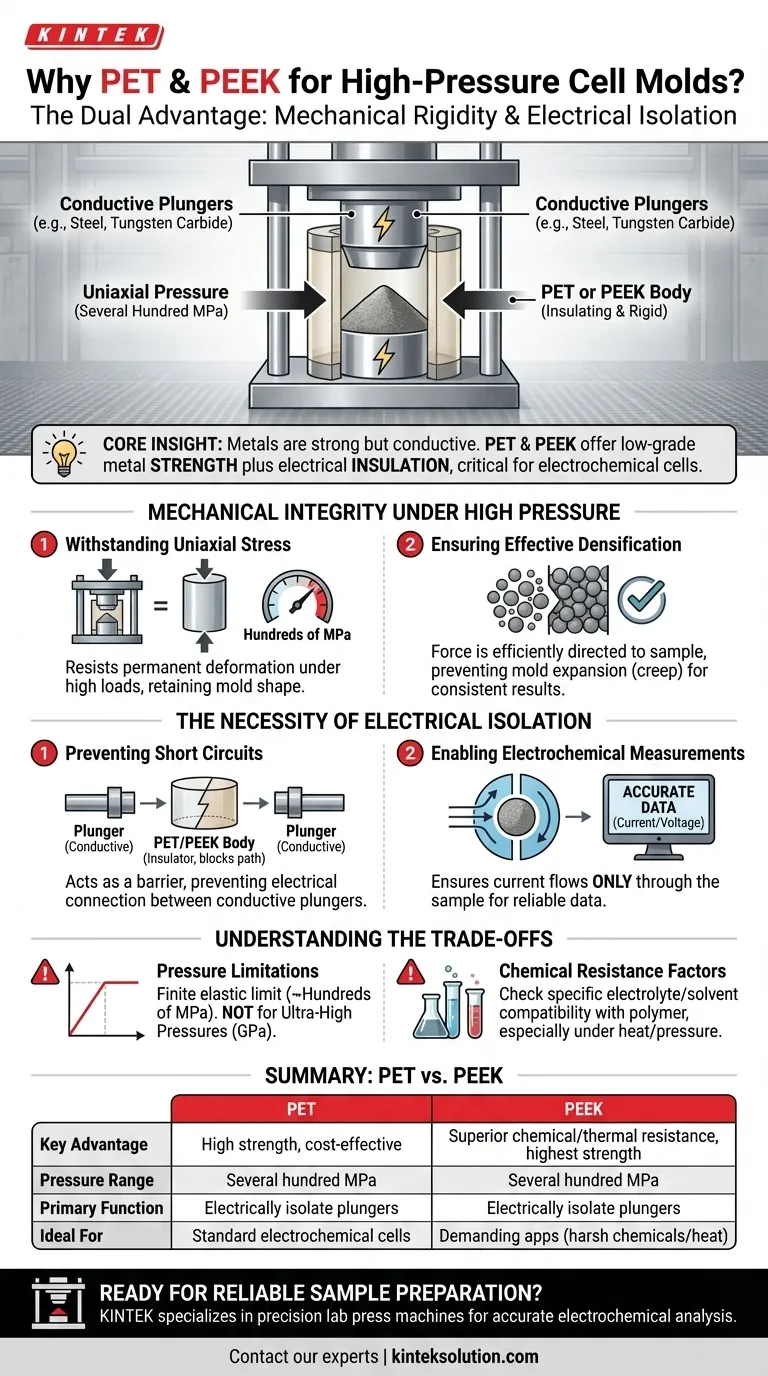
PET and PEEK are the industry standards for high-pressure cell mold bodies because they offer a rare combination of extreme mechanical rigidity and total electrical isolation. These engineering plastics are capable of withstanding uniaxial pressures of several hundred megapascals (MPa) without permanently deforming, while simultaneously preventing electrical interference during sensitive electrochemical measurements.
Core Insight: In high-pressure applications, strength is usually synonymous with metal. However, for electrochemical cells, metal bodies create short circuits. PET and PEEK are utilized because they are among the few materials that provide the structural integrity of a low-grade metal while retaining the dielectric properties of an insulator.
Mechanical Integrity Under High Pressure
Withstanding Uniaxial Stress
The primary function of a cell mold is to contain powder samples while they are compressed. PET (Polyethylene terephthalate) and PEEK (Polyether ether ketone) are high-strength engineering plastics.
They can endure uniaxial pressures of several hundred MPa without undergoing plastic deformation. This ensures the mold retains its shape rather than bulging or yielding under the load.
Ensuring Effective Densification
Because these materials resist deformation, the force applied by the press is directed efficiently into the powder sample.
If the mold body were to expand significantly (creep) under pressure, the effective pressure on the sample would drop. The rigidity of PET and PEEK guarantees the effective densification of the powder, which is critical for consistent sample preparation.
The Necessity of Electrical Isolation
Preventing Short Circuits
In a typical setup, the pressure is applied via plungers made of conductive materials, such as stainless steel or tungsten carbide.
If the cylindrical body were also metal, the upper and lower plungers would be electrically connected through the body, creating a dead short. PET and PEEK act as an insulating barrier, physically guiding the plungers while keeping them electrically isolated.
Enabling Electrochemical Measurements
This insulation is not just for safety; it is functionally required for the data collection.
During electrochemical measurements, the current must flow exclusively through the sample. The excellent insulating properties of PET and PEEK ensure that the electrical path is confined to the sample material, preventing signal leakage or erroneous data.
Understanding the Trade-offs
Pressure Limitations
While these materials are exceptionally strong for plastics, they have a finite elastic limit defined as "hundreds of MPa."
Unlike hardened steel or tungsten carbide molds, PET and PEEK cannot withstand ultra-high pressures (in the GPa range). Exceeding their rated pressure limit will result in permanent deformation or catastrophic failure of the mold body.
Chemical Resistance Factors
The references highlight the chemical resistance of these materials, which makes them suitable for varied environments.
However, users must still verify that the specific electrolytes or solvents used in their electrochemical tests do not degrade the polymer matrix over time, particularly under heat and pressure.
Making the Right Choice for Your Application
When selecting materials for cell mold bodies, align your choice with your specific testing parameters.
- If your primary focus is Electrochemical Analysis: Prioritize these materials to ensure zero conductivity between plungers, guaranteeing the accuracy of your voltage and current readings.
- If your primary focus is Sample Densification: Rely on PEEK or PET only if your required pressure stays within the "hundreds of MPa" range to avoid deforming the mold.
By leveraging the unique dual-nature of these polymers, you achieve the necessary compression for sample preparation without sacrificing signal integrity.
Summary Table:
| Property | PET (Polyethylene Terephthalate) | PEEK (Polyether Ether Ketone) |
|---|---|---|
| Key Advantage | High strength, cost-effective | Superior chemical/thermal resistance, highest strength |
| Pressure Range | Several hundred MPa | Several hundred MPa |
| Primary Function | Electrically isolate conductive plungers | Electrically isolate conductive plungers |
| Ideal For | Standard high-pressure electrochemical cells | Demanding applications with harsh chemicals or heat |
Ready to ensure the integrity of your high-pressure experiments? KINTEK specializes in precision lab press machines, including automatic and heated lab presses, designed for reliable sample preparation. Our expertise ensures your cell molds function perfectly under high pressure. Contact our experts today to discuss how our solutions can enhance your laboratory's efficiency and data accuracy.
Visual Guide
Related Products
- Lab Button Battery Tablet Press Sealing Mold
- Lab Button Battery Disassembly and Sealing Mold
- Assemble Lab Cylindrical Press Mold for Laboratory Use
- Lab Cylindrical Press Mold for Laboratory Use
- Lab Cylindrical Press Mold with Scale
People Also Ask
- How does a sealed battery mold facilitate the assembly and testing of asymmetric supercapacitors using VO2?
- Why use standardized CR2032 components & high-precision presses? Ensure reliability in lithium metal battery research.
- Why is a laboratory battery sealing press essential for desolvation energy testing? Ensure Reliable Kinetic Data
- What is the function of specialized battery molds and sealing consumables? Optimize Your In-situ XRD Testing Today
- What role does a laboratory sealing press play in thermal analysis of solid dispersion films? Ensure Data Integrity



















