
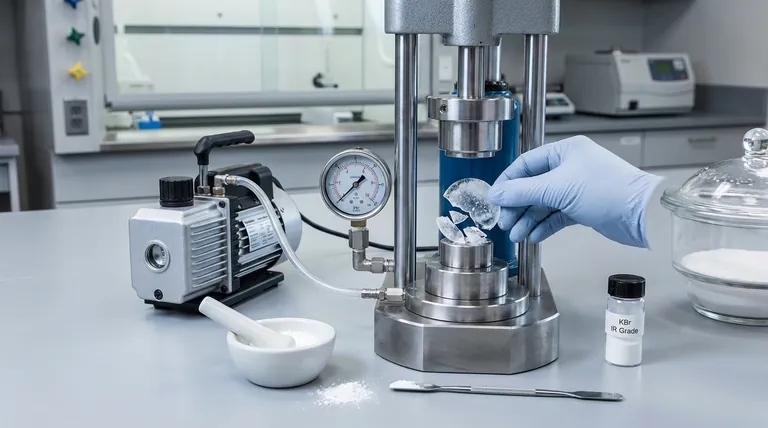
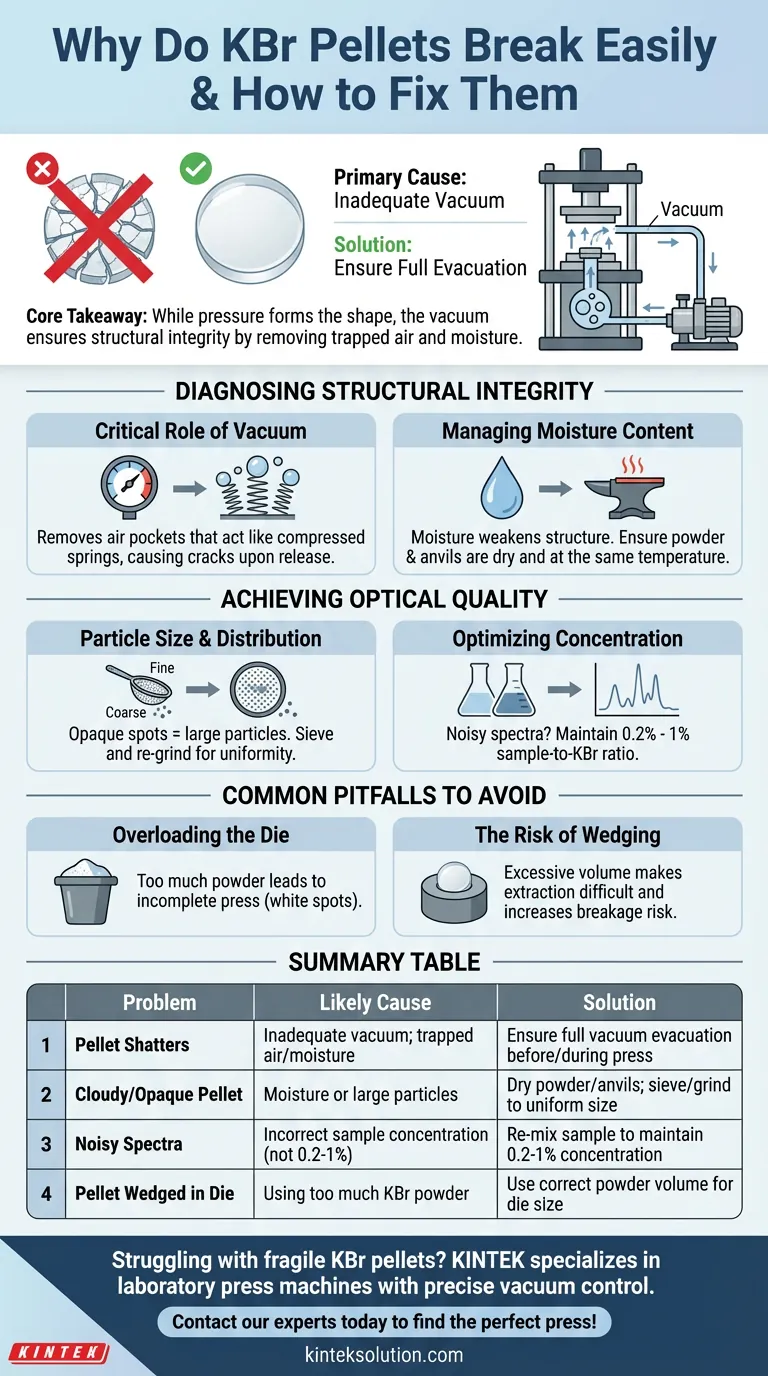
The primary cause of fragile KBr pellets is an inadequate vacuum applied during the pressing stage. When the vacuum is insufficient, air and residual moisture remain trapped within the powder matrix, preventing the potassium bromide particles from fusing into a solid, cohesive disc. To resolve this, you must ensure your vacuum system is functioning correctly to fully evacuate the die before and during compression.
Core Takeaway: While pressure forms the shape, the vacuum ensures structural integrity. A durable pellet requires the complete removal of interstitial air and moisture to allow the KBr crystals to mechanically bond without internal stress fractures.
Diagnosing Structural Integrity
The failure of a pellet to hold its shape is rarely a result of the sample material itself, but rather the environment in which it was pressed.
The Critical Role of Vacuum
The vacuum stage is not optional for stable pellets. Its purpose is to remove air pockets that would otherwise be compressed during the pressing cycle.
If this air remains, it acts like a compressed spring. Once the hydraulic pressure is released, the trapped air expands, causing the pellet to crack or shatter immediately.
Managing Moisture Content
While moisture is the primary cause of cloudy pellets, it also affects mechanical stability. The KBr powder and the pressing anvils must be completely dry.
Ensure the powder and anvils are at the same temperature before pressing. Temperature discrepancies can lead to condensation, creating defects that weaken the pellet's structure.
Achieving Optical Quality
Solving the breakage issue ensures you have a physical pellet to test, but you must also address composition to ensure that pellet yields useful spectral data.
Particle Size and Distribution
Opaque spots in an otherwise clear pellet indicate uneven powder distribution or the presence of large particles.
To fix this, the powder mixture must be sieved to remove coarse grains. If the mix is inconsistent, re-grind the sample and press it again to achieve a uniform, transparent window.
Optimizing Concentration
A durable pellet is useless if the spectral data is unreadable. Noisy spectra often result from an incorrect sample-to-KBr ratio.
Maintain a sample concentration between 0.2% and 1%. Concentrations outside this range lead to over-absorption or light scattering, degrading the quality of the analysis.
Common Pitfalls to Avoid
Even with a good vacuum, mechanical errors during preparation can lead to failed presses.
Overloading the Die
One of the most frequent errors is using too much KBr powder. A thicker pellet requires significantly more force to compress effectively.
If you use too much powder without applying inordinate force, the pellet will likely contain white spots, indicating an incomplete press.
The Risk of Wedging
Excessive powder volume also presents a mechanical hazard. The resulting pellet often wedges tightly in the die, making extraction difficult and increasing the risk of breakage during removal.
Making the Right Choice for Your Goal
To consistently produce high-quality KBr pellets, you must balance mechanical preparation with chemical composition.
- If your primary focus is preventing breakage: Prioritize the vacuum system to ensure all air is evacuated before applying full hydraulic pressure.
- If your primary focus is optical clarity: Ensure all materials are moisture-free and sieved to remove coarse particles that cause opaque spots.
- If your primary focus is spectral accuracy: Strictly adhere to the 0.2% to 1% concentration range to prevent noise and scattering.
Mastering the vacuum step is the foundational skill that transforms a pile of loose powder into a durable, analytical-grade window.
Summary Table:
| Problem | Likely Cause | Solution |
|---|---|---|
| Pellet Shatters | Inadequate vacuum; trapped air/moisture | Ensure full vacuum evacuation before/during press |
| Cloudy/Opaque Pellet | Moisture or large particles | Dry powder/anvils; sieve/grind to uniform size |
| Noisy Spectra | Incorrect sample concentration (not 0.2-1%) | Re-mix sample to maintain 0.2-1% concentration |
| Pellet Wedged in Die | Using too much KBr powder | Use correct powder volume for die size |
Struggling with fragile KBr pellets? KINTEK specializes in laboratory press machines, including automatic lab presses and heated lab presses designed with precise vacuum control to eliminate the air and moisture that cause pellets to break. Ensure your sample preparation is reliable and your FTIR results are accurate. Contact our experts today to find the perfect press for your lab's needs!
Visual Guide
Related Products
- Laboratory Hydraulic Press 2T Lab Pellet Press for KBR FTIR
- XRF KBR Plastic Ring Lab Powder Pellet Pressing Mold for FTIR
- XRF KBR Steel Ring Lab Powder Pellet Pressing Mold for FTIR
- Laboratory Hydraulic Pellet Press for XRF KBR FTIR Lab Press
- Automatic Laboratory Hydraulic Press for XRF and KBR Pellet Pressing
People Also Ask
- What is the role of a laboratory pressure machine and KBr in FTIR? Master Sample Preparation for Flame Retardants
- What is the role of a laboratory hydraulic press in high-loading NCM811 cathode prep for solid-state batteries?
- Why is a laboratory hydraulic press necessary for sample preparation? Precise Pelleting for Spiro Heterocyclic Analysis
- What role does a laboratory hydraulic press play in reaction pellets? Optimizing Lunar Soil and Metal Fuel Density
- What role does a laboratory hydraulic press play in molding polymer composites? Ensure Specimen Integrity & Precision



















