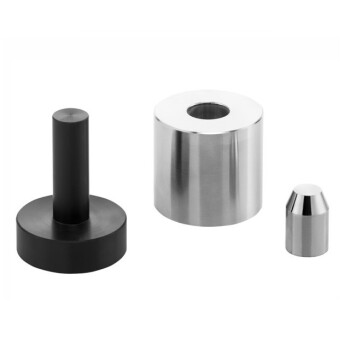
Precision dies for energy materials require a dual focus on extreme material hardness and exceptional surface finishing. To ensure sample integrity, these dies are typically constructed from high-hardness alloy steel or cemented carbides capable of withstanding immense pressure without deformation. Crucially, the internal walls must undergo ultra-precision grinding to drastically reduce sidewall friction, which is the primary cause of sample failure during ejection.
The success of pressing energy materials hinges on minimizing friction during the demolding process. By combining wear-resistant materials with ultra-precision ground surfaces, you eliminate the mechanical stresses that cause delamination and micro-cracking, thereby guaranteeing accurate subsequent test data.
Material Selection Requirements
Withstanding Extreme Pressures
The primary requirement for the die body is the ability to resist deformation under load. Energy materials often require extreme forming pressures to achieve the necessary density.
Preferred Materials
To meet these pressure demands, dies are constructed from high-hardness, wear-resistant alloy steel or cemented carbides. These materials provide the structural rigidity required to maintain dimensional accuracy over repeated cycles.
Surface Design and Finishing
Ultra-Precision Grinding
The material hardness alone is insufficient; the finish of the die's internal cavity is equally critical. The internal walls must undergo ultra-precision grinding.
Minimizing Sidewall Friction
The specific goal of this high-level finishing is to minimize sidewall friction. A rougher surface would grab the material during the pressing and ejection phases, introducing fatal structural flaws.
Ensuring Sample Integrity
The Ejection Phase
The most critical moment for sample integrity is demolding (ejection). If friction is present, the ejection force translates into shear stress across the sample.
Preventing Structural Defects
By reducing friction through precision grinding, the design prevents common failure modes. Specifically, this eliminates delamination, edge chipping, and micro-cracks that often occur when a sample "sticks" to the die walls.
Impact on Data Accuracy
The physical integrity of the sample directly correlates to the accuracy of test data. A sample with micro-cracks will yield compromised results, making the die's surface quality a prerequisite for valid scientific analysis.
Understanding the Trade-offs
Cost vs. Data Fidelity
Achieving an ultra-precision ground finish on extremely hard carbide materials is a manufacturing challenge that increases tooling costs. However, for energy materials, this investment is necessary to avoid the hidden costs of invalid test results caused by microscopic sample defects.
Handling and Maintenance
While cemented carbides offer superior wear resistance, they are often brittle. These dies require careful handling to prevent the die itself from chipping, which would immediately ruin the internal surface finish and compromise future samples.
Making the Right Choice for Your Goal
To select the correct die configuration for your application, consider the following:
- If your primary focus is long-term durability: Prioritize cemented carbides, as their extreme wear resistance maintains the critical surface finish over a higher number of pressing cycles.
- If your primary focus is preventing immediate sample failure: Verify that the internal walls feature ultra-precision grinding, as this is the deciding factor in preventing cracking during ejection.
- If your primary focus is cost-efficiency for lower pressures: Alloy steel may suffice, provided the internal surface finish still meets the strict friction-reduction requirements.
Invest in the surface quality of your die today to ensure the reliability of your energy data tomorrow.
Summary Table:
| Requirement Category | Specification Detail | Benefit to Sample Integrity |
|---|---|---|
| Core Material | High-hardness alloy steel or Cemented Carbides | Prevents die deformation under extreme pressures |
| Surface Finish | Ultra-precision grinding | Minimizes sidewall friction during ejection |
| Structural Goal | Friction reduction | Eliminates delamination, chipping, and micro-cracks |
| Data Quality | High dimensional accuracy | Ensures valid scientific analysis and reliable test results |
Precision Solutions for Your Battery Research
Guarantee the integrity of your samples with KINTEK’s high-performance laboratory pressing solutions. From manual and automatic presses to specialized cold and warm isostatic presses, we provide the precision engineering required to eliminate mechanical stress and sample failure.
Our value to you:
- Versatile Equipment: Models ranging from heated and multifunctional to glovebox-compatible designs.
- Advanced Materials: Dies crafted from ultra-hard carbides with superior surface finishes.
- Expert Support: Tailored solutions specifically for rigorous battery material research.
Don't compromise your data with inferior tooling. Contact KINTEK today to find the perfect pressing solution for your lab!
References
- Xiaojun Tang, Song Lv. Applications of All‐Solid‐State Lithium‐Ion Batteries Across Wide Temperature Ranges: Challenges, Progress, and Perspectives (Adv. Energy Mater. 29/2025). DOI: 10.1002/aenm.70008
This article is also based on technical information from Kintek Solution Knowledge Base .
Related Products
- Lab Ring Press Mold for Sample Preparation
- XRF KBR Steel Ring Lab Powder Pellet Pressing Mold for FTIR
- XRF KBR Plastic Ring Lab Powder Pellet Pressing Mold for FTIR
- Lab XRF Boric Acid Powder Pellet Pressing Mold for Laboratory Use
- Lab Button Battery Tablet Press Sealing Mold
People Also Ask
- What is the purpose of incorporating cartridge heaters into a lab press mold for MLCC block compression? Optimize Results
- What is the role of a laboratory press in COF electrolyte prep? Achieving High-Performance Pellet Densification
- Why is precise cooling management of the lab press mold necessary? Protect Core Integrity in Thermoforming
- What is the function of a pressing tool in thermoplastic panels? Master Precision Shaping & Fusion Bonding
- What impact does a sample preparation press have on testing results when researching MXene as an electrolyte additive?