
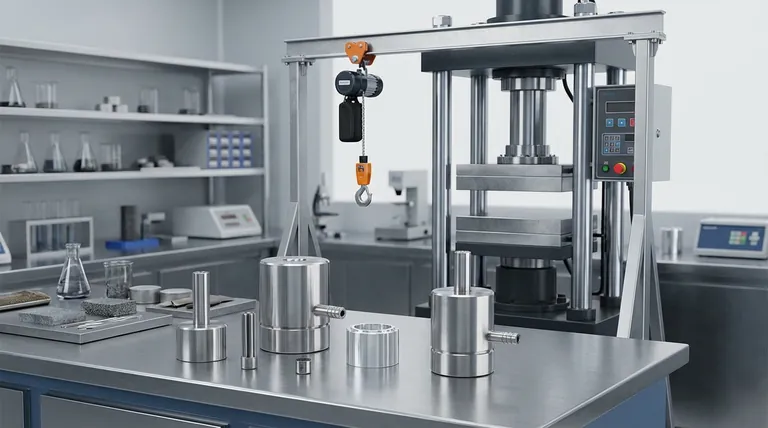
Beyond the standard configuration, the primary additional modules available for these presses are specialized press moulds and tools for material shaping and cranes designed for efficient batch loading and unloading. These components expand the press's capabilities from a general-purpose unit into a solution tailored for specific applications and workflows.
A standard press provides controlled heat and pressure, but its true utility is unlocked by additional modules. These modules are the critical link between the press's power and your specific goal, whether that's creating a precise component shape or achieving high-volume throughput.
The Foundation: Standard Press Equipment
Before considering additions, it is essential to understand the baseline. A standard laboratory press is a complete system for applying force and heat.
Core Functional Components
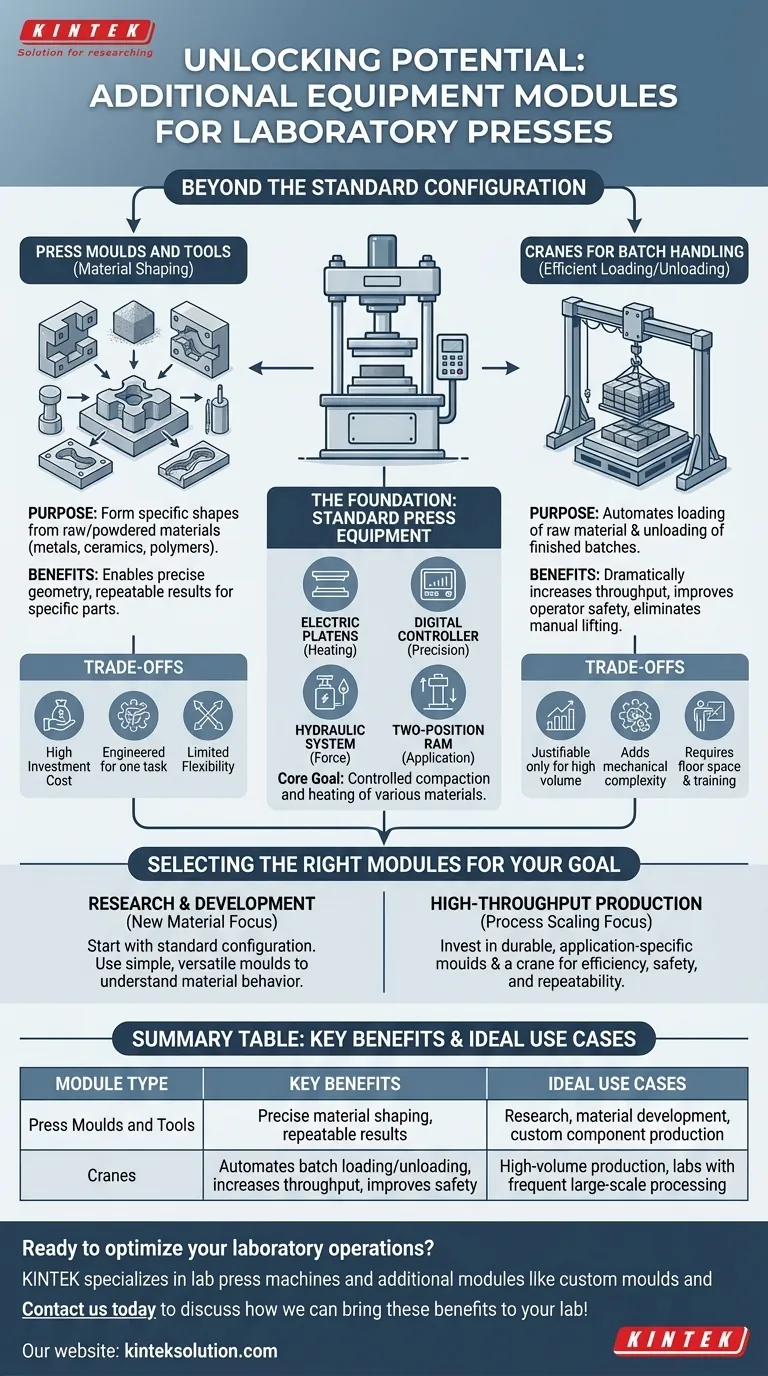
Every press includes a set of standard components that manage its core operation. These are the electric platens for heating, a precise digital temperature controller, a robust hydraulic system for generating force, and a two-position ram to apply it.
The Standard Operational Goal
This built-in equipment is designed to achieve one primary goal: the controlled compaction and heating of various materials. The broad pressure range is engineered to handle everything from metals and ceramics to plastics and composites.
Key Additional Modules and Their Purpose
Additional modules are not accessories; they are functional extensions that adapt the press for a specific task or production scale. They fall into two main categories: tooling and material handling.
Press Moulds and Tools
This is the most critical module for shaping a final product. The mould is the cavity that defines the part's geometry as pressure is applied.
Specialized moulds and tools are required to form a specific shape from a raw or powdered material. The design of the mould depends entirely on the material being processed—metals, ceramics, and polymers behave differently under compaction.
Cranes for Batch Handling
For labs or production environments moving beyond single-sample tests, material handling becomes a significant bottleneck.
A crane module automates the loading of raw material and the unloading of finished batches. This dramatically increases throughput and improves operator safety by eliminating the need for manual lifting of heavy assemblies.
Understanding the Trade-offs
Integrating additional modules provides enhanced capability, but it also introduces new considerations that must be weighed carefully.
The Cost and Specificity of Tooling
Custom moulds are a significant investment. They are engineered for a specific part and material, meaning they offer very little flexibility if your processing needs change.
This specialization is a trade-off between versatility and precision. A custom mould produces highly repeatable results for one task but cannot be easily repurposed for another.
The Overhead of Material Handling
Integrating a crane system is only justifiable for high-volume workflows. It adds mechanical complexity, requires dedicated floor space, and necessitates operator training.
For occasional R&D work, the efficiency gains from a crane are negligible and do not outweigh the added operational overhead and initial cost.
Selecting the Right Modules for Your Goal
The decision to invest in additional modules should be driven entirely by your specific operational objectives.
- If your primary focus is research and new material development: Begin with the standard press configuration and perhaps a few simple, versatile mould designs to understand material behavior.
- If your primary focus is process scaling and high-throughput production: Investing in durable, application-specific moulds and a crane for batch handling is critical for achieving efficiency, safety, and repeatability.
Ultimately, viewing these modules as extensions of the core press allows you to build a system precisely tailored to your material processing challenge.
Summary Table:
| Module Type | Key Benefits | Ideal Use Cases |
|---|---|---|
| Press Moulds and Tools | Enables precise material shaping, repeatable results for specific parts | Research, material development, custom component production |
| Cranes | Automates batch loading/unloading, increases throughput, improves safety | High-volume production, labs with frequent large-scale processing |
Ready to optimize your laboratory operations? KINTEK specializes in lab press machines, including automatic lab presses, isostatic presses, and heated lab presses, tailored to meet your specific needs. Our additional modules, like custom moulds and cranes, can enhance precision, efficiency, and safety for your material processing challenges. Contact us today to discuss how we can bring these benefits to your lab!
Visual Guide
Related Products
- Lab Isostatic Pressing Molds for Isostatic Molding
- Lab Cylindrical Press Mold with Scale
- Lab Polygon Press Mold
- Square Lab Press Mold for Laboratory Use
- Lab Round Bidirectional Press Mold
People Also Ask
- What is the purpose of incorporating cartridge heaters into a lab press mold for MLCC block compression? Optimize Results
- What is the function of an isostatic lab press in energy storage research? Achieve Superior Material Standardization
- How do laboratory press machines resolve increased impedance in solid-state batteries? Achieve Low-Resistance Interfaces
- How does controlling the parameters of a laboratory isostatic press contribute to reducing deformation in LTCC channels?
- What is the primary function of a laboratory isostatic press in the synthesis of nitride materials? Achieve High Density



















