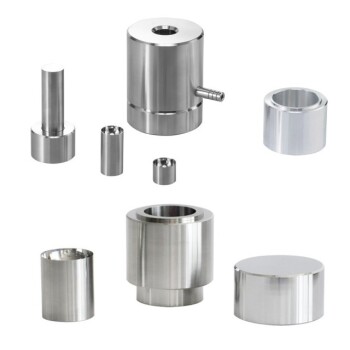
The specific material pairing of PEEK and titanium is driven by the unique chemical volatility and mechanical requirements of sulfide-based solid electrolytes like Li6PS5Cl.
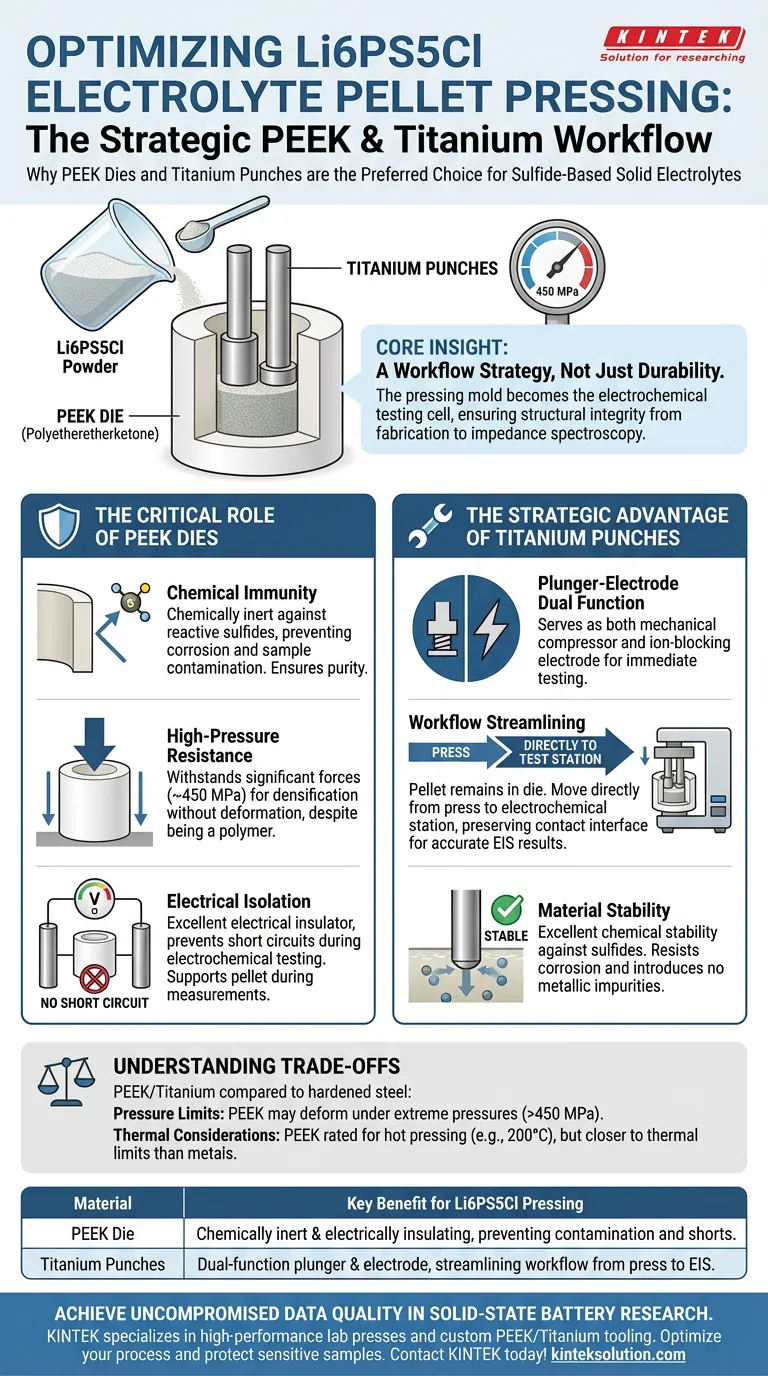
PEEK is selected because it is chemically inert against reactive sulfides and electrically insulating, preventing both sample contamination and short circuits during testing. Titanium punches are chosen for their dual capability: they are hard enough to compress the powder into high-density pellets and chemically stable enough to serve immediately as current collectors, eliminating the need to transfer fragile pellets between devices.
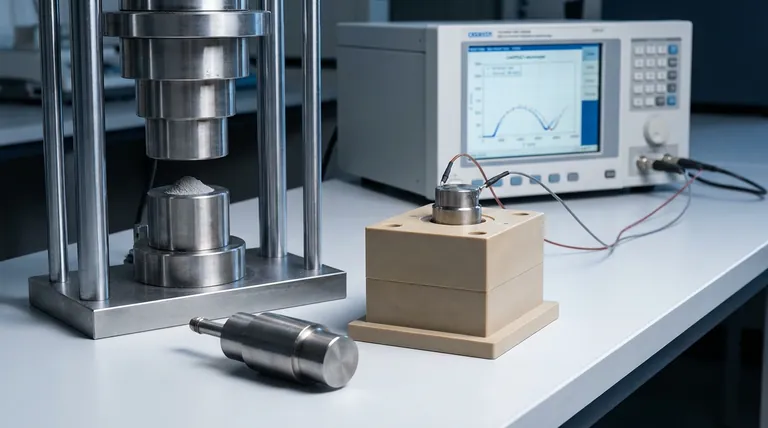
Core Insight: This material combination is not just about durability; it is a workflow strategy. By using PEEK and Titanium, the pressing mold effectively becomes the electrochemical testing cell, ensuring that the pellet's structural integrity remains undisturbed from fabrication through impedance spectroscopy.
The Critical Role of PEEK Dies
Chemical Immunity
Li6PS5Cl is a highly active sulfide electrolyte. Standard steel dies can react with sulfides, leading to corrosion of the die and contamination of the sample.
PEEK (polyetheretherketone) is chemically inert. It ensures the purity of the electrolyte pellet remains compromised during the compaction process.
High-Pressure Resistance
To achieve high ionic conductivity, the electrolyte powder must be densified to eliminate voids. This requires significant force, often around 450 MPa.
PEEK possesses exceptional mechanical strength for a polymer. It withstands these high-pressure forming processes without significant deformation or failure.
Electrical Isolation
During electrochemical testing, the die often remains in place to support the pellet.
Because PEEK is an excellent electrical insulator, it prevents short circuits between the top and bottom plungers. This ensures that any electrical measurements taken reflect the properties of the electrolyte, not the mold.
The Strategic Advantage of Titanium Punches
The "Plunger-Electrode" Dual Function
In a standard setup, you press a pellet, eject it, and place it between electrodes. This risks breaking the fragile pellet.
Titanium plungers solve this by serving two roles simultaneously. They act as the mechanical ram to compress the powder, and subsequently as the "ion-blocking" electrode for electrical testing.
Workflow Streamlining
Because the punches serve as electrodes, the pellet does not need to be removed from the die after pressing.
You can move the entire assembly directly from the hydraulic press to the electrochemical station. This preserves the contact interface between the particles, which is critical for accurate impedance spectroscopy (EIS) results.
Material Stability
Like PEEK, titanium exhibits excellent chemical stability against sulfide electrolytes (and similar materials like Na3PS4).
It resists corrosion and does not introduce metallic impurities into the solid electrolyte, which ensures the accuracy of full battery assembly or conductivity tests.
Understanding the Trade-offs
While PEEK and Titanium are ideal for this specific application, they have limitations compared to hardened steel.
Pressure Limits vs. Steel
While PEEK is strong, it is not as rigid as tool steel. Under extreme pressures (significantly exceeding 450 MPa), PEEK dies can undergo elastic deformation or "barreling," which may affect pellet dimensionality.
Thermal Considerations
Hot pressing (e.g., at 200°C) is often used to improve plasticity and creep in Li6PS5Cl pellets. PEEK handles this temperature well, but it is closer to its thermal limits than metals. Continuous cycling at very high temperatures may degrade the die over time compared to ceramic or metal alternatives.
Making the Right Choice for Your Goal
To maximize the quality of your Li6PS5Cl electrolyte data, align your tooling with your specific experimental needs:
- If your primary focus is Electrochemical Impedance Spectroscopy (EIS): Use the Titanium/PEEK setup to test the pellet while it remains under pressure in the mold, ensuring the lowest possible interfacial resistance.
- If your primary focus is achieving maximum density via Hot Pressing: Ensure your PEEK grade is rated for the specific temperature (e.g., 200°C) to prevent die creep during the heating phase.
- If your primary focus is mass production of pellets for storage: You may use standard steel dies only if lined with a protective inert foil, but PEEK remains the safer option to avoid surface reactions.
By choosing these materials, you are prioritizing the chemical purity and structural continuity essential for high-performance solid-state battery research.
Summary Table:
| Material | Key Property | Benefit for Li6PS5CL Pellet Pressing |
|---|---|---|
| PEEK Die | Chemically inert & electrically insulating | Prevents sample contamination and short circuits during pressing and testing. |
| Titanium Punches | High strength & chemical stability | Acts as both plunger and electrode, streamlining the workflow from press to EIS. |
Achieve Uncompromised Data Quality in Your Solid-State Battery Research
Are you working with sensitive materials like Li6PS5Cl or other solid electrolytes? The right tooling is critical for success. KINTEK specializes in high-performance lab press machines and custom tooling solutions, including PEEK dies and titanium punches, designed specifically for the demanding needs of battery research laboratories.
Our automatic lab presses, isostatic presses, and heated lab presses ensure you can achieve the high-density pellets required for accurate electrochemical testing. Let us help you streamline your workflow and protect your samples from contamination.
Contact us today to discuss your specific application and optimize your pellet pressing process with KINTEK!
Visual Guide
Related Products
- Laboratory Hydraulic Split Electric Lab Pellet Press
- Lab Ring Press Mold for Sample Preparation
- Lab XRF Boric Acid Powder Pellet Pressing Mold for Laboratory Use
- Lab Infrared Press Mold for No Demolding
- XRF KBR Steel Ring Lab Powder Pellet Pressing Mold for FTIR
People Also Ask
- What are the emerging trends in the design and materials of lab pellet presses? Modernize Your Lab Efficiency
- What are common lab pellet press issues? Expert Troubleshooting Guide for Reliable Material Research
- How do lab pellet presses support customization and flexibility? Optimize Your Sample Prep for Any Material
- What are the common operational types of lab pellet presses? Choosing the Right Manual, Automatic, or Hydraulic System
- Why use a laboratory pellet press for solid-state battery evaluation? Ensure Accuracy in Interface Stability Testing