
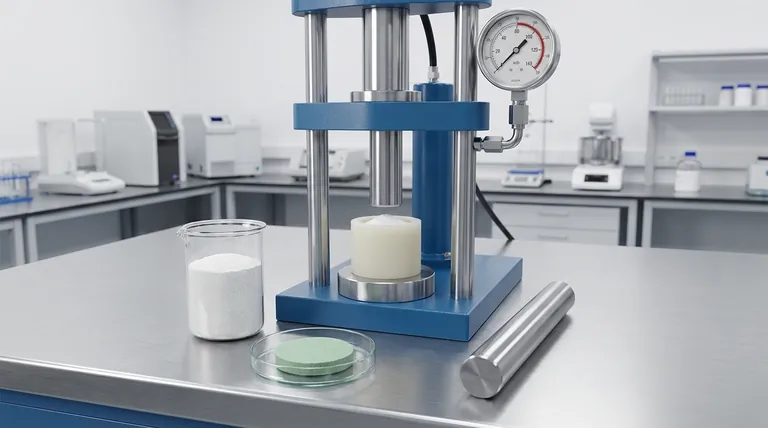
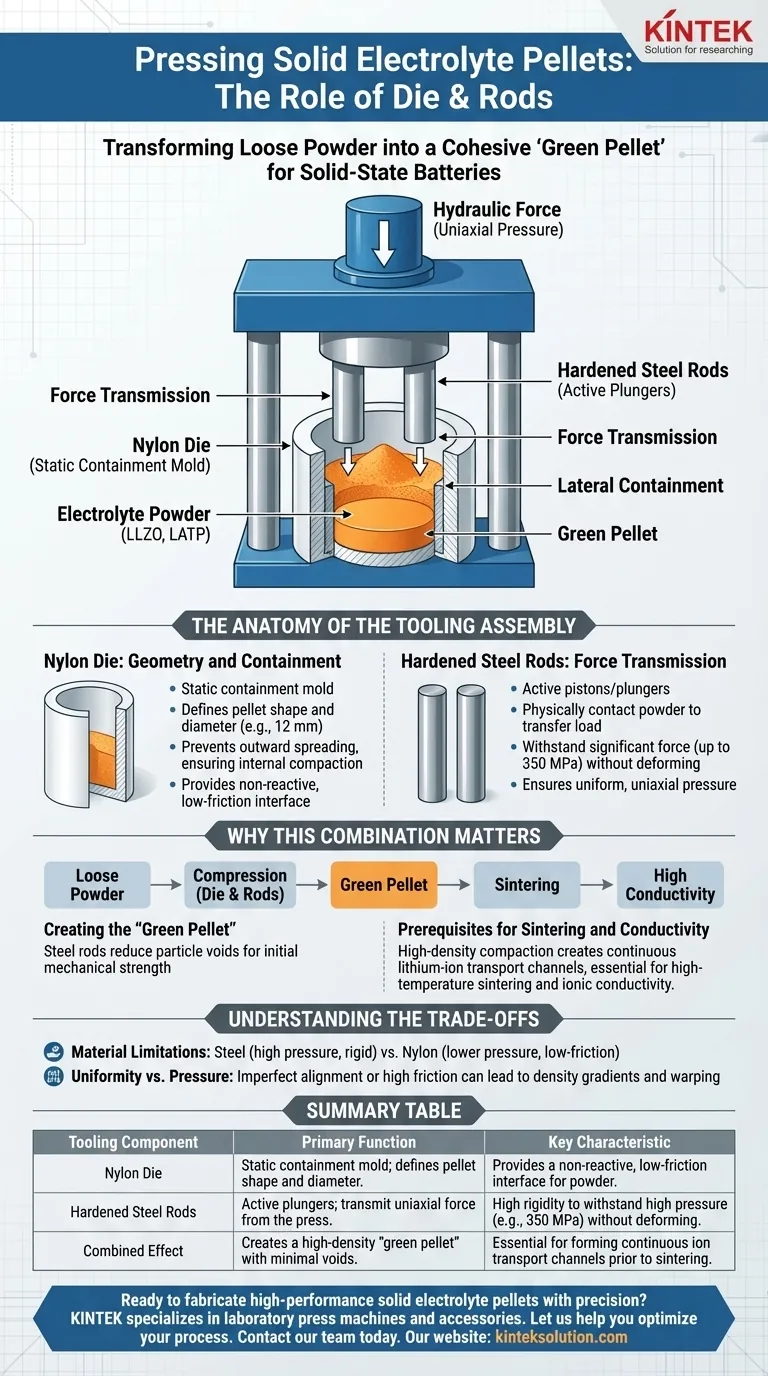
In the fabrication of solid electrolyte pellets, the nylon die functions as the static containment mold that defines the pellet's shape and diameter, while the hardened steel rods act as the active plungers to transmit force. This specific tooling combination transforms loose electrolyte powder into a cohesive unit by subjecting it to precise uniaxial pressure within a hydraulic press.
The synergy between the containment of the die and the rigidity of the rods is the determining factor in creating a "green pellet" with sufficient density. Without this precise tooling, the hydraulic press cannot effectively reduce particle voids to create the continuous transport channels required for ionic conductivity.
The Anatomy of the Tooling Assembly
The Nylon Die: Geometry and Containment
The primary role of the nylon die is to serve as the shaping vessel. It confines the loose electrolyte powder (such as LLZO, LATP, or Li6PS5Cl) within a specific geometric boundary.
By restricting the powder's lateral movement, the die ensures the final product achieves a consistent diameter (e.g., 12 mm). This containment is passive but critical; it translates the vertical force of the press into internal compaction rather than outward spreading.
The Steel Rods: Force Transmission
The hardened steel rods function as pistons or plungers. They are the dynamic components that physically enter the nylon die to make contact with the powder.
Their role is to transfer the load generated by the hydraulic press directly onto the electrolyte material. Because they are made of hardened steel, they can withstand significant force (often up to 10 kilonewtons or pressures around 350 MPa) without deforming, ensuring the pressure applied to the powder is uniform and uniaxial.
Why This Combination Matters
Creating the "Green Pellet"
The immediate goal of this tooling is to produce a "green pellet"—a compacted disk with enough initial mechanical strength to be handled.
The steel rods compress the powder to significantly reduce the voids between particles. This compaction is the necessary first step to create a form stable enough for subsequent processing.
Prerequisites for Sintering and Conductivity
The interaction between the die and rods directly impacts the electrochemical performance of the final material. By forcing particles into closer contact, the tooling facilitates the creation of continuous lithium-ion transport channels.
This high-density compaction is a fundamental prerequisite for high-temperature sintering. If the initial pressing by the rods and die is insufficient, the final ceramic sheet will lack the ionic conductivity required for high-performance solid-state batteries.
Understanding the Trade-offs
Material Limitations
While hardened steel is excellent for force transmission, it is rigid and unforgiving. The nylon die is used in conjunction likely to provide a non-reactive, lower-friction interface, but nylon has lower pressure limits than steel.
Uniformity vs. Pressure
The process relies on uniaxial compression, meaning force comes from one direction.
If the steel rods are not perfectly aligned within the nylon die, or if the friction at the die walls is too high, the pressure distribution across the pellet may become uneven. This can lead to density gradients where the edges of the pellet are denser than the center, potentially causing warping during the sintering phase.
Making the Right Choice for Your Goal
To ensure you are utilizing this tooling effectively for your specific research needs:
- If your primary focus is mechanical stability: Ensure the steel rods apply sufficient pressure to maximize inter-particle contact, creating a robust green pellet that won't crumble during transfer.
- If your primary focus is ionic conductivity: Prioritize the precision of the nylon die's containment to minimize voids, as density is directly correlated with the reduction of interfacial resistance.
Correctly utilizing the nylon die and steel rods is the first, non-negotiable step in constructing high-performance solid-state batteries.
Summary Table:
| Tooling Component | Primary Function | Key Characteristic |
|---|---|---|
| Nylon Die | Static containment mold; defines pellet shape and diameter. | Provides a non-reactive, low-friction interface for powder. |
| Hardened Steel Rods | Active plungers; transmit uniaxial force from the press. | High rigidity to withstand high pressure (e.g., 350 MPa) without deforming. |
| Combined Effect | Creates a high-density 'green pellet' with minimal voids. | Essential for forming continuous ion transport channels prior to sintering. |
Ready to fabricate high-performance solid electrolyte pellets with precision?
The correct tooling is the foundation of your research. KINTEK specializes in laboratory press machines and accessories, including the precise dies and rods critical for achieving the uniform density required for superior ionic conductivity in solid-state batteries.
Let us help you optimize your process. Our experts can assist in selecting the right equipment for your specific electrolyte materials, such as LLZO or LATP.
Contact our team today to discuss your lab's needs and discover how our automatic lab presses, isostatic presses, and heated lab presses can enhance your results.
Visual Guide
Related Products
- XRF KBR Plastic Ring Lab Powder Pellet Pressing Mold for FTIR
- Lab XRF Boric Acid Powder Pellet Pressing Mold for Laboratory Use
- Laboratory Hydraulic Split Electric Lab Pellet Press
- Lab Ring Press Mold for Sample Preparation
- Lab Infrared Press Mold for No Demolding
People Also Ask
- What is the purpose of making KBr pellets for FTIR? Achieve Precise Molecular Analysis with Solid Samples
- What factors should be considered when choosing a lab press for XRF pellet preparation? Ensure Accurate and Consistent Results
- Why are pellets used in XRF analysis, and what is their limitation? Boost Accuracy and Speed in Your Lab
- How are pellets prepared for XRF analysis and what is a potential drawback? Master XRF Sample Prep and Accuracy
- What are the different types of XRF pellet preparation methods available? Manual, Hydraulic, and Automated Presses Explained


















