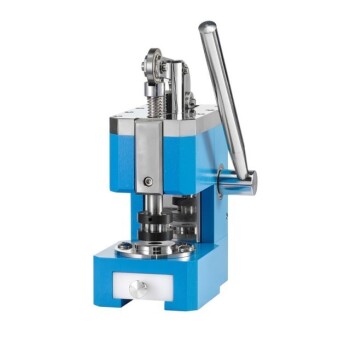
Tungsten Carbide (WC) anvils are the industry standard for this application because they possess the requisite hardness and compressive strength to survive the extreme environments needed for crystal synthesis. Specifically, they serve as the core load-bearing components in the second stage of multi-anvil devices, enabling the system to reach the 22 GPa ultra-high pressure threshold required to synthesize Stishovite.
Synthesizing Stishovite requires subjecting materials to pressures that would crush standard steel components. Tungsten Carbide is employed because its superior compressive strength allows it to act as a second-stage anvil, concentrating massive force through a specific 4mm truncation to achieve the necessary 22 GPa without structural failure.
The Mechanics of Ultra-High Pressure
Reaching the 22 GPa Threshold
The primary challenge in synthesizing Stishovite single crystals is generating an environment of 22 GPa.
This is an ultra-high pressure range that exceeds the capabilities of standard high-pressure apparatus materials.
To achieve this, the equipment must rely on materials that offer exceptional resistance to deformation under load.
The Role of Second-Stage Anvils
In multi-anvil high-pressure devices, pressure is often generated in stages to manage the mechanical stress on the equipment.
Tungsten Carbide anvils are specifically utilized as the second-stage anvils.
They act as the inner core of the device, directly bearing the intensifying load required to transition from lower pressures up to the target synthesis pressure.
Material Properties of Tungsten Carbide
Extreme Hardness and Strength
The selection of Tungsten Carbide is driven by its physical properties, specifically its extreme hardness and compressive strength.
These properties ensure that the anvil transmits force to the sample rather than absorbing it through its own deformation.
Without this rigidity, the anvil surfaces would yield before the sample chamber reached the required 22 GPa.
Pressure Concentration via Truncation
Generating 22 GPa requires more than just a strong material; it requires specific geometric engineering.
WC anvils feature specific truncated edge sizes, such as a 4mm truncation.
This geometry is critical because it concentrates the applied force onto a smaller surface area, mathematically multiplying the pressure delivered to the crystal growth zone.
Operational Constraints and Design
Balancing Pressure and Surface Area
While Tungsten Carbide is robust, the physics of high-pressure synthesis involves a strict trade-off between pressure generation and surface area.
To achieve the 22 GPa required for Stishovite, the anvil's contact area must be reduced via truncation (e.g., 4mm).
This truncation is necessary to concentrate the force, but it implies that the effective synthesis volume is geometrically constrained by the size of the anvil tip.
Making the Right Choice for Your Goal
When designing or selecting equipment for high-pressure mineral synthesis, the relationship between anvil material and target pressure is the determining factor.
- If your primary focus is reaching Stishovite synthesis thresholds: Ensure your multi-anvil device is equipped with Tungsten Carbide second-stage anvils designed with 4mm truncations to reliably hit 22 GPa.
- If your primary focus is equipment longevity: Prioritize Tungsten Carbide for its compressive strength, which prevents premature deformation of the core load-bearing components under ultra-high stress.
Success in Stishovite synthesis relies not just on applying force, but on using Tungsten Carbide's material properties to concentrate that force precisely where it is needed.
Summary Table:
| Feature | Specification/Detail |
|---|---|
| Primary Material | Tungsten Carbide (WC) |
| Anvil Stage | Second-Stage (Inner Core) |
| Target Pressure | 22 GPa |
| Truncation Size | 4mm (Standard for Stishovite) |
| Key Benefit | High compressive strength prevents deformation |
| Application | Ultra-high pressure mineral synthesis |
Elevate Your Research with KINTEK’s Precision Pressing Solutions
Achieving the 22 GPa threshold for Stishovite synthesis requires equipment that never yields under pressure. KINTEK specializes in comprehensive laboratory pressing solutions, providing the high-performance components needed for advanced battery research and mineral synthesis.
Whether you require manual, automatic, heated, or glovebox-compatible models—or specialized cold and warm isostatic presses—our expert team is ready to help you configure the perfect setup for your ultra-high-pressure requirements.
Contact KINTEK today to optimize your laboratory synthesis process!
References
- Narangoo Purevjav, Tomoo Katsura. Temperature Dependence of H<sub>2</sub>O Solubility in Al‐Free Stishovite. DOI: 10.1029/2023gl104029
This article is also based on technical information from Kintek Solution Knowledge Base .
Related Products
- Automatic High Temperature Heated Hydraulic Press Machine with Heated Plates for Lab
- Lab Cylindrical Press Mold for Laboratory Use
- Split Automatic Heated Hydraulic Press Machine with Heated Plates
- Lab Double Plate Heating Mold for Laboratory Use
- Carbide Lab Press Mold for Laboratory Sample Preparation
People Also Ask
- Function of a Laboratory Hydraulic Press with Heated Platens in SSE? Enhance Battery Density & Conductivity
- What are the requirements for electrode pressing with high-viscosity ionic liquids like EMIM TFSI? Optimize Performance
- How does a laboratory heated hydraulic press facilitate PBN sample prep for WAXS? Achieve Precise X-Ray Scattering
- What are the industrial applications of heated hydraulic presses? Master Heat & Force for Precision Manufacturing
- Why is a laboratory hydraulic press with heating plates required for PLA/TEC films? Achieve Precise Sample Integrity