
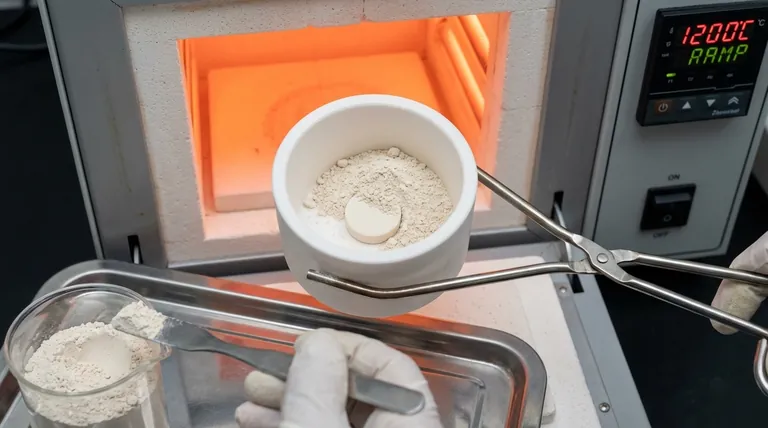
To preserve essential electrochemical properties, the pressed LLTO pellet is buried to counteract the extreme volatility of lithium at high sintering temperatures. Specifically, at 1200°C, lithium atoms tend to evaporate from the crystal lattice, which would otherwise degrade the material's performance.
High-temperature sintering naturally drives lithium out of ceramic materials, leading to stoichiometric defects. By burying the pellet in "sacrificial" powder of the same composition, you create a saturated local atmosphere that effectively stops this evaporation, ensuring the final product retains high ionic conductivity.
The Challenge of High-Temperature Sintering
The Volatility of Lithium
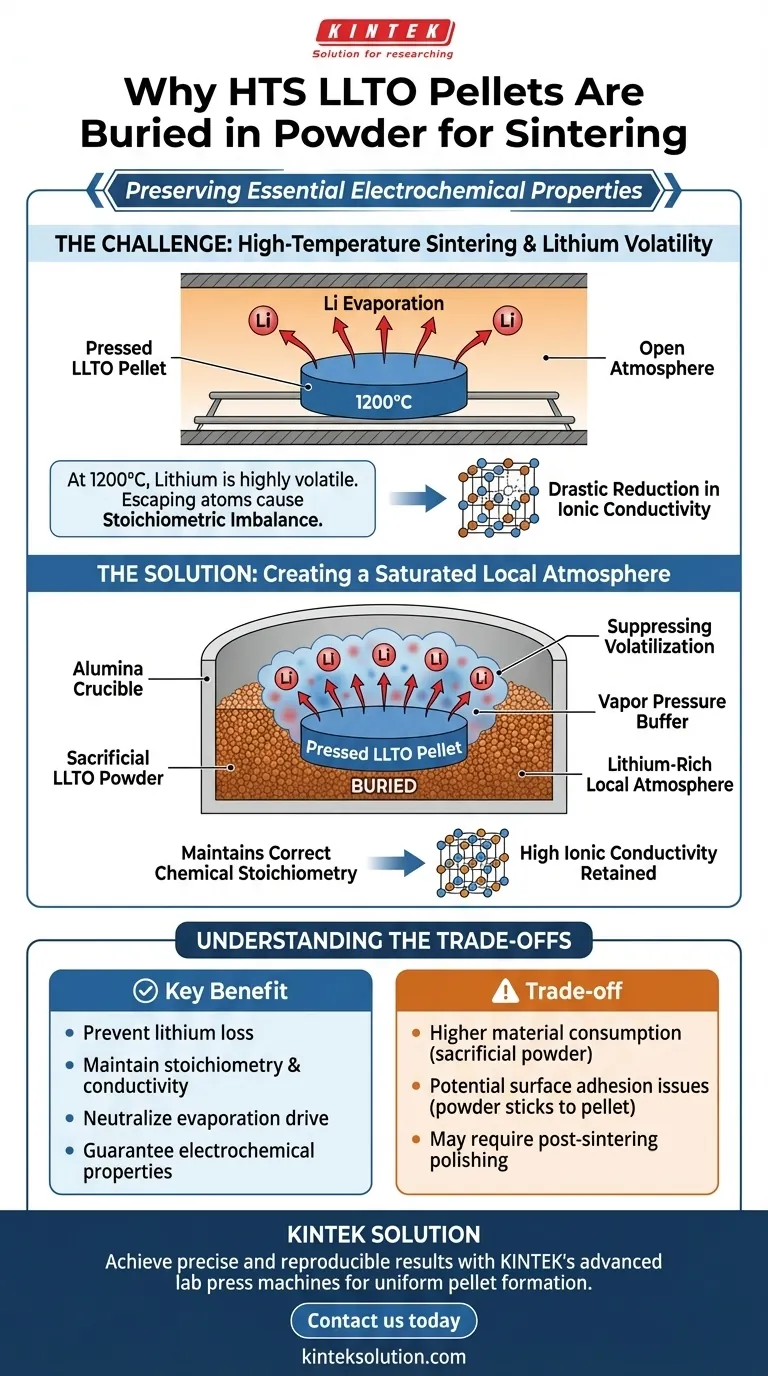
Sintering LLTO (Lithium Lanthanum Titanate) requires temperatures around 1200°C to achieve densification. However, lithium is highly volatile at these elevated temperatures.
Without protection, lithium atoms will escape from the surface of the pellet into the open atmosphere of the furnace.
The Cost of Stoichiometric Imbalance
When lithium evaporates, the chemical composition (stoichiometry) of the pellet changes.
This loss is not merely cosmetic; it fundamentally alters the crystal structure. A deficiency in lithium directly results in a drastic reduction in ionic conductivity, rendering the electrolyte less effective.
How the "Burying" Technique Works
Creating a Local Atmosphere
By burying the pressed pellet in loose powder of the identical LLTO composition, you modify the immediate environment inside the alumina crucible.
As the furnace heats up, the surrounding powder releases lithium vapor just as the pellet would. This creates a lithium-rich local atmosphere directly around the sample.
Suppressing Volatilization
Because the air pockets around the pellet are already saturated with lithium vapor from the powder, the thermodynamic drive for lithium to leave the pellet is neutralized.
This equilibrium creates a "vapor pressure buffer." It effectively suppresses the volatilization loss from the sample, ensuring the pellet maintains the correct chemical stoichiometry throughout the heating cycle.
Understanding the Trade-offs
Material Consumption
The primary downside of this method is material efficiency. You must produce or purchase significantly more LLTO powder than is strictly required for the pellet itself to serve as the "sacrificial" bedding.
Surface Quality Risks
While this method preserves bulk chemistry, physical contact with the powder can impact the surface finish.
At sintering temperatures, the bedding powder may slightly adhere to the pellet surface. This often requires post-processing, such as polishing, to achieve a perfectly smooth interface for subsequent testing or assembly.
Making the Right Choice for Your Goal
This technique is a standard requirement for processing volatile alkali-based ceramics. Here is how to prioritize your approach:
- If your primary focus is conductivity: Prioritize a complete covering of powder to guarantee zero lithium loss, as even minor evaporation can ruin performance.
- If your primary focus is surface finish: Use a coarser bedding powder to minimize adhesion, but ensure the chemical composition remains identical to avoid contamination.
By controlling the local atmosphere, you transform a volatile process into a stable, reproducible manufacturing step.
Summary Table:
| Purpose | Method | Key Benefit | Trade-off |
|---|---|---|---|
| Prevent lithium loss | Bury pellet in identical LLTO powder | Maintains stoichiometry & ionic conductivity | Higher material consumption |
| Create saturated atmosphere | Use sacrificial powder in alumina crucible | Neutralizes lithium evaporation drive | Potential surface adhesion issues |
| Ensure performance | Control local vapor pressure | Guarantees electrochemical properties | May require post-sintering polishing |
Achieve precise and reproducible results in your ceramic sintering processes with KINTEK's advanced lab press machines.
Whether you are preparing LLTO pellets or other volatile ceramic materials, our automatic lab presses, isostatic presses, and heated lab presses ensure uniform pellet formation critical for high-temperature sintering. Let our equipment help you maintain material stoichiometry and achieve superior ionic conductivity.
Contact us today to discuss how KINTEK's solutions can enhance your laboratory's efficiency and material performance.
Visual Guide
Related Products
People Also Ask
- What is the purpose of incorporating cartridge heaters into a lab press mold for MLCC block compression? Optimize Results
- How do the design and geometric precision of pressing molds and mandrels affect the quality of PTFE composite samples?
- What role do precision positioning and pressure molds play in single-lap joints? Ensure 100% Data Integrity
- What are the requirements for pressing molds when using SSCG? Key Materials for Complex Single Crystal Production
- How do industrial-grade pressure molds affect zinc metal pouch cells? Maximize Energy Density & Performance

