
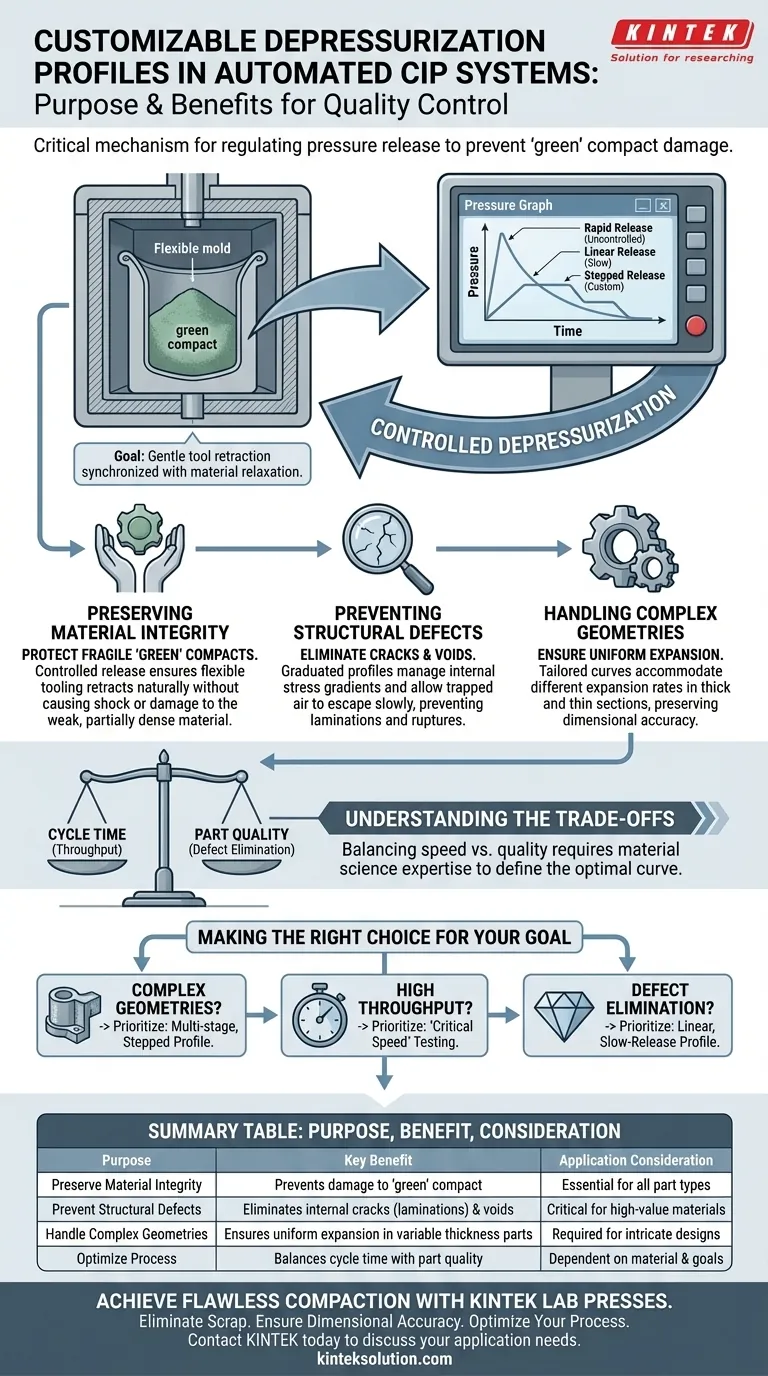
Customizable depressurization profiles serve as a critical quality control mechanism in Cold Isostatic Pressing (CIP) systems. Their primary purpose is to regulate the rate at which pressure is released after the compaction cycle, preventing the sudden expansion of trapped air or material "springback" that destroys the structural integrity of the newly formed part.
By precisely controlling the speed of pressure release, these profiles ensure that the flexible tooling retracts naturally without damaging the fragile "green" compact, thereby preventing defects like cracks and voids.
Preserving Material Integrity
The phase immediately following high-pressure compaction is the most delicate part of the CIP process.
The "Green" Compact State
Once the powder has been compressed, it converts into a "green compact."
This material is partially dense but lacks the strength of a sintered part. It is highly susceptible to mechanical shock.
Controlling Tool Retraction
As pressure drops, the flexible mold (tooling) attempts to return to its original shape.
If the pressure is released too quickly, the tool pulls away violently. Customizable profiles ensure the tool retracts gradually, moving in sync with the material's relaxation.
Preventing Structural Defects
The most significant advantage of adjustable depressurization is the reduction of scrap rates.
Eliminating Cracks and Voids
Rapid depressurization creates internal stress gradients.
This often results in "laminations" or internal cracks that are invisible from the exterior. A controlled profile allows internal stresses to equalize gently.
Managing Air Expansion
Small amounts of air trapped within the powder structure expand as external pressure drops.
A graduated depressurization profile allows this air to escape or expand slowly without rupturing the bonds between powder particles.
Handling Complex Geometries
Standard, linear depressurization is often insufficient for parts with intricate designs.
Geometric Sensitivity
Parts with varying cross-sectional thicknesses or complex curves respond differently to pressure changes.
A thick section may expand at a different rate than a thin section.
Tailored Release Rates
Customizable profiles allow engineers to program specific curves—such as a stepped release—to accommodate these differences.
This ensures uniform expansion across the entire geometry, preserving the dimensional accuracy of the part.
Understanding the Trade-offs
While customizable profiles are essential for quality, they introduce variables that must be managed.
Cycle Time vs. Quality
The primary trade-off is throughput.
An extremely slow, cautious depressurization profile maximizes part quality but extends the total cycle time.
Complexity of Operation
Implementing these profiles requires a deeper understanding of material science.
Operators cannot simply press "go"; they must define the optimal curve for each specific powder and shape to avoid wasting time on unnecessarily slow cycles.
Making the Right Choice for Your Goal
When configuring your CIP system, your approach to depressurization should be dictated by the specific requirements of your end product.
- If your primary focus is Complex Geometries: Prioritize a multi-stage, stepped depressurization profile to account for uneven stress release in variable thicknesses.
- If your primary focus is High Throughput: Conduct testing to find the "critical speed"—the fastest rate you can depressurize without inducing microscopic cracking.
- If your primary focus is Defect Elimination: Use a linear, slow-release profile to guarantee the flexible tooling separates gently from the green compact.
The ultimate value of a customizable profile is the ability to balance production speed against the physical limitations of your material.
Summary Table:
| Purpose | Key Benefit | Application Consideration |
|---|---|---|
| Preserve Material Integrity | Prevents damage to fragile 'green' compact | Essential for all part types |
| Prevent Structural Defects | Eliminates internal cracks (laminations) and voids | Critical for high-value materials |
| Handle Complex Geometries | Ensures uniform expansion in parts with variable thickness | Required for intricate designs |
| Optimize Process | Balances cycle time (throughput) with part quality | Dependent on material and part goals |
Achieve flawless compaction results with a KINTEK lab press.
The precise control offered by customizable depressurization profiles is a hallmark of advanced laboratory pressing. KINTEK's range of automated lab presses, including isostatic and heated models, are engineered to provide this critical level of control for researchers and production specialists.
Whether you are developing new materials or manufacturing complex components, our presses help you:
- Eliminate Scrap: Protect your valuable samples and materials from stress-induced defects like cracks and laminations.
- Ensure Dimensional Accuracy: Maintain the integrity of complex geometries and achieve consistent, high-quality results.
- Optimize Your Process: Fine-tune cycle times without sacrificing the quality of your green compacts.
Ready to enhance your lab's capabilities? Contact KINTALK today to discuss how our press solutions can meet your specific application needs.
Visual Guide
Related Products
- Automatic Lab Cold Isostatic Pressing CIP Machine
- Manual Cold Isostatic Pressing CIP Machine Pellet Press
- Electric Split Lab Cold Isostatic Pressing CIP Machine
- Electric Lab Cold Isostatic Press CIP Machine
- Warm Isostatic Press for Solid State Battery Research Warm Isostatic Press
People Also Ask
- What are the key features of automated laboratory Cold Isostatic Press (CIP) systems? Achieve Precise, High-Pressure Powder Consolidation
- Why is an Isostatic Press (CIP) Necessary After Uniaxial Pressing? Achieve Transparency in Nd:Y2O3 Ceramics
- How does a Cold Isostatic Press (CIP) facilitate the preparation of CaO-doped silicon carbide (SiC) green bodies?
- How does a Cold Isostatic Press (CIP) increase Bi-2223/Ag current density? Boost Superconductivity with Uniform Pressure
- What is the primary function of a Cold Isostatic Press (CIP) in NASICON preparation? Achieve 96% Theoretical Density

















