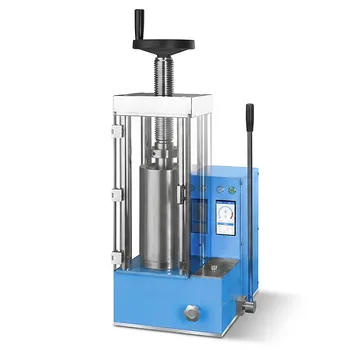
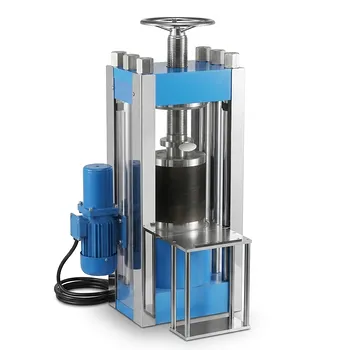
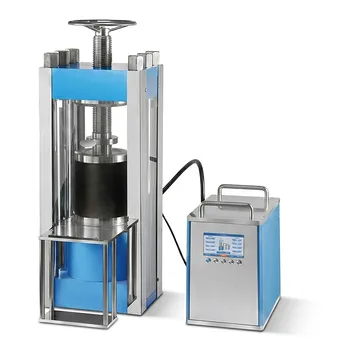
Cold Isostatic Pressing (CIP) uses a fluid medium to apply uniform, omnidirectional pressure—often reaching 200 MPa—to cathode material powders. This method significantly increases the density of the green pellet and eliminates the internal density gradients and stress imbalances typically caused by mold wall friction in standard uniaxial dry pressing.
Core Takeaway: By providing isotropic pressure, Cold Isostatic Pressing ensures a uniform microstructure and high density in cathode pellets. This is essential for preventing defects during sintering and obtaining accurate measurements of bulk ionic and electronic conductivity.
Achieving Structural Uniformity and Density
Elimination of Internal Density Gradients
Standard dry pressing is limited by uniaxial force, which creates friction between the powder and the mold walls. This friction leads to uneven pressure distribution and significant internal density gradients within the pellet.
CIP resolves this by using a liquid medium to transmit isotropic pressure equally from all directions. This omnidirectional compression ensures that the entire volume of the cathode material achieves a uniform state.
Superior Green Body Density
The application of high, uniform pressure—frequently up to 200 MPa—results in a much higher green body density compared to traditional methods. For oxide materials like NLNMOF, this initial density is the foundation for a high-quality final product.
A denser green body reduces the distance between particles. This facilitates better grain growth and more efficient densification during the subsequent sintering phase.
Enhancing Material Integrity During Sintering
Preventing Deformation and Micro-Cracking
Pellets with internal stress imbalances are prone to distortion, cracking, or microstructure heterogeneity when exposed to high-temperature sintering. These defects often stem from the uneven relaxation of stresses trapped during uniaxial pressing.
Because CIP eliminates these stress gradients, the resulting pellets maintain their geometric structure and mechanical integrity. This is particularly critical for maintaining the shape of irregular or high-aspect-ratio samples.
Minimizing Porosity for Accurate Measurement
Achieving a high-density bulk material is decisive for accurately measuring bulk ionic and electronic conductivity. Internal pores can interfere with these measurements, leading to data that reflects porosity rather than the material's intrinsic properties.
CIP minimizes microscopic pores and light scattering losses (in transparent ceramics). In cathode research, this allows scientists to isolate the material's performance by excluding interference from internal voids.
Impact on Electrochemical Performance
Improving Electrode-Electrolyte Compatibility
The uniform force of isostatic pressing ensures that electrolyte and electrode powders are packed with high physical consistency. This improves the physical compatibility between different layers in a solid-state battery or half-cell.
Better contact at these interfaces reduces interfacial resistance. This is a key factor in improving the overall efficiency of energy storage devices.
Enhancing Long-term Cycling Stability
Cathode materials undergo volume changes during the insertion and extraction of ions. Pellets produced via CIP have reduced internal micro-stress, which helps them withstand these mechanical strains.
This enhanced mechanical integrity prevents the formation of micro-cracks during testing. Consequently, the material exhibits better stability and a longer lifespan during long-term electrochemical cycling.
Understanding the Trade-offs
Process Complexity and Throughput
While CIP offers superior material properties, it is generally a slower batch process compared to the high-speed, continuous capability of uniaxial dry pressing. Each sample must be sealed in a flexible, airtight sleeve (such as rubber or silicone) before being submerged in the fluid.
Equipment and Preparation Requirements
The need for a pressure vessel and a fluid handling system makes the initial capital investment higher than for simple mechanical presses. Additionally, the requirement for flexible tooling means that precise dimensional control of the "green" (unsintered) state can be more challenging than with rigid metal molds.
Applying CIP to Your Research or Production
Recommendations for Material Processing
- If your primary focus is conductivity characterization: Utilize CIP to ensure maximum density and eliminate pores that could skew ionic or electronic conductivity data.
- If your primary focus is large-scale production speed: Stick to standard dry pressing unless the material exhibits significant cracking or warping during sintering.
- If your primary focus is long-term mechanical stability: Use CIP to minimize internal micro-stresses that lead to fatigue and cracking during battery cycling.
Cold Isostatic Pressing is the definitive choice when the goal is to eliminate structural defects and achieve the high-density uniformity required for precise electrochemical analysis.
Summary Table:
| Feature | Cold Isostatic Pressing (CIP) | Standard Dry Pressing (Uniaxial) |
|---|---|---|
| Pressure Direction | Omnidirectional (Isotropic) | Single Axis (Uniaxial) |
| Density Uniformity | High (No internal gradients) | Low (Friction creates gradients) |
| Sintering Quality | Low risk of warping or cracking | High risk of distortion/micro-cracks |
| Green Body Density | Superior (Higher compaction) | Moderate |
| Measurement Accuracy | High (Minimizes porosity) | Lower (Voids interfere with data) |
Optimize Your Battery Material Research with KINTEK
Achieving the perfect cathode pellet density is critical for accurate electrochemical analysis and long-term cycling stability. KINTEK specializes in comprehensive laboratory pressing solutions designed to meet the rigorous demands of battery research. From manual and automatic benchtop models to advanced heated and glovebox-compatible systems, we provide the tools you need for success.
Why partner with KINTEK?
- Precision CIP Technology: Our cold isostatic presses ensure uniform pressure distribution to eliminate structural defects.
- Versatile Lab Equipment: We offer manual, automatic, and multifunctional presses, as well as cold and warm isostatic models.
- Tailored for Research: Specifically designed for battery materials, ensuring high-density pellets for superior conductivity measurements.
Ready to eliminate internal stress and enhance your material performance? Contact KINTEK today to find your pressing solution.
References
- Xinglong Chen, Shan Gao. Structure, Electrochemical, and Transport Properties of Li- and F-Modified P2-Na2/3Ni1/3Mn2/3O2 Cathode Materials for Na-Ion Batteries. DOI: 10.3390/coatings13030626
This article is also based on technical information from Kintek Solution Knowledge Base .
Related Products
- Manual Cold Isostatic Pressing CIP Machine Pellet Press
- Electric Split Lab Cold Isostatic Pressing CIP Machine
- Electric Lab Cold Isostatic Press CIP Machine
- Automatic Lab Cold Isostatic Pressing CIP Machine
- Lab Isostatic Pressing Molds for Isostatic Molding
People Also Ask
- Why is Cold Isostatic Pressing (CIP) necessary for SBN ceramics? Achieve High-Density and Crack-Free Sintering
- What are the process advantages of using Cold Isostatic Pressing (CIP) for LSMO? Achieve Defect-Free Density
- Why is Cold Isostatic Pressing (CIP) applied after uniaxial pressing? Optimize Superconductor Precursor Density
- What types of equipment are available for cold isostatic pressing? Explore CIP Solutions for Labs and Production
- What are the technical advantages of cold isostatic pressing equipment compared to uniaxial compression equipment? Learn More!