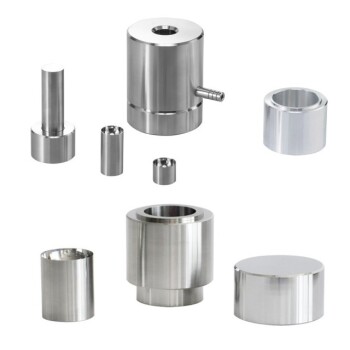
Molybdenum Disulfide (MoS2) functions primarily as a high-performance solid lubricant in the Equal Channel Angular Pressing (ECAP) process. Applied as a thin layer to the sample surface, it drastically reduces the coefficient of friction between the work material and the inner walls of the extrusion die.
Core Takeaway MoS2 is essential for maintaining the mechanical integrity of the ECAP process. By minimizing interfacial friction, it lowers the required hydraulic extrusion force, ensures uniform plastic deformation within the material, and protects the costly die infrastructure from premature wear and damage.
The Mechanics of Friction Reduction
Minimizing Interfacial Resistance
The fundamental role of MoS2 is to separate the sample from the die walls. In ECAP, a billet is forced through an angled channel, creating significant sliding resistance.
MoS2 lowers the contact pressure at this interface. This reduction is critical for allowing the material to slide through the channel angle without seizing.
Optimizing Force Transmission
Effective lubrication ensures that the force applied by the hydraulic punch is utilized efficiently.
By reducing drag at the walls, MoS2 ensures that the extrusion force is transmitted into the material to create shear deformation, rather than being wasted overcoming surface friction.
Reducing Punching Force Requirements
Because friction is minimized, the total load on the hydraulic equipment is reduced.
The supplementary data indicates that this lowers the "required punching force," allowing for the processing of harder materials or the use of lower-capacity presses.
Impact on Material Quality and Tool Life
Ensuring Uniform Deformation
For ECAP to be effective, strain must be introduced evenly throughout the billet.
MoS2 improves stress distribution across the contact surfaces. This results in a more uniform strain distribution, preventing localized variances in the material's grain structure.
Preventing Surface Damage
Direct contact between the billet and the die can result in surface tearing or defects.
The MoS2 layer acts as a protective shield. It prevents the sample surface from being damaged during the intense sliding action of the extrusion.
Mitigating Die Wear and Sticking
The die is a precision tool subjected to high stress. MoS2 prevents abrasive wear on the inner walls of the customized extrusion die.
Crucially, it prevents the billet from "sticking" or galling inside the die, which can cause catastrophic tool failure or necessitate an interruption in production.
Operational Conditions and Trade-offs
Performance Under Extreme Conditions
Standard lubricants often fail under the specific conditions of ECAP.
MoS2 is specifically utilized because it remains stable and effective under both high-temperature and high-pressure conditions. It maintains its lubricity where liquid oils might squeeze out or break down.
The Necessity of Correct Application
While MoS2 is highly effective, its performance relies on the integrity of the applied layer.
If the coating is uneven or too thin, the protective barrier breaks down. This leads to an immediate spike in friction, potentially resulting in stuck billets or inconsistent deformation across the sample length.
Making the Right Choice for Your Goal
When integrating MoS2 into your ECAP workflow, consider your primary objectives to optimize application methods:
- If your primary focus is Process Efficiency: Prioritize MoS2 to reduce the hydraulic load, allowing for faster processing speeds and reduced energy consumption by the press.
- If your primary focus is Material Homogeneity: Focus on the consistency of the MoS2 coating to ensure uniform stress distribution, which guarantees a consistent grain structure throughout the billet.
Effective use of MoS2 transforms ECAP from a high-risk mechanical struggle into a controlled, repeatable manufacturing process.
Summary Table:
| Function | Benefit to ECAP Process |
|---|---|
| Friction Reduction | Minimizes interfacial resistance between billet and die walls. |
| Force Optimization | Lowers the required hydraulic punching force for extrusion. |
| Tool Protection | Prevents abrasive wear, sticking, and galling of the precision die. |
| Deformation Control | Ensures uniform strain distribution for consistent grain refinement. |
| High Stability | Maintains performance under extreme high-pressure and high-temperature conditions. |
Optimize Your Research with KINTEK Pressing Solutions
Maximize the efficiency of your material deformation processes with KINTEK’s industry-leading technology. KINTEK specializes in comprehensive laboratory pressing solutions, offering manual, automatic, heated, multifunctional, and glovebox-compatible models, alongside advanced cold and warm isostatic presses.
Whether you are refining grain structures in battery research or conducting complex ECAP procedures, our high-precision equipment ensures the control and reliability your lab demands. Let our experts help you select the ideal press and consumables for your specific application.
Contact KINTEK Today for a Specialized Consultation
References
- Przemysław Snopiński, Ondřej Hilšer. Mechanism of Grain Refinement in 3D-Printed AlSi10Mg Alloy Subjected to Severe Plastic Deformation. DOI: 10.3390/ma17164098
This article is also based on technical information from Kintek Solution Knowledge Base .
Related Products
- Lab Anti-Cracking Press Mold
- Lab Ball Press Mold
- Lab Infrared Press Mold for Laboratory Applications
- Lab Round Bidirectional Press Mold
- Carbide Lab Press Mold for Laboratory Sample Preparation
People Also Ask
- What is the purpose of incorporating cartridge heaters into a lab press mold for MLCC block compression? Optimize Results
- What is the function of a pressing tool in thermoplastic panels? Master Precision Shaping & Fusion Bonding
- Why is precise cooling management of the lab press mold necessary? Protect Core Integrity in Thermoforming
- What are the requirements for pressing molds when using SSCG? Key Materials for Complex Single Crystal Production
- How do industrial-grade pressure molds affect zinc metal pouch cells? Maximize Energy Density & Performance