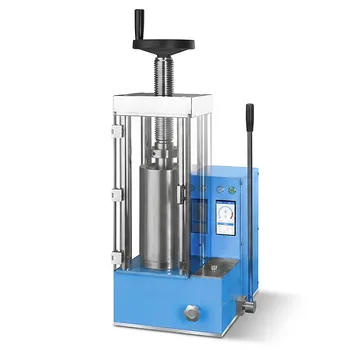
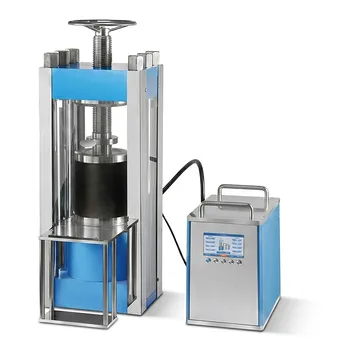
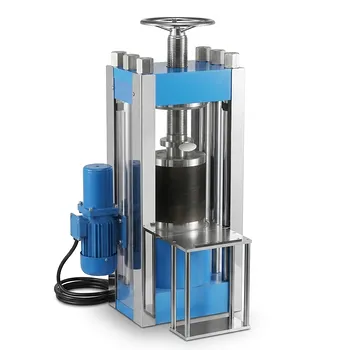
High-pressure cold isostatic pressing (CIP) is the definitive method for transforming loose Hydroxyapatite (HAP) and $Fe_3O_4$ powders into high-density "green bodies." By applying uniform, multidirectional pressure—often reaching 300 MPa—this process compresses the mixed powders into a highly compact state, achieving an initial density of 85-90% of the material's theoretical maximum. This extreme pre-densification is essential for minimizing internal voids and ensuring the structural integrity of the final bioceramic.
Core Takeaway: A cold isostatic press is utilized to eliminate internal density gradients and maximize initial packing density. This ensures uniform shrinkage during sintering, preventing the cracks and deformations that typically plague complex composite bioceramics.
Achieving Maximum Green Density
Reducing Inter-particle Voids
The primary function of the high-pressure environment is to force powder particles into the tightest possible arrangement. By applying pressures up to 300 MPa, the press physically overcomes the resistance between HAP and $Fe_3O_4$ particles, reducing the space between them to an absolute minimum.
Reaching Near-Theoretical Limits
This intense compaction allows the green body to reach 85-90% of its theoretical density before it ever enters a furnace. Starting with such a high initial density is a prerequisite for achieving a final sintered product with near-full density (99.5%+) and superior mechanical strength.
Eliminating Structural Weaknesses
Overcoming Mold Wall Friction
In traditional uniaxial (one-direction) pressing, friction between the powder and the mold walls creates uneven pressure distribution. Cold isostatic pressing uses a liquid medium to apply pressure from all directions simultaneously, effectively eliminating these density gradients.
Preventing Internal Stress Concentrations
By ensuring that every part of the HAP-$Fe_3O_4$ composite receives the same force, CIP prevents the formation of micro-pores and stress concentrations. This uniformity is critical for bioceramics, where even a tiny internal flaw can lead to catastrophic failure under physiological loads.
Optimizing the Sintering Process
Minimizing Sintering Shrinkage
Because the green body is already highly compact, there is significantly less volume change during the high-temperature sintering stage. This reduced shrinkage allows manufacturers to produce parts with much higher dimensional accuracy, meeting the strict tolerances required for medical implants.
Inhibiting Cracks and Deformation
Uniform green density leads to uniform shrinkage rates throughout the material. This prevents the warping, twisting, or cracking that occurs when different areas of a composite shrink at different speeds during the firing process.
Understanding the Trade-offs
Equipment Complexity and Cost
High-pressure CIP systems are significantly more expensive and complex than standard hydraulic presses. They require specialized pressure vessels, high-pressure pumps, and flexible elastomer molds to function correctly.
Production Speed and Geometric Limits
The process is generally slower than uniaxial pressing because it involves sealing parts in flexible bags and a "wet-bag" or "dry-bag" cycle. While it is excellent for uniform density, it may require post-process machining if the final part requires extremely intricate external features that flexible molds cannot perfectly capture.
How to Apply This to Your Project
Recommendations Based on Production Goals
- If your primary focus is maximum mechanical strength: Utilize pressures of at least 300 MPa to ensure a green density above 85%, which is the foundation for a high-strength, low-porosity finished ceramic.
- If your primary focus is dimensional precision: Prioritize CIP to minimize sintering shrinkage, as this reduces the risk of warping and allows for near-net-shape manufacturing.
- If your primary focus is composite uniformity: Use isostatic pressing specifically to prevent the $Fe_3O_4$ particles from segregating or forming clusters, which can happen under uneven uniaxial pressure.
By choosing cold isostatic pressing, you ensure that your HAP-$Fe_3O_4$ composite is built on a physically sound, high-density foundation that can withstand the rigors of both sintering and final application.
Summary Table:
| Feature | CIP Performance (HAP-Fe3O4) | Benefit to Final Bioceramic |
|---|---|---|
| Pressure Level | Up to 300 MPa | Achieves 85-90% theoretical green density |
| Pressure Direction | Multidirectional/Isostatic | Eliminates density gradients & mold wall friction |
| Internal Structure | Zero micro-pores/stress points | High mechanical strength & failure resistance |
| Sintering Impact | Minimized & uniform shrinkage | High dimensional accuracy & zero warping |
| Final Density | Near-theoretical limits (99.5%+) | Optimized structural integrity for implants |
Unlock Precision in Your Material Research with KINTEK
Achieving the perfect green body is critical for high-performance bioceramics and battery research. KINTEK specializes in comprehensive laboratory pressing solutions designed to meet the most demanding specifications. Whether you need high-pressure cold or warm isostatic presses (CIP/WIP) for uniform density, or versatile manual, automatic, heated, and glovebox-compatible models, we have the technology to elevate your results.
Don't let internal voids or sintering cracks compromise your innovation. Our equipment ensures your HAP-Fe3O4 composites and energy materials reach their maximum potential with expert-grade compaction.
Ready to optimize your pressing process? Contact our technical team today and find the perfect solution for your laboratory.
References
- E. Bayraktar. Design of Hydroxyapatite/Magnetite (HAP/Fe3O4) Based Composites Reinforced with ZnO and MgO for Biomedical Applications. DOI: 10.26717/bjstr.2019.21.003649
This article is also based on technical information from Kintek Solution Knowledge Base .
Related Products
- Electric Lab Cold Isostatic Press CIP Machine
- Automatic Lab Cold Isostatic Pressing CIP Machine
- Manual Cold Isostatic Pressing CIP Machine Pellet Press
- Electric Split Lab Cold Isostatic Pressing CIP Machine
- Lab Isostatic Pressing Molds for Isostatic Molding
People Also Ask
- What role do electric lab cold isostatic presses play in industrial contexts? Bridge R&D and Manufacturing with Precision
- What are the applications of electric lab cold isostatic presses in research settings? Advance Material R&D with High-Pressure CIPs
- How does electrical Cold Isostatic Pressing (CIP) contribute to cost savings? Unlock Efficiency and Reduce Expenses
- What are some research applications of electric lab CIPs? Unlock Uniform Powder Densification for Advanced Materials
- What are the characteristics of standard off-the-shelf electric lab CIP solutions? Achieve Immediate, Cost-Effective Processing