
Standard off-the-shelf electric lab solutions are characterized by their pre-engineered design, intended to deliver immediate functionality without the lead times or costs associated with custom equipment. These systems are built to handle a specific set of common manufacturing processes, such as consolidation and molding, right out of the box.
The primary value of an off-the-shelf solution lies in its balance of versatility and availability: it provides a cost-effective, immediate capability for standard processes like stamping and Resin Transfer Molding (RTM) without requiring extensive modifications.
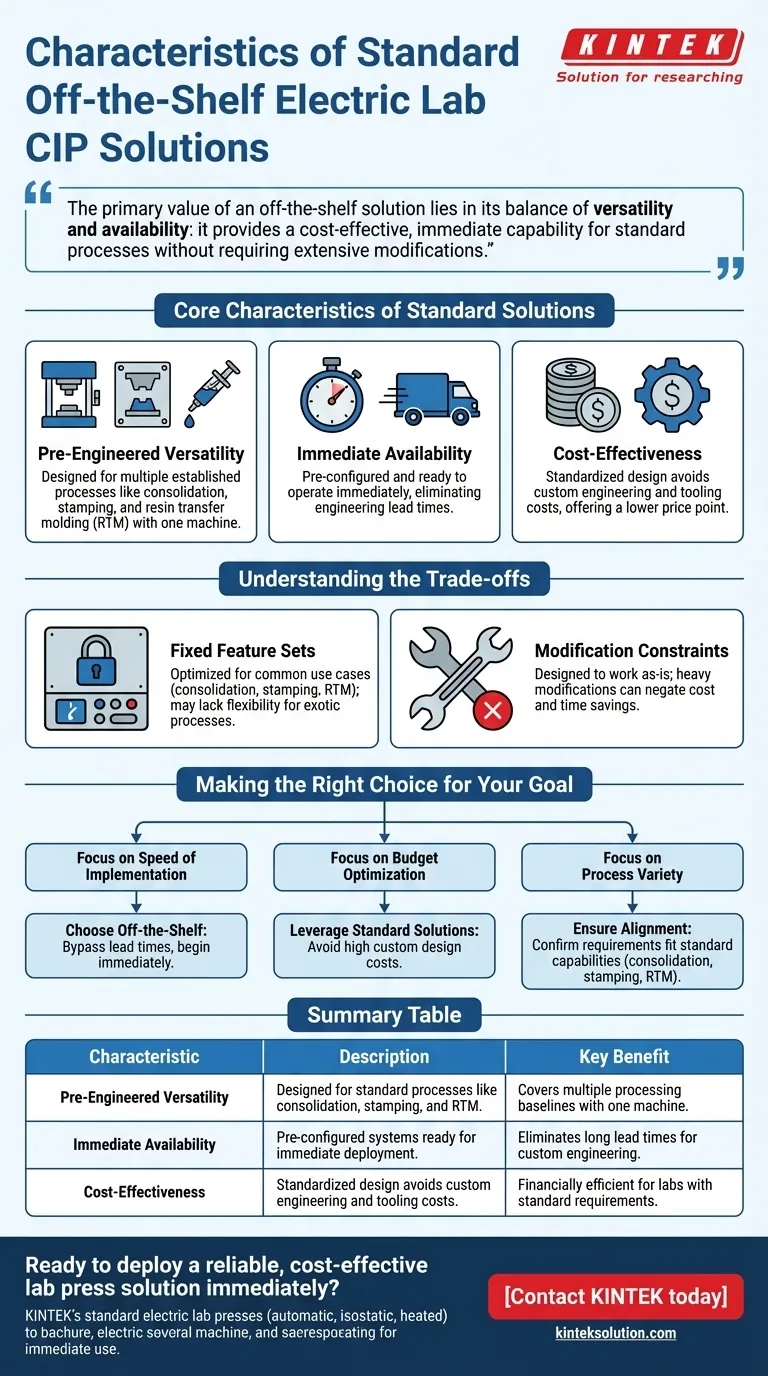
Core Characteristics of Standard Solutions
Pre-Engineered Versatility
The defining feature of these solutions is that they are not built for a single, unique experiment. Instead, they are pre-engineered to perform a range of established industrial processes.
According to standard specifications, these systems are capable of handling tasks such as consolidation, stamping, and resin transfer molding (RTM). This allows a laboratory to cover multiple processing baselines with a single piece of equipment.
Immediate Availability
Speed of deployment is a critical characteristic. Because these units are pre-configured, they are designed for users who require equipment immediately.
This eliminates the engineering and design phases typically required for bespoke machinery. The system arrives ready to operate, bypassing the long lead times associated with custom fabrication.
Cost-Effectiveness
By standardizing the design and removing the need for extensive modifications, manufacturers can offer these solutions at a lower price point.
Users avoid paying for non-recurring engineering costs (NRE) or specialized tooling design. This makes off-the-shelf options a financially efficient choice for labs with standard processing requirements.
Understanding the Trade-offs
Fixed Feature Sets
While cost-effective, these solutions are defined by their "standard" nature. They are optimized for the most common use cases—specifically consolidation, stamping, and RTM.
If your laboratory requires a highly exotic process or unique pressure/temperature profiles outside of these common standards, a pre-engineered solution may lack the necessary flexibility.
Modification Constraints
The advantage of "no extensive modifications" works both ways. These systems are designed to work as-is.
Attempting to heavily modify an off-the-shelf unit to perform a niche task can often negate the initial cost and time savings. They are best utilized when your process fits within the machine's existing capabilities.
Making the Right Choice for Your Goal
Before selecting a standard electric lab solution, evaluate your immediate processing needs against the machine's fixed capabilities.
- If your primary focus is Speed of Implementation: Choose an off-the-shelf solution to bypass engineering lead times and begin processing immediately.
- If your primary focus is Budget Optimization: Leverage standard solutions to avoid the high costs associated with custom design and extensive equipment modifications.
- If your primary focus is Process Variety: Ensure your requirements align with standard capabilities like consolidation, stamping, and RTM before purchasing.
Select the tool that fits your process, rather than altering your process to fit the tool.
Summary Table:
| Characteristic | Description | Key Benefit |
|---|---|---|
| Pre-Engineered Versatility | Designed for standard processes like consolidation, stamping, and RTM. | Covers multiple processing baselines with one machine. |
| Immediate Availability | Pre-configured systems ready for immediate deployment. | Eliminates long lead times for custom engineering. |
| Cost-Effectiveness | Standardized design avoids custom engineering and tooling costs. | Financially efficient for labs with standard requirements. |
Ready to deploy a reliable, cost-effective lab press solution immediately?
KINTEK's standard off-the-shelf electric lab presses (including automatic, isostatic, and heated models) are pre-engineered for immediate use in processes like consolidation, stamping, and RTM—allowing your laboratory to start processing faster and at a lower cost. Avoid custom engineering delays and expenses; get a solution that fits your standard needs right out of the box.
Contact KINTEK today to discuss your requirements and get your lab up and running quickly!
Visual Guide
Related Products
- Electric Lab Cold Isostatic Press CIP Machine
- Electric Split Lab Cold Isostatic Pressing CIP Machine
- Automatic Lab Cold Isostatic Pressing CIP Machine
- Manual Cold Isostatic Pressing CIP Machine Pellet Press
- Cylindrical Lab Electric Heating Press Mold for Laboratory Use
People Also Ask
- What role do electric lab cold isostatic presses play in industrial contexts? Bridge R&D and Manufacturing with Precision
- What are the applications of electric lab cold isostatic presses in research settings? Advance Material R&D with High-Pressure CIPs
- How does electrical Cold Isostatic Pressing (CIP) contribute to cost savings? Unlock Efficiency and Reduce Expenses
- What are some research applications of electric lab CIPs? Unlock Uniform Powder Densification for Advanced Materials
- What types of materials can be compacted using electric lab cold isostatic presses? Achieve Uniform Density for Metals, Ceramics & More














