
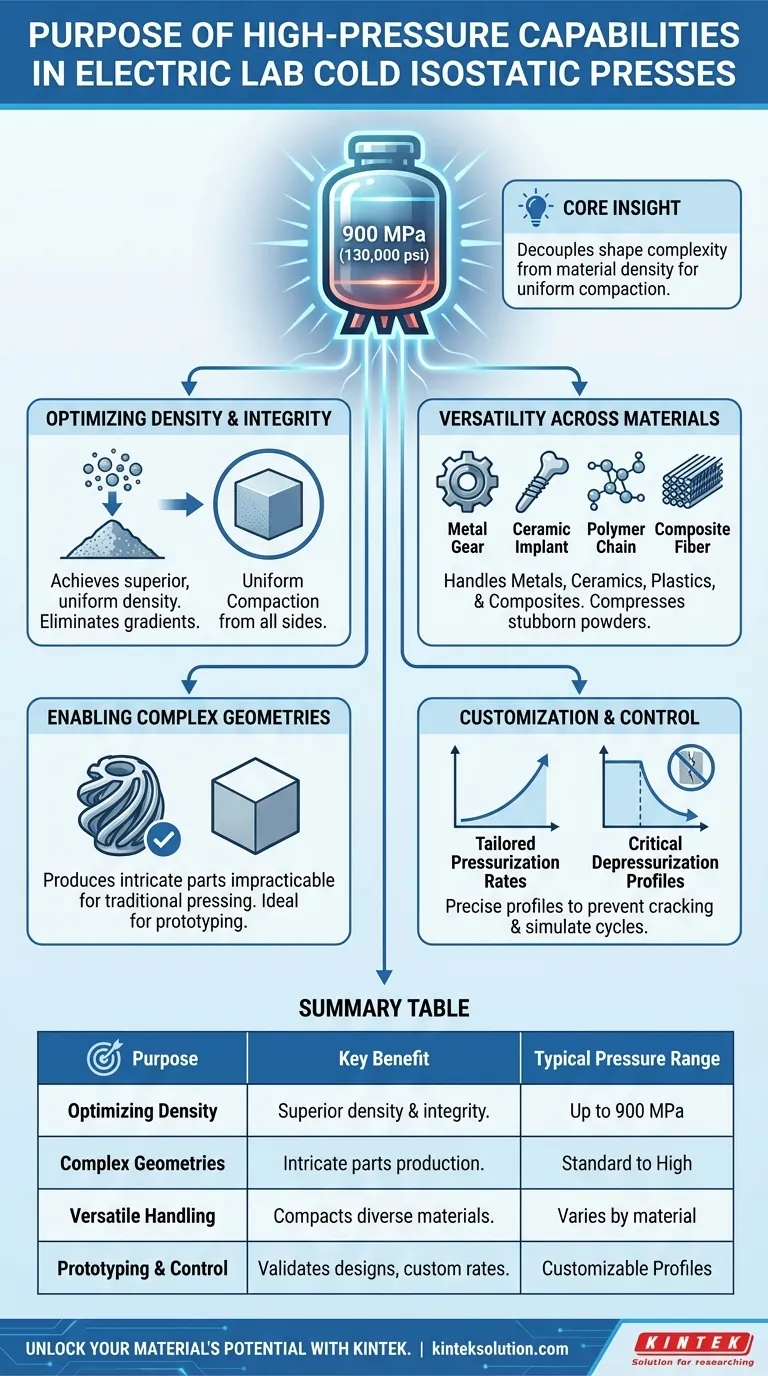
High-pressure capabilities in electric lab cold isostatic presses are primarily utilized to achieve superior density and specific physical properties in advanced materials that standard compaction methods cannot attain. By reaching pressures as high as 900 MPa (130,000 psi), these units allow researchers and engineers to consolidate complex parts made from metals, ceramics, and composites into uniform, high-integrity components. This capability is essential for applications where traditional pressing is either technically impractical or too expensive to be viable.
Core Insight: The value of these high-pressure systems lies in their ability to decouple shape complexity from material density. They provide the extreme force necessary to compact advanced materials uniformly, enabling the development of intricate components without the density gradients or defects common in conventional uniaxial pressing.
Optimizing Material Density and Integrity
Achieving Extreme Pressures
The defining feature of these presses is their ability to generate immense force, ranging from standard levels of 34.5 MPa up to a massive 900 MPa (130,000 psi).
This extreme pressure is not arbitrary; it is a critical requirement for specific industries where maximizing the density of a powder compact is directly linked to the final performance of the material.
Uniform Compaction
Unlike mechanical presses that exert force from one or two directions, isostatic presses apply pressure uniformly from all sides.
This ensures that the "desired material properties" mentioned in technical specifications—such as uniform density and lack of internal stress—are consistent throughout the entire volume of the part.
Versatility Across Material Types
Broad Material Compatibility
High-pressure capabilities enable these presses to handle a diverse spectrum of raw materials.
References confirm that these systems are effective for compacting metals, ceramics, plastics, and composites.
Handling Difficult Powders
Certain advanced ceramics and refractory metals have high yield strengths and resist compaction under standard loads.
The upper limit of 900 MPa ensures that even these stubborn materials can be compressed into viable "green" (unfired) parts ready for sintering.
Enabling Complex Geometries
Overcoming Traditional Limitations
In many industrial contexts, producing parts with complex shapes using traditional die pressing is restricted by friction and ejection issues.
Electric lab cold isostatic presses solve this by allowing for the production of complex parts where traditional methods are deemed impractical or too costly.
Prototyping for Industry
These lab-scale units often serve as the bridge to full-scale production.
They allow engineers to validate that a complex geometry can be successfully compacted at specific pressures before investing in massive industrial tooling.
Customization and Control
Tailored Pressurization Rates
High pressure alone is rarely enough; the rate at which pressure is applied matters.
These presses feature customizable high pressurization rates, allowing operators to simulate various production cycles or study how fast compaction affects the material structure.
Critical Depressurization Profiles
Releasing 130,000 psi of pressure incorrectly can cause a part to crack or delaminate due to trapped air expansion.
To prevent this, these units offer customized depressurization profiles, tailored to the unique requirements of specialized applications to ensure the part remains intact upon retrieval.
Understanding the Trade-offs
The Complexity of Optimization
While high pressure unlocks new possibilities, it introduces the need for precise process control.
Simply applying maximum pressure is not a guaranteed solution; the unit must be configured with the correct dimensions and product characteristics to optimize it for its intended use.
Customization Dependencies
Because these presses are highly customizable—including features like automated loading/unloading—they often require a tailored setup process.
Users must define their specific needs regarding dimensions and cycle automation to ensure the equipment is optimized for their specific workflow, rather than relying on a "one-size-fits-all" approach.
Making the Right Choice for Your Goal
The high-pressure capabilities of these presses are tools for precision, not just brute force. To utilize them effectively, align the machine's capabilities with your specific research or production targets.
- If your primary focus is Material Research: Prioritize units with the full 900 MPa range and customizable depressurization profiles to test the limits of new ceramic or composite formulas without damaging samples.
- If your primary focus is Component Prototyping: Focus on the system's ability to accommodate specific dimensions and complex shapes to validate designs that are impractical for traditional pressing.
Leveraging the correct pressure profile is the difference between a theoretical concept and a viable, high-performance product.
Summary Table:
| Purpose | Key Benefit | Typical Pressure Range |
|---|---|---|
| Optimizing Material Density | Achieves superior density and integrity in powder compacts. | Up to 900 MPa (130,000 psi) |
| Enabling Complex Geometries | Allows production of intricate parts impractical for traditional pressing. | Standard to High Pressures |
| Versatile Material Handling | Effectively compacts metals, ceramics, plastics, and composites. | Varies by material strength |
| Prototyping & Process Control | Validates designs and simulates production cycles with customizable pressurization rates. | Customizable Profiles |
Ready to unlock the potential of high-pressure compaction for your materials? KINTEK specializes in lab press machines, including automatic, isostatic, and heated lab presses designed to meet the demanding needs of laboratory research and prototyping. Our experts can help you select the ideal electric lab cold isostatic press to achieve superior density, handle complex geometries, and optimize your material development process. Contact us today to discuss your specific application and discover the KINTEK advantage!
Visual Guide
Related Products
- Electric Lab Cold Isostatic Press CIP Machine
- Electric Split Lab Cold Isostatic Pressing CIP Machine
- Automatic Lab Cold Isostatic Pressing CIP Machine
- Manual Cold Isostatic Pressing CIP Machine Pellet Press
- Lab Isostatic Pressing Molds for Isostatic Molding
People Also Ask
- What are the applications of electric lab cold isostatic presses in research settings? Advance Material R&D with High-Pressure CIPs
- What role do electric lab cold isostatic presses play in industrial contexts? Bridge R&D and Manufacturing with Precision
- How does electrical Cold Isostatic Pressing (CIP) contribute to cost savings? Unlock Efficiency and Reduce Expenses
- What are some research applications of electric lab CIPs? Unlock Uniform Powder Densification for Advanced Materials
- What are the characteristics of standard off-the-shelf electric lab CIP solutions? Achieve Immediate, Cost-Effective Processing



















