The High Cost of the Last Millimeter
In the world of material science, failure rarely happens in the middle of a process. It happens at the boundaries.
You spend hours calibrating a hydraulic press, perfecting the polymer blend, and precisely controlling the temperature. But as the platens open, the sample clings to the metal. A microscopic bond forms. A tear occurs.
In a single second, a day’s work is lost because of a failure at the interface.
This is why the PTFE (polytetrafluoroethylene) separator sheet is not just a consumable; it is a critical system component. It is the invisible shield that ensures the transition from molten state to solid specimen remains flawless.
The Thermodynamics of Non-Stick
Precision is a fragile thing. When polymers are subjected to heat and pressure, they seek to bond with their environment. PTFE prevents this through a unique combination of chemical indifference and thermal resilience.
Low Surface Energy: The Physics of "No"
PTFE has one of the lowest coefficients of friction known to man. At the molecular level, it simply refuses to interact with the molten matrix of the sample.
- Result: Effortless demolding.
- Impact: Zero surface tears and preserved structural integrity.
Thermal Stability Under Pressure
Most films fail when the thermometer crosses 150°C. They melt, they off-gas, or they become part of the sample. PTFE remains stable well beyond 180°C, providing a reliable barrier that protects the purity of the specimen from metal oxides or residues on the platens.
Beyond Demolding: The Geometry of Smoothness
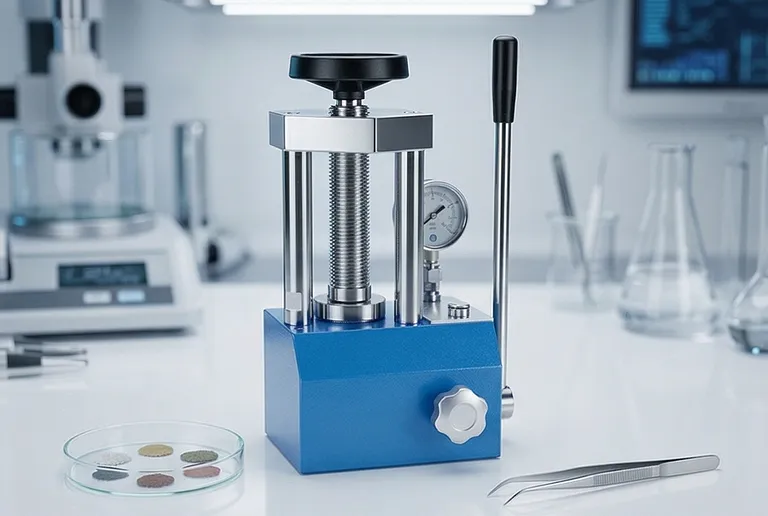
While its "non-stick" nature gets the headlines, the PTFE sheet performs a more subtle, secondary role: it is a surface-leveling engine.
Uniformity is Not Negotiable
In dielectric strength measurements or optical transmittance tests, surface roughness is the enemy. Even the slightest microscopic "peak" or "valley" on a sample can lead to data interference or premature electrical breakdown.
PTFE sheets act as a leveling layer, ensuring:
- Mirror-like Finishes: Reducing surface roughness for accurate analytical data.
- Pressure Distribution: Spreading the hydraulic force evenly across the sample to prevent localized stress concentrations.
- Dimensional Integrity: Maintaining the exact thickness required for rigorous mechanical testing.
The Engineer’s Trade-off
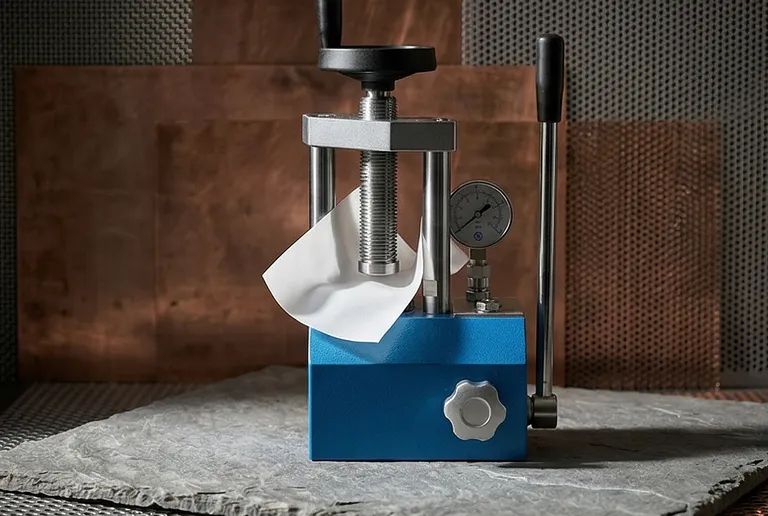
Every technical solution carries a cost. Using PTFE requires an understanding of its physical limits.
| Feature | Limitation | Engineering Adjustment |
|---|---|---|
| Thermal Insulation | Slower heat transfer from platens to sample. | Increase dwell time or slightly raise set temperature. |
| Texture Transfer | Creases in the sheet can imprint on the sample. | Use virgin PTFE and replace sheets frequently. |
| Temperature Ceiling | Softens and releases fumes above 260°C. | Strict monitoring of press thermal limits. |
Optimizing the System
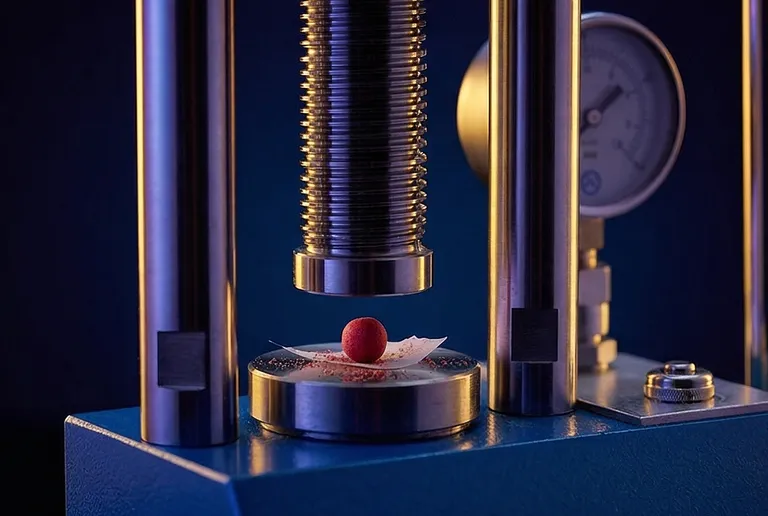
The goal of a lab is not just to "press" a sample; it is to create a repeatable, high-fidelity representation of a material's potential.
If you are working with nanocomposites, your priority is chemical purity—PTFE is your barrier. If you are conducting Repetitive Corrugation and Straightening (RCS), your priority is friction reduction—PTFE is your lubricant.
Success depends on a press that can handle the nuance of these materials. KINTEK provides the high-precision environment—manual, automatic, or isostatic—where these material interactions can be controlled with surgical accuracy.
The press provides the power; the PTFE provides the grace. Together, they define the quality of your results.
Related Products
- Warm Isostatic Press for Solid State Battery Research Warm Isostatic Press
- Lab Heat Press Special Mold
- Automatic High Temperature Heated Hydraulic Press Machine with Heated Plates for Lab
- XRF KBR Plastic Ring Lab Powder Pellet Pressing Mold for FTIR
- Heated Hydraulic Press Machine With Heated Plates For Vacuum Box Laboratory Hot Press
Related Articles
- How Warm Isostatic Pressing Transforms High-Performance Manufacturing
- How Warm Isostatic Pressing Optimizes Material Performance for Industrial Applications
- The Pressure to Be Perfect: How Hot Isostatic Pressing Achieves Absolute Material Integrity
- The Physics of Patience: Why Hot Isostatic Pressing Trades Speed for Certainty
- The Enemy Within: How Hot Isostatic Pressing Forges Perfect Material Integrity






