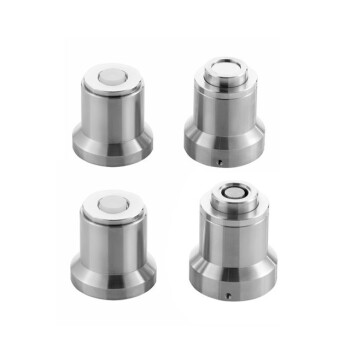
Gold capsules serve as the standard vessel for containing samples in experiments that simulate the conditions of shallow magma chambers. Their primary function is to physically contain the sample under high pressure and temperature without chemically contaminating it. Additionally, they act as a semi-permeable membrane that allows researchers to manipulate the internal chemistry of the melt from the outside.
Core Takeaway: The utility of gold capsules lies in their specific duality: they are chemically inert enough to prevent reaction with corrosive melts, yet permeable enough to hydrogen to allow for precise control of the sample's oxidation-reduction state via external buffers.
Preserving Chemical and Physical Integrity
Avoiding Sample Contamination
The most immediate challenge in simulating magma chambers is preventing the container from reacting with the sample.
Gold is prized for its exceptional chemical inertness. It does not react with silicate melts or corrosive halogen solutions, ensuring that the chemical composition of the experimental magma remains pure.
Withstanding Extreme Conditions
Simulating a magma chamber requires subjecting the sample to significant forces.
Gold possesses high ductility, allowing the capsule to compress and deform without rupturing. This ensures the capsule remains intact even when subjected to the high-temperature and high-pressure conditions characteristic of shallow crustal environments.
Controlling the Oxidation State
The Role of Hydrogen Diffusion
Beyond simple containment, gold plays an active role in experimental control.
The material allows for the free diffusion of hydrogen through the capsule walls. While the capsule is impermeable to the magma itself, hydrogen atoms can pass through the metal lattice.
Managing Redox Conditions
This permeability is essential for controlling the oxidation-reduction (redox) state of the experiment.
By using external buffers outside the capsule, researchers can dictate the hydrogen activity surrounding the capsule. Because hydrogen diffuses freely, the internal environment equilibrates with the external buffer, allowing precise manipulation of the magma's oxidation state.
Understanding the Trade-offs
Temperature Limits of Gold
The use of gold is specifically highlighted for shallow magma chamber conditions for a reason.
While excellent for crustal simulations, gold has a lower melting point compared to other noble metals like platinum. This restricts its use to lower-temperature experiments typical of shallower depths, as it would melt under the extreme temperatures required for deep mantle simulations.
The Double-Edged Sword of Permeability
The hydrogen permeability of gold is a tool, but it is also a constraint.
If an experiment requires a system that is completely closed to hydrogen, gold is not suitable. The very feature that allows for redox control makes it impossible to isolate the sample's hydrogen content from the external environment.
Making the Right Choice for Your Experiment
To determine if gold capsules are the correct apparatus for your simulation, consider your specific experimental variables:
- If your primary focus is preventing contamination: Gold is the superior choice for corrosive halogen solutions or silicate melts due to its high chemical inertness.
- If your primary focus is redox control: Gold is essential for experiments requiring equilibrium with external buffers, as it facilitates the necessary hydrogen diffusion.
Gold capsules provide the critical balance of isolation and permeability required to accurately model the chemistry of the upper crust.
Summary Table:
| Feature | Benefit for Magma Simulations | Why it Matters |
|---|---|---|
| Chemical Inertness | Prevents sample contamination | Ensures purity of silicate melts and halogens |
| High Ductility | Withstands high P/T conditions | Allows capsule to deform without rupturing |
| H₂ Permeability | Facilitates hydrogen diffusion | Enables precise control of oxidation-reduction (redox) states |
| Low Melting Point | Ideal for shallow crustal temps | Specifically optimized for shallow magma chamber modeling |
Elevate Your Geochemical Research with KINTEK
Precision is paramount when simulating the complex environments of the Earth's crust. KINTEK specializes in comprehensive laboratory pressing solutions and high-quality sample containment, offering a range of manual, automatic, heated, and multifunctional models designed to meet the rigorous demands of battery research and geological simulations. Whether you require standard Au capsules for shallow magma studies or advanced isostatic presses for high-pressure material synthesis, our expert team is here to provide the durability and accuracy your lab needs.
Ready to optimize your experimental setup? Contact KINTEK today to discover how our tailored laboratory solutions can enhance your research outcomes!
References
- Ryosuke Sakurai, Takayuki Nakatani. Vapor-phase crystallization from a hydrous silicate melt: an experimental simulation of diktytaxitic texture. DOI: 10.1007/s00410-024-02105-4
This article is also based on technical information from Kintek Solution Knowledge Base .
Related Products
- Lab Cylindrical Press Mold for Laboratory Use
- Lab Double Plate Heating Mold for Laboratory Use
- Lab Button Battery Disassembly and Sealing Mold
- Lab XRF Boric Acid Powder Pellet Pressing Mold for Laboratory Use
- Cylindrical Lab Electric Heating Press Mold for Laboratory Use
People Also Ask
- What is the purpose of incorporating cartridge heaters into a lab press mold for MLCC block compression? Optimize Results
- Why is precise cooling management of the lab press mold necessary? Protect Core Integrity in Thermoforming
- What is the function of a pressing tool in thermoplastic panels? Master Precision Shaping & Fusion Bonding
- Why is a high-performance laboratory molding press critical for in-situ electrolyte formation? Unlock Battery Success
- How does the geometry of laboratory molds influence mycelium-based composites? Optimize Density and Strength