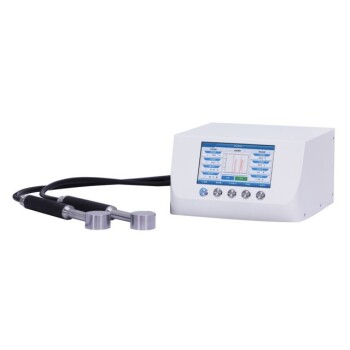
A constant temperature chamber functions as a critical isolation barrier against environmental thermal noise during battery cycle aging. Its primary role is to eliminate the interference caused by the thermal expansion and contraction of test materials, which occurs naturally due to ambient temperature fluctuations.
By strictly controlling the thermal environment, the chamber ensures that pressure readings reflect only the internal mechanical changes driven by electrochemical reactions, rather than external temperature noise. This isolation is essential for accurately mapping reversible pressure amplitude against modulus evolution.
The Challenge of Thermal Expansion Noise
Ambient Fluctuations and Material Response
Materials used in battery construction and testing fixtures naturally expand and contract when exposed to temperature changes.
Even minor fluctuations in the laboratory's ambient temperature can cause physical dimensional changes in the test setup.
The Impact on Pressure Sensors
Pressure sensors used in these tests are highly sensitive.
If the testing fixture or the battery cell expands due to a rise in room temperature, the sensor will register a pressure increase.
This creates "false" data, where environmental noise is indistinguishable from the battery's actual performance.
Isolating Mechanical State Changes
Stabilizing the Environment
The constant temperature chamber acts as a shield, maintaining a rigorous and steady thermal setpoint.
By locking the temperature, the chamber removes the variable of external thermal expansion from the equation entirely.
Focusing on Electrochemical Reactions
With thermal interference removed, the data collected becomes pure.
The chamber ensures that the data recorded by pressure sensors reflects mechanical state changes driven solely by internal electrochemical reactions.
This allows researchers to attribute pressure changes directly to the battery's chemistry, rather than the room's thermostat.
Enhancing Analytical Accuracy
Analyzing Reversible Pressure Amplitude
Battery cycling involves repetitive expansion and contraction, known as reversible pressure amplitude.
To measure this accurately, the baseline must be stable. The chamber prevents thermal drift from skewing these amplitude measurements.
Tracking Modulus Evolution
The primary reference highlights the importance of analyzing modulus evolution (changes in stiffness/structural integrity).
Accurately correlating pressure amplitude with modulus evolution is impossible if thermal noise is present.
The chamber ensures the relationship between these two factors can be analyzed without distortion.
Considerations for Testing Precision
Internal Heat Generation
While the chamber controls the external environment, it is important to note that the battery itself generates heat during cycling.
Ideally, the chamber should have sufficient air circulation to dissipate this self-generated heat to maintain the setpoint.
Sensor Stability
The chamber is only effective if its internal regulation is precise.
If the chamber's own temperature regulation oscillates significantly, it can introduce the very interference it is designed to prevent.
Ensuring Data Validity in Battery Research
To achieve high-fidelity results in battery aging tests, you must prioritize environmental control.
- If your primary focus is Material Characterization: Use the chamber to ensure that observed changes in stiffness (modulus) are chemical, not thermal.
- If your primary focus is Cycle Life Prediction: Rely on the chamber to provide a noise-free pressure baseline, allowing for the detection of subtle degradation trends.
By eliminating thermal variables, the constant temperature chamber transforms pressure data from a rough estimate into a precise metric of electrochemical health.
Summary Table:
| Interference Factor | Impact on Testing | Role of Constant Temp Chamber |
|---|---|---|
| Ambient Temperature | Causes fixture expansion/contraction | Maintains a locked thermal setpoint |
| Thermal Noise | Distorts pressure sensor readings | Acts as a shield to isolate mechanical data |
| Reversible Amplitude | Skews cycle-to-cycle data baseline | Ensures stable baseline for accurate mapping |
| Modulus Evolution | Masks changes in material stiffness | Enables pure correlation with electrochemical reactions |
Optimize Your Battery Research with KINTEK Precision Solutions
Don't let thermal noise compromise your data integrity. At KINTEK, we specialize in comprehensive laboratory pressing and testing solutions tailored for the most demanding battery research environments. Whether you are analyzing modulus evolution or conducting long-term cycle aging, our range of manual, automatic, heated, and multifunctional presses, alongside our advanced cold and warm isostatic presses, provide the stability and precision required for high-fidelity results.
Why choose KINTEK?
- Glovebox-Compatible Designs: Seamlessly integrate your testing setup into controlled environments.
- Isostatic Pressing Expertise: Achieve uniform density and pressure for superior material characterization.
- End-to-End Support: Our solutions are widely applied in cutting-edge battery research to ensure every PSI reflects true electrochemical performance.
Ready to eliminate experimental variables and elevate your lab's efficiency? Contact KINTEK today to find the perfect solution for your battery testing needs!
References
- Shuaibang Liu, Xiaoguang Yang. Expansion Pressure as a Probe for Mechanical Degradation in LiFePO4 Prismatic Batteries. DOI: 10.3390/batteries11110391
This article is also based on technical information from Kintek Solution Knowledge Base .
Related Products
- Lab Double Plate Heating Mold for Laboratory Use
- Infrared Heating Quantitative Flat Plate Mold for Precise Temperature Control
- Heated Hydraulic Press Machine with Heated Plates for Vacuum Box Laboratory Hot Press
- Manual Heated Hydraulic Lab Press with Integrated Hot Plates Hydraulic Press Machine
- Automatic High Temperature Heated Hydraulic Press Machine with Heated Plates for Lab
People Also Ask
- How does the geometry of laboratory molds influence mycelium-based composites? Optimize Density and Strength
- Why are precision laboratory molds essential for forming basalt-reinforced lightweight concrete specimens?
- Why are high-precision laboratory molds and specific compaction processes required? Ensure Data Integrity in Soil Research
- Why is low-temperature pre-drying on a laboratory hot plate necessary? Stabilize Silver Ink for Better Conductivity
- How is a laboratory hot plate utilized in Li-Si alloy electrode preparation? Achieve High-Activity Battery Materials