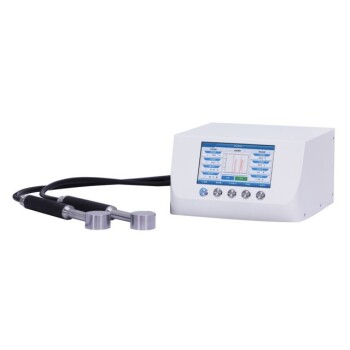
A high-stability hot plate is a critical requirement for the annealing of polymer thin films because it provides the precise thermal control necessary to drive chemical and physical stabilization. By maintaining a consistent temperature, it effectively removes residual solvent molecules and volatile impurities that would otherwise compromise the film's integrity. This process is essential for ensuring that subsequent experimental data, particularly regarding charge trap dynamics, reflects the intrinsic properties of the material rather than preparation artifacts.
Core Takeaway Reliable polymer research depends on eliminating variables introduced during film casting. A high-stability hot plate ensures the complete removal of solvents and the stabilization of microscopic morphology, providing a consistent baseline for studying complex phenomena like charge carrier behavior.
The Mechanics of Solvent Elimination
Driving Out Residual Molecules
Polymer films are frequently cast from liquid solutions, leaving solvent molecules trapped within the solidifying matrix. A high-stability heat source provides the sustained energy required to fully evaporate these residual molecules.
Eliminating Volatile Impurities
Beyond the primary solvent, films may contain other volatile impurities that degrade performance. Precise annealing ensures these contaminants are removed systematically without subjecting the polymer to thermal spikes that could cause degradation.
Stabilizing Microscopic Morphology
Promoting Chain Reorganization
Polymers require thermal energy to transition from a disordered state to a thermodynamically stable configuration. Stable annealing allows polymer chains to move and reorganize into a cohesive structure.
Locking in the Structure
Once the chains have reorganized, the film achieves a stabilized microscopic morphology. This structural uniformity is the foundation for consistent physical and electronic properties across the entire sample.
Ensuring Experimental Reliability
Reducing Data Interference
Residual solvents and unstable structures often act as defects within the film. These defects can obscure results and interfere heavily with the study of charge trap dynamics.
Guaranteeing Reproducibility
High-stability equipment minimizes thermal fluctuations that lead to inconsistent samples. By removing volatile impurities and stabilizing the structure, you ensure that your experimental data remains reliable and reproducible.
Risks of Inadequate Thermal Control
The Cost of Thermal Fluctuation
Using a standard hot plate with poor stability often leads to uneven heating or temperature drift. This can result in "skin effects" where the surface dries too quickly, trapping solvents deep inside the film.
Misinterpretation of Charge Dynamics
If the annealing temperature fluctuates, the polymer chains may not settle uniformly. This can create artificial charge traps, leading researchers to misinterpret these preparation defects as intrinsic material behaviors.
Achieving Precision in Your Process
To maximize the fidelity of your polymer thin films, align your heating strategy with your specific analytical goals:
- If your primary focus is structural integrity: Ensure your hot plate maintains uniform heat distribution to facilitate complete and even polymer chain reorganization.
- If your primary focus is electrical characterization: Prioritize precise temperature holding to guarantee the total removal of volatile impurities that distort charge trap dynamics.
Precision in thermal processing is the prerequisite for accuracy in experimental insight.
Summary Table:
| Factor | Impact of High-Stability Heating | Risk of Inadequate Control |
|---|---|---|
| Solvent Removal | Complete evaporation of residual molecules | Trapped solvents and "skin effects" |
| Morphology | Uniform chain reorganization & stabilization | Artificial charge traps & defects |
| Data Quality | High reproducibility of intrinsic properties | Misinterpretation due to prep artifacts |
| Impurity Control | Systematic removal of volatile contaminants | Thermal degradation from spikes |
Elevate Your Thin Film Research with KINTEK
Don't let preparation artifacts compromise your data. KINTEK specializes in comprehensive laboratory pressing and thermal solutions designed for high-precision battery research and material science. From heated presses to multifunctional models, our equipment provides the thermal stability required to eliminate charge trap interference and lock in microscopic morphology.
Ready to achieve superior film integrity? Contact us today to find the perfect thermal solution for your lab!
References
- Mohammad Sedghi, Roland Hany. Formation of electron traps in semiconducting polymers via a slow triple-encounter between trap precursor particles. DOI: 10.1080/14686996.2024.2312148
This article is also based on technical information from Kintek Solution Knowledge Base .
Related Products
- Automatic High Temperature Heated Hydraulic Press Machine with Heated Plates for Lab
- 24T 30T 60T Heated Hydraulic Lab Press Machine with Hot Plates for Laboratory
- Laboratory Manual Heated Hydraulic Press Machine with Hot Plates
- Automatic Heated Hydraulic Press Machine with Hot Plates for Laboratory
- Heated Hydraulic Press Machine With Heated Plates For Vacuum Box Laboratory Hot Press
People Also Ask
- Function of a Laboratory Hydraulic Press with Heated Platens in SSE? Enhance Battery Density & Conductivity
- What are the requirements for electrode pressing with high-viscosity ionic liquids like EMIM TFSI? Optimize Performance
- How does a laboratory heated hydraulic press facilitate PBN sample prep for WAXS? Achieve Precise X-Ray Scattering
- What are the industrial applications of heated hydraulic presses? Master Heat & Force for Precision Manufacturing
- Why is a laboratory hydraulic press with heating plates required for PLA/TEC films? Achieve Precise Sample Integrity