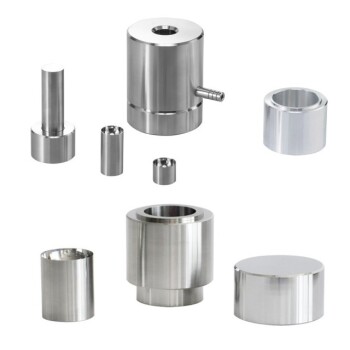
Preheating forming molds to approximately 200°C is a critical technical requirement in the thermoplastic processing of magnesium alloys because it directly manages the thermal interaction between the tooling and the workpiece. This specific temperature range is necessary to minimize the thermal gradient, preventing the alloy’s surface from cooling rapidly upon contact and ensuring the material remains pliable enough to shape without failure.
The central purpose of preheating is to prevent the mold from acting as a heat sink that creates a "chilled skin" on the alloy. By maintaining thermal equilibrium, you avoid a sharp spike in deformation resistance and prevent surface cracking, ensuring the final component has high structural integrity.
The Physics of Thermal Interaction
Reducing the Temperature Gradient
The fundamental technical challenge in processing magnesium alloys is the disparity between the high temperature of the specimen and the ambient temperature of the tooling.
Preheating the mold to 200°C acts as a thermal bridge. It significantly reduces the temperature gradient at the interface where the metal meets the mold, stabilizing the process environment.
Preventing Rapid Surface Cooling
If a hot magnesium specimen contacts a cold mold, heat transfer occurs instantly and aggressively.
This creates a quenching effect where the surface of the specimen cools much faster than its core. Preheating eliminates this rapid cooling, keeping the surface temperature of the alloy consistent with its internal temperature.
Impact on Material Mechanics
Mitigating Deformation Resistance
Magnesium alloys exhibit a direct correlation between temperature and malleability.
When the surface cools rapidly due to a cold mold, deformation resistance increases sharply. Preheating ensures the material offers consistent resistance, allowing the forming machinery to shape the part without requiring excessive force or causing tool deflection.
Eliminating Surface Defects
The most severe consequence of a high temperature gradient is the loss of surface integrity.
When the outer layer of the alloy cools and hardens while being stretched or compressed, it cannot deform at the same rate as the hotter core. This mismatch creates tensile stresses that lead to surface cracks and micro-fractures, rendering the part unusable.
Ensuring Uniform Metal Flow
High-quality thermoplastic processing requires the metal to move fluidly into every crevice of the die cavity.
A heated mold ensures that the viscosity and plasticity of the alloy remain uniform throughout the forming stroke. This promotes uniform metal flow, ensuring that corners are filled and complex geometries are achieved without flow lines or voids.
Common Pitfalls and Process Risks
The Consequence of "Cold Start" Forming
Attempting to process magnesium alloys without adequate mold preheating is a primary cause of process instability.
Even if the alloy itself is at the perfect temperature, a cold mold will induce immediate localized hardening. This often results in incomplete fills or parts that shatter under the forming pressure.
Thermal Consistency vs. Cycle Speed
While preheating is essential for quality, it introduces a variable in cycle time management.
Operators must ensure the mold returns to the target temperature between cycles if the part removal draws away significant heat. Failing to maintain the 200°C baseline between runs will lead to inconsistent batch quality.
Optimizing Process Parameters
To ensure consistent results in magnesium alloy forming, align your thermal strategy with your specific quality goals.
- If your primary focus is Surface Finish: Strictly maintain the mold temperature at 200°C to prevent the thermal shock that causes surface cracking and checking.
- If your primary focus is Geometric Precision: Ensure the mold is heated uniformly to guarantee even metal flow and prevent warping caused by variable deformation resistance.
Consistent thermal management of the mold is just as critical as the temperature of the alloy itself for achieving defect-free components.
Summary Table:
| Technical Factor | Effect of 200°C Preheating | Consequence of Cold Mold |
|---|---|---|
| Temperature Gradient | Minimized; acts as a thermal bridge | High; causes rapid quenching effect |
| Metal Flow | Uniform and fluid into complex dies | Inconsistent; leads to voids and lines |
| Surface Quality | Smooth; eliminates tensile stress | Cracking and micro-fractures |
| Deformation Resistance | Low and consistent | Sharp increase; requires excessive force |
| Structural Integrity | High; uniform cooling throughout core | Low; localized hardening and shattering |
Optimize Your Magnesium Research with KINTEK
Maximize the precision of your thermoplastic processing with KINTEK’s specialized laboratory pressing solutions. Whether you are working on advanced battery research or metallurgical testing, our comprehensive range of manual, automatic, heated, and multifunctional presses ensures perfect thermal management for every specimen.
From glovebox-compatible models to high-pressure cold and warm isostatic presses, KINTEK provides the tooling stability you need to eliminate surface defects and ensure uniform metal flow.
Ready to elevate your material performance? Contact KINTEK today to find the perfect press for your lab!
References
- Krzysztof Majerski, Piotr Surdacki. Investigations of the Effect of Heat Treatment and Plastic Deformation Parameters on the Formability and Microstructure of AZ91 Alloy Castings. DOI: 10.12913/22998624/174932
This article is also based on technical information from Kintek Solution Knowledge Base .
Related Products
- Lab Double Plate Heating Mold for Laboratory Use
- Lab Anti-Cracking Press Mold
- XRF KBR Steel Ring Lab Powder Pellet Pressing Mold for FTIR
- XRF KBR Plastic Ring Lab Powder Pellet Pressing Mold for FTIR
- Square Lab Press Mold for Laboratory Use
People Also Ask
- How does the geometry of laboratory molds influence mycelium-based composites? Optimize Density and Strength
- Why are precision laboratory molds essential for forming basalt-reinforced lightweight concrete specimens?
- Why are high-precision laboratory molds and specific compaction processes required? Ensure Data Integrity in Soil Research
- What is the purpose of using a laboratory hot plate and weight pressing? Mastering Cellulose Filament Bond Strength
- Why is low-temperature pre-drying on a laboratory hot plate necessary? Stabilize Silver Ink for Better Conductivity