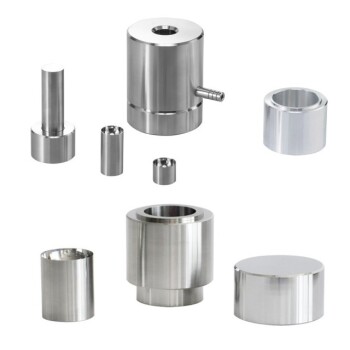
The cooling circulation system is a critical component in the compression molding of wood flour-PLA composites because it allows the material to solidify rapidly while remaining under high pressure. This process prevents thermal deformation caused by uneven shrinkage, stabilizes the internal microstructure of the composite, and directly regulates the crystallization behavior of the Polylactic Acid (PLA) matrix.
The primary role of a cooling circulation system is to transition the composite from a molten state to a dimensionally stable solid before the mold is opened. By controlling the rate of heat removal, the system ensures the final product meets specific physical and structural requirements while maximizing production efficiency.
Ensuring Structural Integrity and Dimensional Stability
Preventing Thermal Deformation and Warping
When the molding process is complete, the composite material is in a high-temperature, semi-fluid state. If the pressure is released before the material has cooled sufficiently—typically to below 60°C—the internal heat can cause the part to warp or deform as it meets the cooler ambient air. The cooling system ensures the material reaches a stable, solid state while still confined by the mold's dimensions.
Managing Internal Stress and Shrinkage
Wood flour-PLA composites are prone to uneven thermal shrinkage as they transition from hot to cold. A circulating water system provides a uniform reduction in temperature across the mold cavity, which minimizes the development of internal stresses. This uniformity is essential for ensuring that the final specimens or parts maintain their intended geometric precision.
Regulating Material Properties and Microstructure
Influencing PLA Crystallization Behavior
Polylactic Acid is a semi-crystalline polymer, meaning its mechanical properties are heavily dependent on how its molecules organize during cooling. The cooling circulation system allows technicians to control the cooling rate, which directly influences the degree of crystallinity in the PLA matrix. This control ensures the final composite achieves the specific stiffness and impact resistance required for its intended application.
Locking in the Composite Microstructure
During the hot-pressing stage, high pressure (often ranging from 20 to 200 tons) forces the wood flour and PLA into a dense, integrated microstructure. The cooling system "locks" this structure into place by rapidly lowering the temperature while the material is still under compression. This prevents the polymer chains from shifting or the wood fibers from relaxing, ensuring consistent quality throughout the batch.
Optimizing Production Efficiency
Shortening the Processing Cycle
Without an active cooling system, a mold would rely on passive air cooling, which is significantly slower and less predictable. By using circulating water, the time required to reach a safe demolding temperature is drastically reduced. This allows for faster turnover of the mold, increasing the number of parts that can be produced in a single shift.
Understanding the Trade-offs
The Risk of Rapid Thermal Shock
While rapid cooling is generally beneficial for efficiency, cooling the mold too quickly can sometimes lead to surface defects or brittle microstructures. If the exterior of the composite solidifies much faster than the core, it can create a "skin" effect that traps internal heat and stress. Balancing the flow rate of the cooling water is necessary to achieve speed without compromising the material's physical toughness.
How to Apply This to Your Process
Making the Right Choice for Your Goal
- If your primary focus is Dimensional Precision: Ensure the cooling system brings the mold temperature below 60°C before releasing the clamping pressure to prevent warping.
- If your primary focus is Mechanical Strength: Carefully calibrate the cooling rate to achieve the desired level of PLA crystallinity, as faster cooling typically results in lower crystallinity and higher ductility.
- If your primary focus is High-Volume Production: Maximize the flow rate of the circulation system to shorten the cooling phase, provided the material can withstand the rapid temperature drop without internal cracking.
By precisely managing the thermal transition of the composite, you ensure that the final product is not only produced efficiently but also possesses the exact physical characteristics required for its application.
Summary Table:
| Feature | Benefit for Wood Flour-PLA Composites |
|---|---|
| Rapid Cooling | Prevents thermal deformation and warping by solidifying under pressure. |
| Uniform Shrinkage | Minimizes internal stress for superior dimensional stability and precision. |
| Crystallization Control | Regulates PLA molecular organization to optimize mechanical properties. |
| Thermal Management | Shortens the processing cycle by cooling below 60°C for faster demolding. |
Elevate Your Material Research with KINTEK
Achieve uncompromising precision in your composite molding projects. KINTEK specializes in comprehensive laboratory pressing solutions tailored for advanced material science and battery research. Whether you need manual, automatic, heated, multifunctional, or glovebox-compatible models, or require high-performance cold and warm isostatic presses, our systems are designed to provide the exact thermal stability and pressure control your research demands.
Why choose KINTEK?
- Precision Cooling: Integrated systems to ensure structural integrity and prevent warping.
- Versatile Solutions: Equipment ranging from standard heated presses to specialized isostatic systems.
- Research Focused: Optimized for battery research and high-performance composite development.
Don't let thermal deformation compromise your results. Contact us today to find the perfect laboratory press for your application!
References
- Nasır Narlıoğlu. Comparison of mechanical properties of 3D-printed and compression-molded wood-polylactic acid (PLA) composites. DOI: 10.15376/biores.17.2.3291-3302
This article is also based on technical information from Kintek Solution Knowledge Base .
Related Products
- Lab Polygon Press Mold
- Lab Round Bidirectional Press Mold
- Lab XRF Boric Acid Powder Pellet Pressing Mold for Laboratory Use
- XRF KBR Plastic Ring Lab Powder Pellet Pressing Mold for FTIR
- Lab Ball Press Mold
People Also Ask
- What is the purpose of incorporating cartridge heaters into a lab press mold for MLCC block compression? Optimize Results
- How do the design and geometric precision of pressing molds and mandrels affect the quality of PTFE composite samples?
- What role do precision positioning and pressure molds play in single-lap joints? Ensure 100% Data Integrity
- What are the requirements for pressing molds when using SSCG? Key Materials for Complex Single Crystal Production
- How do industrial-grade pressure molds affect zinc metal pouch cells? Maximize Energy Density & Performance