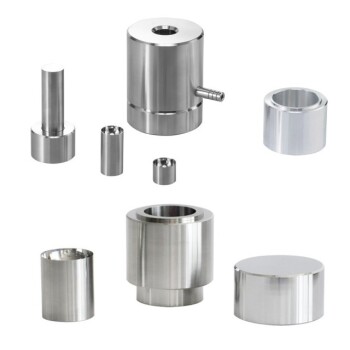
The primary purpose of incorporating cartridge heaters into a lab press mold is to enable precise temperature control, typically raising the environment to around 353K during compression. This thermal regulation is critical because the polymer binders within MLCC (Multi-Layer Ceramic Capacitor) green sheets are thermoplastic, meaning their physical hardness and flow characteristics change significantly when heated.
By introducing controlled heat, you transform a standard mechanical test into an accurate simulation of industrial reality. This ensures that the laboratory conditions mimic the rheology of the material as it behaves during actual manufacturing hot-pressing cycles.
The Physics of Binder Rheology
Understanding Thermoplastic Behavior
MLCC green sheets are not solid ceramics during the pressing phase; they are composites held together by polymer binders. These binders are thermoplastic, meaning they soften and become more malleable upon exposure to heat.
Altering Flow Properties
When cartridge heaters raise the mold temperature, the "rheological properties" of these sheets change. Essentially, the material transitions from a rigid solid to a flowable state. This change is necessary to understand how the material will move under pressure.
Bridging Lab Data and Industrial Reality
Replicating Hot-Pressing Conditions
Real-world manufacturing of MLCCs involves industrial hot-pressing. To generate data that is actionable and relevant to production, the lab press must replicate this thermal environment.
Accurate Deformation Simulation
Without heat, the ceramic block would deform differently than it does on the production line. The cartridge heaters ensure that the overall deformation behavior observed in the lab correlates with what happens in the factory.
Internal Electrode Gap Filling
One of the most critical aspects of MLCC compression is ensuring the ceramic material fills the voids between internal electrodes. The heat provided by the cartridge heaters softens the material enough to accurately simulate this gap-filling process.
Understanding the Trade-offs
Simulation Fidelity vs. Process Complexity
While incorporating heaters increases the complexity of the mold design, the trade-off is the validity of your data.
The Risk of Cold Pressing
If you omit the heaters and rely on "cold pressing," the polymer binder remains too stiff. This leads to inaccurate data regarding deformation and gap filling, rendering the simulation useless for predicting industrial outcomes.
Making the Right Choice for Your Goal
To determine if heated molds are necessary for your specific testing requirements, consider the following:
- If your primary focus is realistic process simulation: You must incorporate cartridge heaters to replicate the thermoplastic behavior and rheology of the binder system.
- If your primary focus is analyzing micro-structural integrity: Controlled heating is essential to accurately reproduce how the ceramic flows into and fills internal electrode gaps.
Ultimately, adding thermal control to your lab press is the only way to bridge the gap between theoretical testing and practical manufacturing success.
Summary Table:
| Feature | Purpose in MLCC Compression | Benefit to Lab Analysis |
|---|---|---|
| Thermal Regulation | Maintains ~353K environment | Mimics industrial hot-pressing cycles |
| Binder Softening | Transitions polymers to flowable state | Accurate simulation of material rheology |
| Deformation Control | Replicates factory-level material flow | Correlates lab data with production reality |
| Electrode Gap Filling | Softens ceramic sheets for movement | Analyzes micro-structural integrity accurately |
Elevate Your MLCC Research with KINTEK Precision
Bridge the gap between laboratory testing and industrial manufacturing with KINTEK’s advanced laboratory pressing solutions. Whether you require manual, automatic, heated, or multifunctional models, our equipment is engineered to handle the complex thermoplastic requirements of battery research and ceramic components.
Why choose KINTEK?
- Precision Heating: Integrated cartridge systems for accurate rheology simulation.
- Versatile Solutions: Comprehensive range including cold and warm isostatic presses.
- Targeted Expertise: Specialized tools designed for the specific needs of MLCC and battery material researchers.
Don't settle for inaccurate cold-pressing data. Contact KINTEK today to find the perfect heated press solution for your laboratory!
References
- Fumio NARUSE, Naoya TADA. OS18F003 Deformation Behavior of Multilayered Ceramic Sheets with Printed Electrodes under Compression. DOI: 10.1299/jsmeatem.2011.10._os18f003-
This article is also based on technical information from Kintek Solution Knowledge Base .
Related Products
- Lab Round Bidirectional Press Mold
- Carbide Lab Press Mold for Laboratory Sample Preparation
- Lab Infrared Press Mold for Laboratory Applications
- Square Lab Press Mold for Laboratory Use
- Lab Cylindrical Press Mold for Laboratory Use
People Also Ask
- Why is precise cooling management of the lab press mold necessary? Protect Core Integrity in Thermoforming
- What is the function of a pressing tool in thermoplastic panels? Master Precision Shaping & Fusion Bonding
- Why is a high-performance laboratory molding press critical for in-situ electrolyte formation? Unlock Battery Success
- How do the design and geometric precision of pressing molds and mandrels affect the quality of PTFE composite samples?
- What challenges are associated with recycling textiles, and how do laboratory presses help? Overcome Recycling Hurdles with Precision Tools