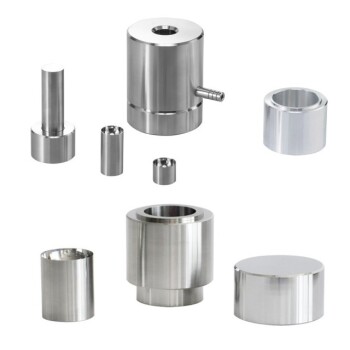
Precision stainless steel molds serve as the critical interface between your equipment and your material, acting as the defining physical boundary during the hot-pressing of composite laminates. They ensure strict dimensional accuracy while facilitating the rapid, uniform transfer of heat and pressure—often up to 20 MPa—from the laboratory press to the composite layers. By maintaining rigidity under these extreme conditions, these molds prevent deformation and guarantee the orderly arrangement of internal reinforcements, such as glass fiber layers.
Core Takeaway: The mold is not merely a container; it is an active component in the thermodynamic process. Its ability to provide a rigid geometric constraint while conducting heat uniformly is the determining factor in achieving a dense, structurally sound laminate with accurate mechanical properties.
Thermal Management and Process Control
Facilitating Rapid Heat Transfer
In hot-pressing, the mold acts as a thermal conduit. High thermal conductivity is essential to transfer heat from the press platens to the core of the composite material efficiently.
Precision stainless steel ensures this transfer is both rapid and uniform. This uniformity eliminates "cold spots" that could lead to uneven curing or internal stresses within the laminate.
Controlling the Cooling Phase
The role of the mold extends beyond heating; it is equally vital during the cooling cycle.
As referenced in testing protocols, the high thermal conductivity of the mold ensures the material cools down at a uniform rate. This prevents warping and ensures the internal structure solidifies consistently throughout the geometric volume.
Structural Integrity and Pressure Containment
Withstanding High Pressure
Hot-pressing composite laminates often requires significant force to consolidate layers and eliminate voids.
Molds must withstand pressures as high as 20 MPa without yielding. The rigidity of precision stainless steel prevents the mold walls from bowing or deforming, which would otherwise result in a laminate with uneven thickness or distorted geometry.
Preserving Fiber Alignment
For composites utilizing reinforcements like glass fiber, the internal architecture is paramount.
The mold’s rigidity ensures that the pressure is applied vertically and evenly, preventing the lateral shifting of materials. This guarantees the orderly arrangement of fiber layers, which is critical for the final mechanical strength of the part.
Ensuring Uniform Internal Structure
When using composite powders or creating disc-shaped green bodies, the mold provides a fixed geometric constraint.
This constraint ensures that the pressing force is transmitted uniformly throughout the powder bed. The result is a component with a uniform internal structure, free of density gradients that could cause failure under load.
Standardization and Dimensional Precision
Meeting ASTM Standards
For research and quality assurance, the physical dimensions of the sample dictate the validity of the data.
Precision molds define the final shape—such as 120 mm x 100 mm x 3.2 mm—to exact tolerances. This accuracy ensures that specimens prepared for tensile, flexural, and impact testing strictly comply with ASTM standards, making the resulting mechanical data scientifically comparable.
Facilitating Layered Architectures
In advanced applications, such as alternating metal and ceramic layers, precision molds allow for exact volume control.
The high-precision nature of these molds supports a layer-by-layer filling process. This allows you to strictly control the thickness and chemical composition of each stratum, establishing the ideal architecture for high-quality interfacial bonding.
Understanding the Trade-offs
Surface Finish Implications
The internal surface quality of the mold directly dictates the surface finish of your laminate.
While stainless steel is durable, any imperfections or roughness in the mold surface will be transferred to the composite. To produce "green bodies" with smooth surfaces, the mold itself must be maintained to a mirror-like finish, which requires careful handling and maintenance.
Thermal Expansion Mismatch
While stainless steel is excellent for conductivity, it is a metal, not a composite.
You must account for the coefficient of thermal expansion (CTE) of the steel versus your composite material. During the cooling phase, if the mold contracts significantly faster or slower than the laminate, it can induce residual stresses or make part ejection difficult.
Making the Right Choice for Your Goal
To maximize the effectiveness of your hot-pressing process, align your mold selection with your specific objective:
- If your primary focus is Scientific Data Validity: Prioritize molds with verified dimensional tolerances to ensure your tensile and flexural specimens meet ASTM standards for comparable results.
- If your primary focus is Complex Material Architecture: Focus on high-precision molds that allow for controlled, layer-by-layer filling to maintain strict thickness and composition uniformity across different strata.
- If your primary focus is Structural Integrity: Ensure the mold wall thickness and steel grade are rated for pressures exceeding 20 MPa to prevent deformation and guarantee orderly fiber alignment.
The precision of your mold is the upper limit of the quality of your laminate.
Summary Table:
| Feature | Function in Hot-Pressing | Impact on Final Laminate |
|---|---|---|
| Thermal Conductivity | Rapid & uniform heat transfer | Eliminates cold spots and prevents warping |
| Structural Rigidity | Withstands pressures up to 20 MPa | Prevents deformation and maintains fiber alignment |
| Geometric Precision | Defines strict physical boundaries | Ensures compliance with ASTM standards for testing |
| Surface Quality | Acts as material interface | Determines surface finish and ease of ejection |
| Thermal Expansion | Managed cooling phase | Prevents internal stresses and density gradients |
Elevate Your Material Research with KINTEK
Precision in your equipment determines the quality of your results. KINTEK specializes in comprehensive laboratory pressing solutions, offering a versatile range of manual, automatic, heated, multifunctional, and glovebox-compatible models, alongside advanced cold and warm isostatic presses.
Whether you are conducting cutting-edge battery research or developing high-performance composites, our precision-engineered solutions provide the thermal management and structural containment necessary for scientific data validity.
Ready to optimize your hot-pressing workflow? Contact our experts today to discover how KINTEK can enhance your laboratory’s efficiency and precision.
References
- Mingzhen Xu, Bo Li. Study on the Curing Behaviors of Benzoxazine Nitrile-Based Resin Featuring Fluorene Structures and the Excellent Properties of Their Glass Fiber-Reinforced Laminates. DOI: 10.3390/ma17246167
This article is also based on technical information from Kintek Solution Knowledge Base .
Related Products
- Lab Heat Press Special Mold
- Lab Polygon Press Mold
- Lab Round Bidirectional Press Mold
- Special Shape Lab Press Mold for Laboratory Applications
- Lab Anti-Cracking Press Mold
People Also Ask
- How is a laboratory heat press used to evaluate bio-based aliphatic polyesters? Prepare Reliable Samples for Analysis
- How is a laboratory heat press utilized in MEA preparation? Achieve High-Efficiency Iron-Chromium Redox Flow Batteries
- Why is a laboratory heat press necessary for biodegradable films? Unlock Precision Bonding and Barrier Performance
- What is the purpose of incorporating cartridge heaters into a lab press mold for MLCC block compression? Optimize Results
- How does the Born stability criterion inform LLZO heated press processes? Mastering Cubic Phase Ceramic Stability