
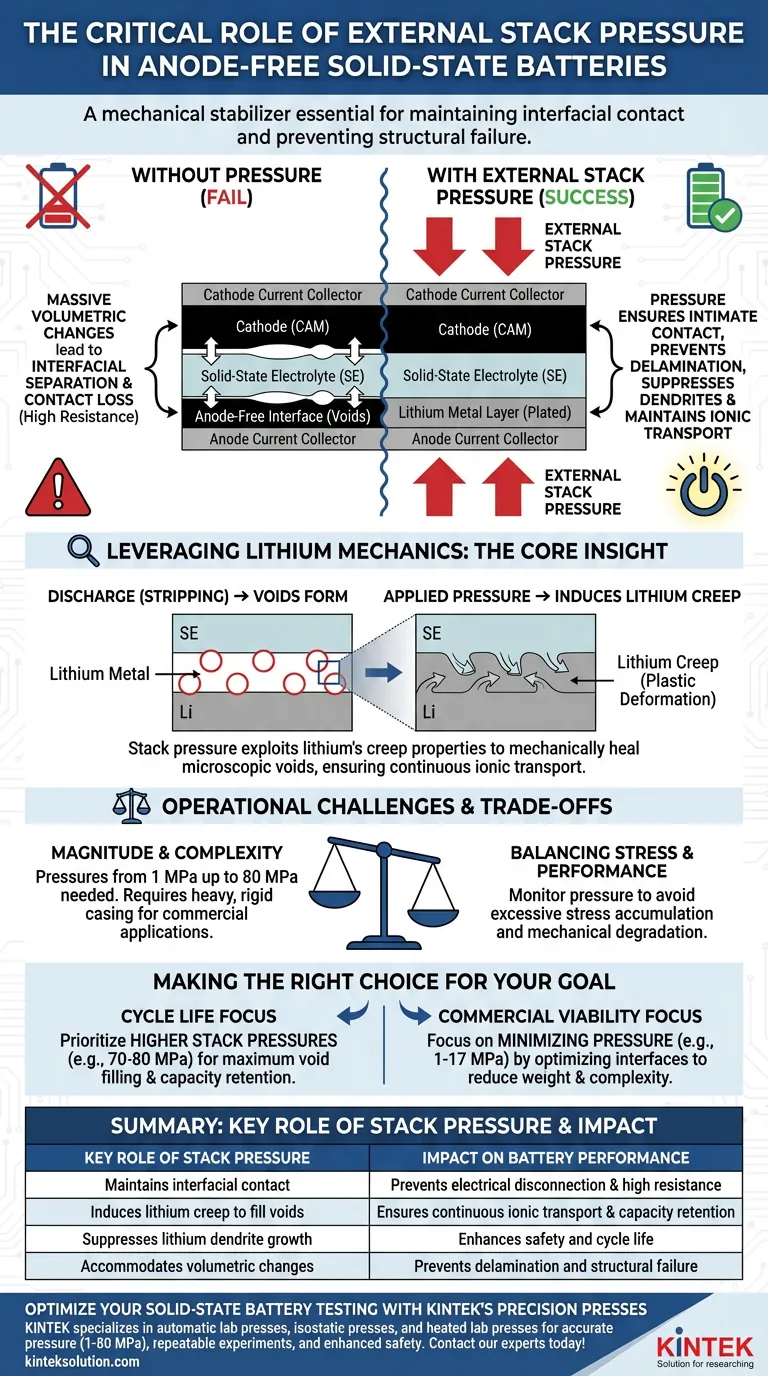
External stack pressure acts as a critical mechanical stabilizer in anode-free solid-state batteries. Because these batteries rely on the repeated plating and stripping of lithium metal, they undergo massive volumetric changes that inevitably lead to physical separation at the material interfaces. Applying pressure ensures the electrode layers remain in intimate contact, preventing the battery from electrically disconnecting or short-circuiting.
The Core Insight: The fundamental purpose of stack pressure is to exploit the creep properties of lithium metal. By applying constant force, the soft lithium is mechanically pushed to fill microscopic voids created during discharge, ensuring continuous ionic transport and preventing structural failure.

The Physics of Interface Stability
Counteracting Massive Volume Fluctuations
In an anode-free design, the anode is formed in-situ during charging. This results in significant volumetric expansion and contraction as lithium acts as the active material.
Without external constraint, this expansion pushes the cell components apart. External stack pressure accommodates these changes, acting as a buffer that holds the cell architecture together despite the internal physical shifting.
Preventing Delamination and Contact Loss
The most immediate risk during operation is the separation of the cathode active material (CAM) from the solid-state electrolyte (SE).
When lithium is stripped (discharged), it leaves behind gaps. Stack pressure forces the layers together, preventing interfacial separation and ensuring that the internal resistance of the battery does not spike due to contact loss.
Leveraging Lithium Mechanics
Inducing Lithium Creep to Fill Voids
A unique requirement of these batteries is the need to actively manage "void formation." As lithium is consumed, empty spaces form at the interface.
External pressure utilizes the natural creep behavior (plastic deformation) of lithium metal. The pressure forces the soft metal to flow into and fill these interfacial voids, maintaining a pristine contact area essential for long-term cycling.
Suppressing Dendrite Penetration
Uniform pressure plays a vital role in safety and longevity. It helps create a dense, uniform lithium layer rather than a porous or uneven one.
By maintaining tight physical contact, pressure effectively suppresses the growth of lithium dendrites (needle-like structures). This prevents them from penetrating the electrolyte and causing short circuits.
Operational Trade-offs and Engineering Challenges
The Magnitude of Required Pressure
While pressure is necessary, the magnitude required can be an engineering hurdle. Research indicates that pressures ranging from 1 MPa up to 80 MPa may be needed depending on the setup.
Complexity in Real-World Integration
In a laboratory, this is achieved with hydraulic presses or specialized testing fixtures. However, translating this to commercial applications requires heavy, rigid casing to maintain such high pressures.
Balancing Stress and Performance
Monitoring this pressure is critical. Too little pressure leads to voids and high resistance; however, researchers must also evaluate stress accumulation using in-situ monitoring to prevent mechanical degradation of the separator or active materials.
Making the Right Choice for Your Goal
Understanding the role of pressure allows you to optimize your testing protocols or battery design strategies.
- If your primary focus is Cycle Life: Prioritize higher stack pressures (referencing ranges like 70-80 MPa) to maximize void filling via lithium creep and ensure the highest possible capacity retention.
- If your primary focus is Commercial Viability: Focus on minimizing the required pressure (aiming closer to the 1-17 MPa range) by optimizing interfacial materials, as lower pressures reduce the weight and complexity of the final battery pack.
Ultimately, stack pressure is not just a variable; it is an active component of the battery system that mechanically heals the interface during every cycle.
Summary Table:
| Key Role of Stack Pressure | Impact on Battery Performance |
|---|---|
| Maintains interfacial contact | Prevents electrical disconnection & high resistance |
| Induces lithium creep to fill voids | Ensures continuous ionic transport & capacity retention |
| Suppresses lithium dendrite growth | Enhances safety and cycle life |
| Accommodates volumetric changes | Prevents delamination and structural failure |
Optimize Your Solid-State Battery Testing with KINTEK's Precision Presses
Designing or testing anode-free solid-state batteries? Applying the correct stack pressure is non-negotiable for reliable results. KINTEK specializes in automatic lab presses, isostatic presses, and heated lab presses that deliver precise, uniform pressure control—exactly what you need to simulate real-world battery conditions, study lithium creep behavior, and prevent interfacial failure.
Let us help you achieve:
- Accurate pressure application (from 1 MPa to 80 MPa) for void-free cycling
- Repeatable experiments with consistent mechanical stability
- Enhanced safety by suppressing dendrite formation
Don’t let pressure variability compromise your research. Contact our experts today to find the ideal lab press for your solid-state battery development!
Visual Guide
Related Products
- Laboratory Hydraulic Pellet Press for XRF KBR FTIR Lab Press
- Heated Hydraulic Press Machine with Heated Plates for Vacuum Box Laboratory Hot Press
- Automatic High Temperature Heated Hydraulic Press Machine with Heated Plates for Lab
- Automatic Laboratory Hydraulic Press for XRF and KBR Pellet Pressing
- Automatic Heated Hydraulic Press Machine with Heated Plates for Laboratory
People Also Ask
- Laboratory Pellet Press for Solar PV Recycling: Ensuring High-Precision Material Analysis and Purity
- Why is a professional laboratory pellet press required for XRF of silica sand? Achieve +/- 0.10% Precision
- Why is high consistency in holding pressure from a laboratory pellet press required when preparing multi-component alloy specimens?
- Why Use a Laboratory Pellet Press for PXRD Anode Material Prep? Standardize Samples for Precise Analysis
- What are the different types of pellet-making tools available for labs? Choose the Right Press for Your Sample



















