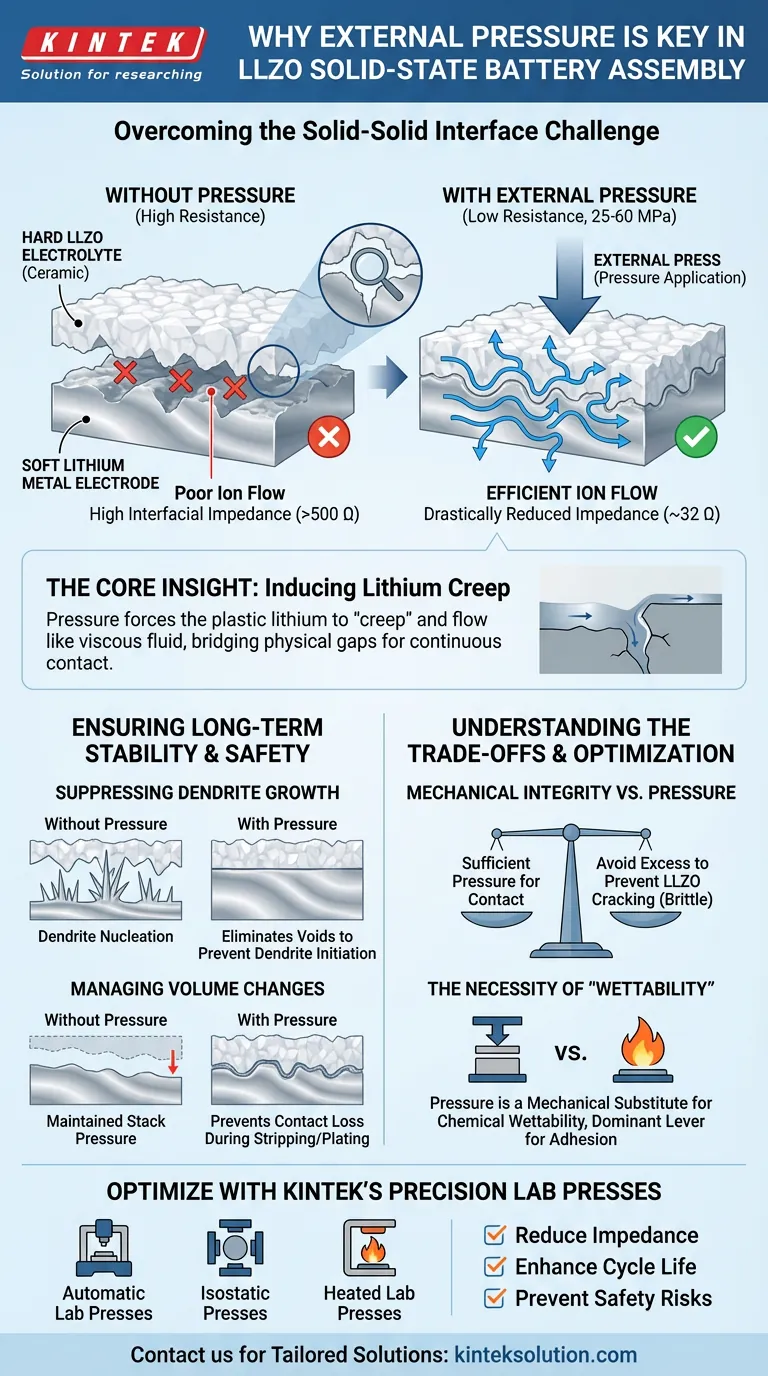
External pressure is applied to mechanically force the soft lithium metal to deform and flow into the microscopic surface irregularities of the hard LLZO ceramic. This process bridges the physical gaps between the two solid materials, ensuring the continuous contact necessary for ions to move efficiently between the electrode and the electrolyte.
The Core Insight Placing two solids together naturally creates microscopic voids that block ion flow, resulting in high resistance. Pressure leverages the plasticity of lithium to eliminate these voids, lowering interfacial impedance and preventing the dangerous growth of lithium dendrites.
Overcoming the Solid-Solid Interface Challenge
The Physical Mismatch
Unlike liquid electrolytes that naturally wet a surface, solid electrolytes like LLZO have rigid, rough surfaces on a microscopic level.
When you simply place a lithium electrode against LLZO, they only touch at the highest peaks of the ceramic's surface. This leaves significant gaps, or voids, between the materials where ions cannot travel.
Inducing Lithium Creep
Lithium metal is relatively soft and possesses plastic properties.
By applying precise pressure (often around 25 to 60 MPa during assembly), you force the lithium to "creep." This means the metal physically flows like a very viscous fluid, filling the pores and valleys of the LLZO surface to create a void-free interface.
Drastically Reducing Resistance
The primary metric for success here is interfacial impedance.
Without pressure, the resistance to ion flow is extremely high due to poor contact area. References indicate that applying pressure can reduce this impedance significantly—for example, dropping it from over 500 Ω down to approximately 32 Ω. This reduction is a prerequisite for a functioning, high-performance battery.
Ensuring Long-Term Stability and Safety
Suppressing Dendrite Growth
Lithium dendrites are needle-like structures that grow through the electrolyte and cause short circuits.
Dendrites tend to nucleate in voids or areas of poor contact where current density is uneven. By eliminating voids and ensuring intimate contact through controlled pressure, you remove the physical conditions that favor dendrite initiation.
Managing Volume Changes
During battery operation, specifically stripping and plating, the volume of the lithium layer changes.
In anode-free or lithium-metal configurations, removing lithium (stripping) can leave behind vacancies. Continuous external stack pressure ensures the interface collapses strictly to fill these gaps, preventing contact loss and maintaining stability over long cycling periods.
Understanding the Trade-offs
Mechanical Integrity vs. Pressure
While high pressure is beneficial for contact, it must be carefully controlled.
References note that extremely high pressures (up to 375 MPa) are used for cold-pressing pellets to densify them, but assembly pressures are generally lower. The pressure must be sufficient to deform the lithium but not so excessive that it cracks the brittle LLZO ceramic electrolyte.
The Necessity of "Wettability"
Pressure is a mechanical substitute for chemical wettability.
While heating can help "wet" the interface by softening materials, pressure is the dominant mechanical lever used to ensure the lithium adheres to the ceramic. Relying solely on contact without sufficient pressure results in a "loose" structure with poor ionic conduction pathways.
Making the Right Choice for Your Goal
To optimize your solid-state assembly process, consider your primary objective:
- If your primary focus is lowering initial resistance: Apply pressure (e.g., 25 MPa) specifically to induce plastic deformation in the lithium, aiming for a measurable drop in impedance (target <50 Ω).
- If your primary focus is maximizing cycle life: Ensure the pressure is maintained as stack pressure during operation to accommodate volume changes and prevent void formation during stripping.
- If your primary focus is electrolyte densification: Utilize high-pressure cold pressing (up to 375 MPa) or hot pressing on the electrolyte membrane before assembly to minimize internal porosity.
The successful assembly of an LLZO-based battery relies not just on the materials used, but on the mechanical engineering used to fuse them into a single, cohesive unit.
Summary Table:
| Key Aspect | Purpose of Pressure | Typical Pressure Range |
|---|---|---|
| Initial Contact | Deform lithium to fill LLZO surface gaps | 25–60 MPa |
| Resistance Reduction | Lower interfacial impedance (e.g., from 500 Ω to 32 Ω) | 25–60 MPa |
| Dendrite Suppression | Eliminate voids where dendrites nucleate | Maintained stack pressure |
| Cycle Stability | Accommodate volume changes during stripping/plating | Operational stack pressure |
| Electrolyte Densification | Minimize internal porosity in LLZO pellets | Up to 375 MPa (pre-assembly) |
Optimize Your Solid-State Battery Assembly with KINTEK's Precision Lab Presses
Struggling with high interfacial resistance or dendrite growth in your LLZO-based batteries? The right pressure application is critical. KINTEK specializes in automatic lab presses, isostatic presses, and heated lab presses designed to deliver the precise, controlled pressure (25–375 MPa) needed for:
- Reducing impedance by ensuring intimate lithium-LLZO contact.
- Enhancing cycle life with stable stack pressure management.
- Preventing safety risks by suppressing dendrite formation.
Our lab presses are trusted by researchers and manufacturers to overcome solid-solid interface challenges. Contact us today to discuss how we can tailor a solution for your laboratory needs!
Visual Guide
Related Products
- Warm Isostatic Press for Solid State Battery Research Warm Isostatic Press
- Lab Button Battery Tablet Press Sealing Mold
- Laboratory Hydraulic Press Lab Pellet Press Button Battery Press
- Button Battery Sealing Press Machine for Lab
- Lab Infrared Press Mold for Laboratory Applications
People Also Ask
- Why must composite cathodes be sealed in vacuum lamination bags for WIP? Ensure Battery Stability and Density
- What is the function of elastic molds in warm isostatic pressing? Achieve Uniform Density in Composite Particles
- How do sacrificial volume materials (SVM) maintain microchannels in isostatic pressing? Ensure Structural Integrity
- What is the function of hydraulic pressure in warm isostatic pressing? Achieve Uniform Material Density
- What is the significance of temperature control in Warm Isostatic Pressing? Unlock Uniform Densification and Process Stability